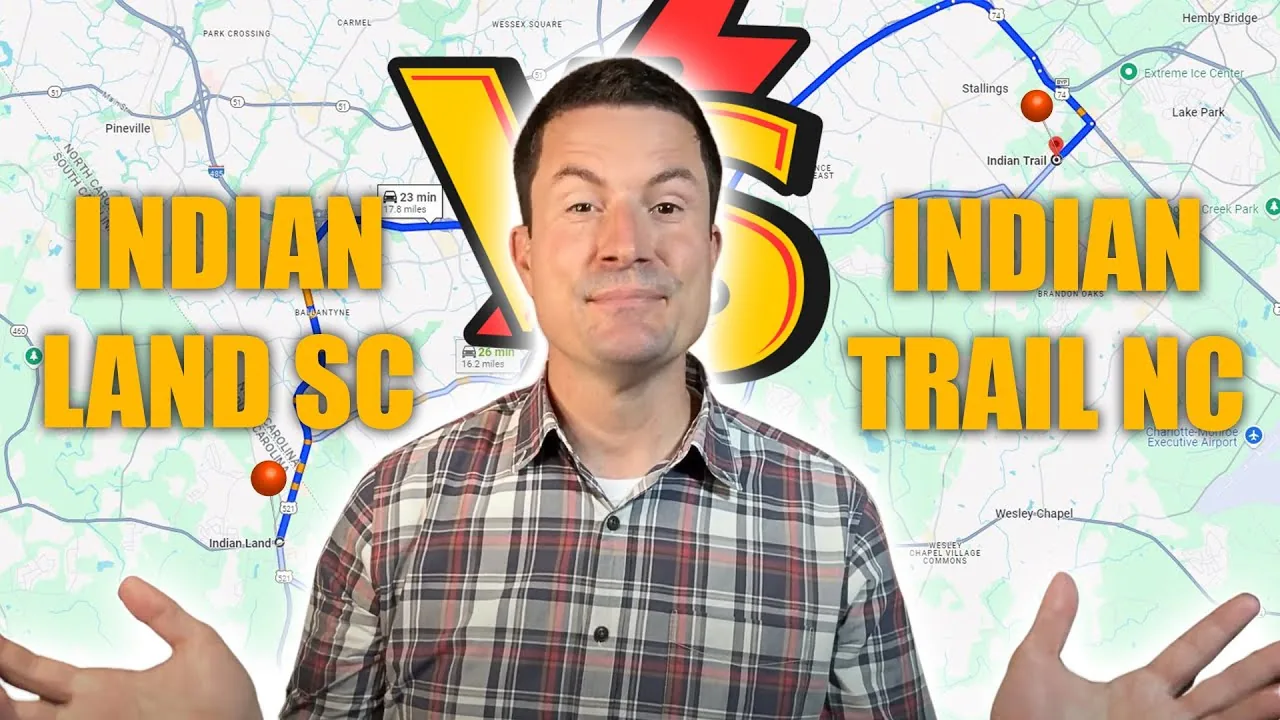
Indian Trail is in Union County, North Carolina. Indian Land is in Lancaster County, South Carolina. They are about 20 miles apart and the difference between them is not lifestyle, it is a set of five mechanical systems that change the moment you cross: how your house is assessed, how your income is taxed, how your retirement money is treated, how your cars are registered and taxed, and which school district you belong to. This page walks each one with the 2026 numbers and where they come from.
Quick answer
North Carolina taxes your home on 100 percent of its appraised value. South Carolina taxes your primary home on 4 percent of its value and removes most school operating tax, but taxes everything else at 6 percent. On a $500,000 owner-occupied house the two land closer together than most people expect. The bigger differences are retirement income, vehicles and schools.
- Property tax on a $500,000 owner-occupied home: about $3,021 in Indian Trail, about $3,620 in Indian Land before credits
- 2026 income tax: North Carolina is a flat 3.99 percent; South Carolina is 1.99 percent under $30,000 and 5.21 percent minus $966 above it
- Two different school systems: Union County Public Schools in North Carolina, Lancaster County School District in South Carolina
| Distance apart | About 20 miles |
|---|---|
| Tax on a $500,000 owner-occupied home | About $3,021 in Indian Trail, about $3,620 in Indian Land |
| Property tax rate | Indian Trail 60.42 cents per $100; Indian Land 181.0 mills on a legal residence |
| 2026 state income tax | NC flat 3.99 percent; SC 1.99 percent under $30,000, 5.21 percent minus $966 above |
| Vehicle cost of the move | $250 infrastructure maintenance fee per vehicle registered in South Carolina |
| School systems | Union County Public Schools NC, Lancaster County School District SC |
How does property tax differ in Indian Trail vs Indian Land?
In North Carolina you are taxed on the full appraised value. Indian Trail’s fiscal year 2025 to 2026 rate is the Union County rate of 43.42 cents plus the town’s 17 cents, for 60.42 cents per $100 (North Carolina Department of Revenue, pulled September 6, 2026). A $500,000 home is about $3,021 a year.
In South Carolina you are taxed on a fraction of value. A home you claim as your legal residence is assessed at 4 percent of fair market value; everything else is assessed at 6 percent (South Carolina Code Section 12-43-220). Lancaster County’s total 2026 millage is 344.2, and the state legal residence exemption removes 163.2 mills of school operating tax from an owner-occupied home, leaving 181.0 mills (Lancaster County Auditor, 2026 Millage Rates, revised August 6, 2026, pulled September 6, 2026). That same $500,000 home is about $3,620 before the local option sales tax credit.
So on a primary residence, North Carolina is the cheaper of these two specific places right now. What South Carolina does is treat a primary residence enormously better than any other property. The identical $500,000 house, not claimed as your legal residence, is assessed at 6 percent on the full 344.2 mills, which is roughly $10,326. Nothing in North Carolina’s system produces a spread like that.
Income tax, and why the headline rates mislead
North Carolina’s individual income tax rate for tax year 2026 is a flat 3.99 percent (North Carolina Department of Revenue, pulled September 6, 2026). South Carolina’s for 2026 is 1.99 percent on income under $30,000 and 5.21 percent minus $966 on income of $30,000 and above (South Carolina Department of Revenue, pulled September 6, 2026).
Do not stop there. The two states do not apply their rates to the same number, because each defines taxable income its own way with its own deductions. A rate comparison alone will point you the wrong direction more often than not. If income tax is a real factor in your decision, have someone run both returns on your actual numbers before you pick a side of the line.
How is retirement income taxed in Indian Land vs Indian Trail?
South Carolina taxpayers 65 and older may deduct up to $10,000 of retirement income a year, compared with $3,000 for those under 65, and residents 65 and up may deduct up to $15,000 of income of any kind, reduced by whatever retirement deduction they already claimed, so the pair together caps at $15,000 (South Carolina Department of Revenue, pulled September 6, 2026).
The property tax relief programs also work differently. South Carolina’s homestead exemption removes the first $50,000 of fair market value for owners who are 65, totally disabled or legally blind and have been South Carolina residents for a full year, with no income test (South Carolina Code Section 12-37-250). North Carolina’s elderly or disabled exclusion removes the greater of $25,000 or 50 percent of appraised value for owners who are 65 or totally and permanently disabled, but it is income tested, and the income ceiling is set each year by the Department of Revenue (North Carolina General Statute 105-277.1). Half the value off a $500,000 house is a bigger number than $50,000, but only if you qualify on income.
Your cars cross the line too
Both states bill an annual property tax on vehicles, which surprises people arriving from states that do not. North Carolina collects it through the Division of Motor Vehicles alongside registration, and North Carolina charges a highway use tax instead of sales tax when a title transfers (North Carolina Division of Motor Vehicles, pulled September 6, 2026). South Carolina counties place cars, trucks, campers, motorcycles, boats and aircraft on the personal property tax roll, and Lancaster County’s auditor does that work locally (Lancaster County Auditor, pulled September 6, 2026).
The move itself carries a one time cost on the South Carolina side. Since July 1, 2017, anyone moving to South Carolina with a vehicle, trailer or similar item that has to be registered there owes a $250 infrastructure maintenance fee per item, on top of title, registration and property taxes (South Carolina Department of Motor Vehicles). On a purchase rather than a move, that fee is 5 percent of the price capped at $500. Two cars and a camper is $750 you did not budget for.
Which school district serves Indian Trail and Indian Land?
Indian Trail addresses are served by Union County Public Schools, which organizes attendance into high school clusters. Indian Trail Elementary and Shiloh Valley sit in the Sun Valley cluster; Hemby Bridge, Poplin, Sardis and Stallings sit in the Porter Ridge cluster; and several elementary schools across the county are listed as split feeders, meaning they send students to more than one middle and high school (Union County Public Schools attendance and boundary maps, pulled September 6, 2026).
Indian Land addresses are served by Lancaster County School District, a South Carolina district with its own calendar, its own graduation requirements, its own state report card and its own boundaries. The two systems are not comparable line for line, and neither one will tell you about the other. Confirm any specific address with the district that actually serves it, and get all three levels in writing before you write an offer. Assignments as described here were checked in September 2026.
The state line, item by item
| Item | Indian Trail, Union County NC | Indian Land, Lancaster County SC |
|---|---|---|
| Local government | Incorporated town, town tax of 17 cents per $100 | Unincorporated, no town, no town tax |
| Property tax basis | 100 percent of appraised value | 4 percent of value for your legal residence, 6 percent otherwise |
| 2025 to 2026 or 2026 rate | 60.42 cents per $100 combined | 181.0 mills on a legal residence, 344.2 mills otherwise |
| Tax on a $500,000 owner-occupied home | about $3,021 | about $3,620 before the sales tax credit |
| Same home not your legal residence | about $3,021, same treatment | about $10,326 |
| 2026 state income tax | flat 3.99 percent | 1.99 percent under $30,000; 5.21 percent minus $966 above |
| Retirement income deduction | no general state deduction of this kind | up to $10,000 at 65 and up, $3,000 under 65, coordinated with a $15,000 age 65 deduction |
| Senior property tax relief | greater of $25,000 or 50 percent of value, age 65 or disabled, income tested | first $50,000 of value, age 65 or disabled or blind, one year residency, no income test |
| Vehicles | annual vehicle property tax through NCDMV; highway use tax on title transfer | annual vehicle property tax on the county roll; $250 infrastructure maintenance fee per vehicle when you move in |
| School system | Union County Public Schools | Lancaster County School District |
Sources: North Carolina Department of Revenue 2025 to 2026 County and Municipal Tax Rates; Lancaster County Auditor 2026 Millage Rates, revised August 6, 2026; Lancaster County Assessor; South Carolina Code Sections 12-43-220 and 12-37-250; North Carolina General Statute 105-277.1; South Carolina Department of Revenue; North Carolina Department of Revenue; South Carolina Department of Motor Vehicles; Union County Public Schools attendance and boundary maps. All pulled September 6, 2026. Figures exclude fire district charges and the Lancaster local option sales tax credit. These are illustrations, not tax advice.
The tradeoff, stated plainly
If you are still working, still earning a normal salary, and buying a primary residence, the state line does less for you than the marketing suggests. Indian Trail’s property tax bill on a $500,000 house is lower than Indian Land’s, and North Carolina’s flat 3.99 percent is competitive. What you get in Indian Land is newer housing, no town tax and a county that is building fast.
If you are retiring, the line matters a great deal, and it tilts toward South Carolina: the retirement income deductions, the $50,000 homestead exemption with no income test at 65, and the 4 percent treatment of a primary residence add up over a long retirement. The cost is that everything hinges on genuinely moving your residency, filing two separate county applications, and eating a one time vehicle fee to get there.
On this site, see Indian Trail and Indian Land.
Frequently asked questions
Is property tax lower in Indian Land SC than Indian Trail NC?
Not on a primary residence at that price point. A $500,000 owner-occupied home works out to about $3,021 a year in Indian Trail at the fiscal year 2025 to 2026 combined rate of 60.42 cents per $100, and about $3,620 in unincorporated Lancaster County at 181.0 mills on a 4 percent assessment, before the local option sales tax credit. Both figures checked September 6, 2026.
Which state taxes income less, North Carolina or South Carolina?
For 2026, North Carolina is a flat 3.99 percent and South Carolina is 1.99 percent under $30,000 and 5.21 percent minus $966 above that, per each state’s Department of Revenue, checked September 6, 2026. The states define taxable income differently, so the rates are not applied to the same number. Run both returns on your actual figures rather than comparing rates.
Does it cost anything to register my car in South Carolina?
Yes. Since July 1, 2017, someone moving to South Carolina with a vehicle that must be registered there owes a $250 infrastructure maintenance fee per item, in addition to title and registration fees and property taxes, per the South Carolina Department of Motor Vehicles, checked September 6, 2026. Both states also bill an annual property tax on vehicles.
Which senior property tax break is better?
It depends on your income and your home’s value. South Carolina exempts the first $50,000 of fair market value at 65 with a one year residency requirement and no income test. North Carolina excludes the greater of $25,000 or 50 percent of appraised value at 65, but only if your income falls under a ceiling the Department of Revenue sets annually. Sources: SC Code 12-37-250 and NC General Statute 105-277.1, checked September 6, 2026.
Do children from Indian Land go to Union County schools?
No. Indian Land is in South Carolina and is served by Lancaster County School District. Union County Public Schools serves Indian Trail and the rest of Union County, North Carolina, and has no role across the state line. Confirm any specific address with the district that serves it before making an offer. Checked September 2026.
Updated September 2026. Tax rates from the North Carolina Department of Revenue and the South Carolina Department of Revenue; millage from the Lancaster County Auditor 2026 Millage Rates sheet revised August 6, 2026; assessment ratios and exemptions from South Carolina Code Sections 12-43-220 and 12-37-250 and North Carolina General Statute 105-277.1; vehicle fees from the South Carolina Department of Motor Vehicles and the North Carolina Division of Motor Vehicles; school clusters from Union County Public Schools attendance and boundary maps. All pulled September 6, 2026. Commute times, home prices and insurance costs were not verified for this update and are deliberately left out. The video above predates these figures.