If you’re weighing Matthews against Waxhaw, or Ballantyne against Fort Mill, there’s a good chance someone has already told you the tax difference between them comes down to the property tax rate. That’s the number most people check, and it’s a real one. What almost nobody mentions is the second gap that opened on July 1, 2026, when the sales tax in Mecklenburg County went from 7.25% to 8.25% under an important notice the North Carolina Department of Revenue issued on March 2, 2026. At 8.25%, Mecklenburg now carries the highest sales tax rate of any of North Carolina’s 100 counties.
That matters to you because the county line running through South Charlotte is short. Matthews, Mint Hill, Pineville and Ballantyne sit in Mecklenburg. Waxhaw, Weddington, Marvin, Indian Trail and Monroe sit in Union. Below I will walk you through what the new rate is, what it doesn’t apply to, what the gap is worth on either side of that line, how the three Mecklenburg towns in this area actually voted on it, and what the law says the money can be spent on.
13 min read | By Steve Jarrell | Living in South Charlotte | Updated September 19, 2026
Free · 26-Page Insider Guide
Weighing NC against SC before you buy?
Towns compared, NC vs SC taxes and schools side by side, and the 5 mistakes out-of-state buyers make.
What This Story Covers
- The short answer on the Mecklenburg County sales tax
- What changed on July 1, 2026
- Is 8.25% the highest sales tax in North Carolina?
- What the county line is worth on a shopping trip
- The purchases the increase doesn’t touch
- How did South Charlotte vote on it?
- Where the money goes, and what the law caps
The short answer on the Mecklenburg County sales tax
The Mecklenburg County sales tax is 8.25% as of July 1, 2026, up a full percentage point from 7.25%. It’s the highest county rate in North Carolina and the only one above 7.5%. The extra penny funds roads and public transportation under a state law passed in 2025, and it doesn’t apply to groceries, manufactured homes or modular homes. Union County, a few miles east, stayed at 6.75%.
The Short Answer
Mecklenburg County now charges 8.25% sales tax, the highest rate of any county in North Carolina. Union County next door charges 6.75%. If you’re choosing between a Mecklenburg address and a Union County one, that gap is a live cost, and it’s separate from the property tax difference.
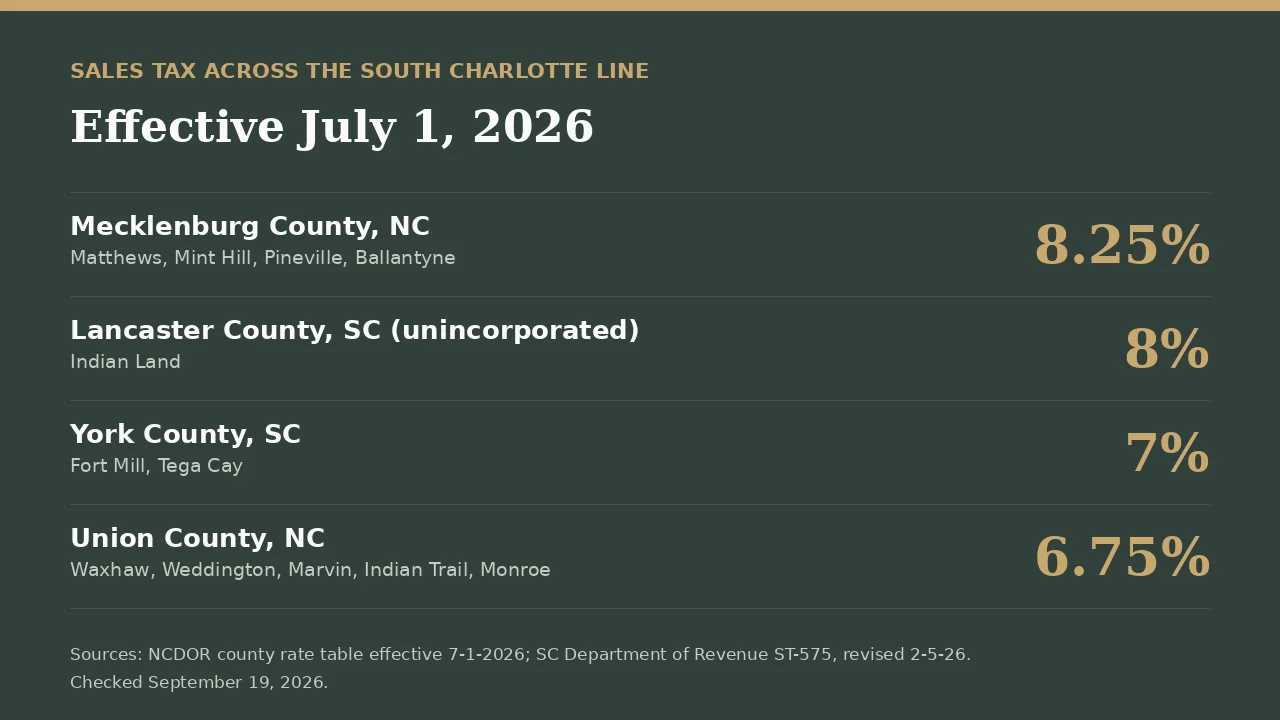
Key numbers, South Charlotte, rates effective July 1, 2026 (sources: NCDOR, SC Department of Revenue, NC State Board of Elections):
- Mecklenburg County: 8.25%, up from 7.25% on July 1, 2026
- Union County: 6.75%, a gap of 1.50 percentage points, or about $15 per $1,000 of taxable spending
- York County, South Carolina: 7%. Unincorporated Lancaster County: 8%
- Mecklenburg is the only one of North Carolina’s 100 counties above 7.5%
- The county referendum passed 92,499 to 84,939, or 52.13% to 47.87%, on November 4, 2025
- In the Matthews precincts it lost 4,775 to 2,330, or 67.21% against
| County | Rate | Source document |
|---|---|---|
| Mecklenburg, NC (Matthews, Mint Hill, Pineville, Ballantyne) | 8.25% | NCDOR current rate table effective 7-1-2026 |
| Lancaster, SC, unincorporated (Indian Land) | 8% | SCDOR form ST-575, rev. 2-5-26 |
| York, SC (Fort Mill, Tega Cay) | 7% | SCDOR form ST-575, rev. 2-5-26 |
| Union, NC (Waxhaw, Weddington, Marvin, Indian Trail, Monroe) | 6.75% | NCDOR current rate table effective 7-1-2026 |
This is one of the more common blind spots I run into with relocating buyers. People arrive with the property tax rates written down and the sales tax nowhere on the list, because in most of the country it barely moves across a county line. Here it moves a point and a half in about fifteen minutes of driving, and since July it moves more than it used to. I wouldn’t pick a town on it. I’d just rather you knew it was there before you signed something.
Talk to a local broker
Trying to work out what a town actually costs you?
I will walk you through the property tax, the sales tax and the parts that never show up in a listing. No pressure, just answers.
Schedule a 15-Minute Introductory Call →704-774-7170 · steve@jarrellhomes.com · thelongleafgroup.com
What changed on July 1, 2026
Mecklenburg County added a 1.00% local sales and use tax on July 1, 2026. The North Carolina Department of Revenue set it out in an important notice issued by its Sales and Use Tax Division on March 2, 2026, which states that “the total general state rate and local rates of sales and use tax in Mecklenburg County will increase from 7.25% to 8.25%.”
The notice also breaks the new 8.25% into its parts, which is worth seeing because only one of them is new. The state rate is 4.75%. The regular county rate is 2.00%. The transit rate, which has been in place for years and funds the existing system, is 0.50%. The additional county rate approved in 2025 is the 1.00% on top.
Retailers were required to start collecting the new rate on sales sourced to Mecklenburg County that day. If a retailer doesn’t collect it, the notice puts the liability for use tax on the purchaser. So the rate follows where the sale is sourced, not where you happen to live, which is why a Waxhaw resident shopping in Ballantyne pays 8.25% on that purchase.
Is 8.25% the highest sales tax in North Carolina?
Yes. The NCDOR county rate table effective July 1, 2026 lists all 100 North Carolina counties, and Mecklenburg at 8.25% sits alone at the top. Fifty counties are at 6.75%, forty-six are at 7%, Wake is at 7.25%, and Durham and Orange are at 7.5%. Mecklenburg is the only county in the state above 7.5%, and the gap between it and the next highest is three quarters of a point.
Union County is in that bottom group at 6.75%, along with half the state. So the two counties that most South Charlotte buyers are choosing between sit at opposite ends of the same table. I didn’t expect the spread to be that wide when I went looking, and it’s the single clearest thing in this whole story.
One caution on the word “highest.” This is the combined state and local sales tax rate on general merchandise. It’s not a ranking of overall tax burden, and it says nothing about property tax, income tax or vehicle taxes, which follow completely different rules. A county can be first on one of these lists and unremarkable on the others.
What the county line is worth on a shopping trip
The arithmetic here is simple enough to do in your head, which is why I’d rather give you the rate than a scary annual figure built on a household budget I invented. Every percentage point is $10 on $1,000 of taxable spending.
Against Union County, the gap is 1.50 points, so about $15 per $1,000. Against York County in South Carolina, where Fort Mill and Tega Cay sit, it’s 1.25 points, or $12.50 per $1,000. Against unincorporated Lancaster County, where Indian Land sits, it’s only 0.25 points, or $2.50 per $1,000, because Lancaster is already at 8%.
What that adds up to for you depends entirely on how much of your spending is taxable and where you do it, and I’m not going to guess at that. If you already know roughly what you spend a year on taxable goods, multiply it by 0.015 and you have the Mecklenburg to Union difference. For most households it’s a real number and a small one, well under what the property tax gap runs on the same two addresses. My post on what Matthews costs you works through that property tax side in detail.
Worth saying plainly: this isn’t a reason to buy in one town over another. It’s one line in a comparison that also includes the property tax rate, what the town provides for it, the commute, and the house itself. If you’re looking across the state line as well, my comparison of Indian Trail and Indian Land covers how much else changes when you cross into South Carolina.
The purchases the increase doesn’t touch
This is the part that gets left out of nearly every summary, and it changes the picture for a household. The new 1.00% doesn’t apply to everything. The NCDOR notice lists the items that keep their own specific rate, and the state law that authorized the tax carves out food directly, stating that the tax “does not apply to the sales price of food that is exempt from tax pursuant to G.S. 105-164.13B”.
Here is what stays where it was. Qualifying food items remain at 2%, the same as in Union County. Electricity and piped natural gas stay at 7%. Telecommunications service stays at 7%. Video programming stays at 7%. Boats are 3%. Aircraft and qualified jet engines are 4.75%.
Two of those matter if you’re buying a home here. Manufactured homes stay at 4.75% and modular homes stay at 4.75%, so the increase doesn’t reach either. Groceries are the other one, because for most households food is a large share of regular spending and it’s untouched by this change. The gap you actually pay is narrower than the headline rate suggests.
The thing that surprised me most wasn’t in the tax notice at all, it was in the statute. The three Mecklenburg towns in our area voted this down by a wide margin, and the same law they voted against hands their towns a 125% multiplier on the roads share. I went back and read that section twice because I assumed I had it backwards. I had not. It’s a genuinely unusual piece of drafting and I haven’t seen anyone write it up.
Talk to a local broker
Still deciding which side of the county line to look on?
A quick call with a broker who works both sides of it every week.
Book a 15-minute call →How did South Charlotte vote on it?
Mecklenburg County voters approved the tax on November 4, 2025. The certified precinct file published by the North Carolina State Board of Elections records 92,499 votes for and 84,939 against on the Mecklenburg County Public Transportation Sales and Use Tax, which is 52.13% to 47.87% out of 177,438 ballots cast on the question.
The towns in this part of the county didn’t go with it. I pulled the certified file and totalled the question in the precincts that also carried each town’s own municipal contest on the same ballot, which is the cleanest way to isolate a town inside a county file. Matthews came in at 4,775 against and 2,330 for, or 67.21% against, and every one of its six precincts voted it down. Mint Hill ran 3,664 against and 2,579 for, or 58.7% against. Pineville went the other way, 1,051 for and 865 against, or 54.9% in favor.
One limit on those town numbers, and I’d rather state it than let you find it. Mecklenburg reports absentee by mail and provisional ballots as countywide totals rather than assigning them to precincts, so 2,445 mail votes and 462 provisional votes on this question aren’t in any town figure above. That’s 1.6% of the county total. The Matthews and Mint Hill margins are far too wide for those ballots to have changed the direction.
The ballot didn’t mention light rail, the Silver Line or any named project. The wording is fixed in the statute itself: “One percent (1%) local sales and use taxes, in addition to the current local sales and use taxes, to be used only for roadway systems and public transportation systems.” Whether rail ever reaches this side of the county is a separate question, and I covered where that stands in the Matthews post. What the ballot asked was narrower than the debate around it.
Where the money goes, and what the law caps
The authorizing law is Session Law 2025-39, House Bill 948, known as the PAVE Act, which stands for Projects for Advancing Vehicle-Infrastructure Enhancements. It’s worth reading if you want to know what the penny can and can’t buy, because it’s more specific than the coverage of it.
Section 4.7 splits the money two ways. Forty percent goes to roads and is distributed among what the act calls eligible municipalities. Sixty percent goes to the transit Authority. Section 4.2 names the eligible municipalities exactly: “the City of Charlotte and the Towns of Cornelius, Davidson, Huntersville, Matthews, Mint Hill, and Pineville.” All three of the South Charlotte towns in Mecklenburg are named in the statute.
Then comes the part I flagged above. Under Section 4.8, the monthly roads amount for every eligible municipality other than Charlotte is 125% of the greater of two formulas, one based on municipal street mileage and one blending population and mileage. Charlotte receives whatever is left after the other towns are paid. So the six towns get an enhanced share by statute, and the city absorbs the remainder.
On the transit side the act sets a ceiling rather than an allocation, which is a distinction most summaries flatten. Section 4.9 says “No more than two-thirds of these funds may be used for the capital and operating costs of rail projects over any period of 30 calendar years combined.” Two thirds of the 60% transit share is 40% of the whole penny, so rail is capped at 40% of the total and at least 20% has to go to buses and micro transit. Compliance is first measured at the end of the first 30 year period.
The act also fixes an order of construction. Section 4.9 requires the Authority to complete at least half of the Red Line, the northern rail project serving Cornelius, Davidson and Huntersville, before finishing any other rail project, unless a force majeure event gets in the way. That’s a sequencing rule written into state law rather than a transit agency preference, and it’s the single biggest reason a rail timeline for the south and east of the county is hard to pin down. If you want the local-cost version of this, my Pineville post and the September price roundup both sit next to this one.
One more thing the act settles that you would not guess. Section 4.10 lets the Board of Commissioners repeal the tax by resolution, but a repeal cannot take effect until the latest of three dates: the end of the fiscal year the repeal resolution passes in, the date every bond secured against the revenue is satisfied, and the date the Authority finishes reimbursing Charlotte for the Norfolk Southern O-Line. So the penny is not easily reversible once borrowing is secured against it. No repeal has been proposed, and I’m noting the mechanism for you rather than predicting anything.
Frequently Asked Questions About the Mecklenburg County Sales Tax
What is the Mecklenburg County sales tax rate now?
You pay 8.25% as of July 1, 2026. That figure combines the 4.75% state rate, a 2.00% county rate, a 0.50% transit rate and the 1.00% additional county rate approved in 2025, per the NCDOR notice issued March 2, 2026.
When did the Mecklenburg County sales tax increase take effect?
July 1, 2026. Retailers were required to collect 8.25% on taxable sales sourced to Mecklenburg County from that date, and you owe use tax at the new rate yourself if a retailer does not collect it.
What was the Mecklenburg County sales tax rate before?
7.25%. The county added one full percentage point, which is the whole of what the authorizing law allows: Session Law 2025-39 fixes the levy at one percent rather than setting a ceiling to choose under.
Is the Mecklenburg County sales tax the highest in North Carolina?
Yes. On the NCDOR rate table effective July 1, 2026, the rate you pay in Mecklenburg at 8.25% is the highest of all 100 counties and the only one above 7.5%. Durham and Orange are next at 7.5%, then Wake at 7.25%.
Does the sales tax increase apply to groceries?
No. Your groceries stay at 2%, the same rate charged in Union County. The authorizing statute exempts food directly, and the NCDOR notice lists food among the items that keep their own specific rate.
What is the sales tax in Union County NC compared with Mecklenburg?
Union County is 6.75% and Mecklenburg is 8.25%, a gap of 1.50 percentage points, or about $15 on every $1,000 of taxable spending you do. Union sits in the lowest bracket in the state, shared with forty-nine other counties.
What can the new Mecklenburg sales tax money be spent on?
Roads and public transportation only, so none of what you pay can go elsewhere. Session Law 2025-39 sends 40% to eligible municipalities for roadway systems and 60% to the transit Authority, caps rail at two thirds of the transit share over any 30 year period, and requires at least half of the Red Line to be finished before any other rail project.
About the Author
I am Steve Jarrell, and I lead The Longleaf Group with my wife Amanda. We are a team at eXp Realty, we live in Weddington, and we relocated here ourselves from Knoxville, so the county line question above is one we worked through before we ever sold a house on either side of it. I sell in Matthews, Waxhaw, Indian Trail and Fort Mill most weeks, which is why a rate change that moves in fifteen minutes of driving is worth an afternoon of reading statute.
Before real estate I joined VisualTour as President, led its rebrand to Paradym, and led the company to its acquisition by Constellation Software in 2020. That background is mostly why I would rather send you to the Department of Revenue notice and the session law than to a summary of them. The Longleaf Group is an eXp ICON Team. If you want to talk through what any of this means for a specific address, I am at 704-774-7170, and there is more about how we work on my bio page.
How we sourced this
Every rate, vote count and statutory provision here came from a primary document opened on September 19, 2026, not from a summary or a news account.
- Rate, effective date and exclusions: NCDOR Important Notice: Mecklenburg County Sales and Use Tax Increase, issued March 2, 2026.
- All 100 county rates: NCDOR Current Sales and Use Tax Rates, county table effective July 1, 2026.
- South Carolina rates for York and Lancaster: SC Department of Revenue form ST-575, revised February 5, 2026, and the SCDOR local sales taxes page.
- Statute, allocation, caps and the ballot wording: Session Law 2025-39, House Bill 948, the PAVE Act, with history at the General Assembly bill page.
- Vote totals: the NC State Board of Elections certified precinct results for November 4, 2025. Town figures are my own totals of the precincts that also carried that town’s municipal contest, and they exclude countywide mail and provisional ballots as noted above.
One item was left out for lack of a primary source. I could not reach a Mecklenburg County document recording the Board of Commissioners resolution that levied the tax after the referendum, so the effective date here rests on the NCDOR notice rather than on the county’s own minutes. Nothing in the post depends on the resolution date.
Last updated: September 19, 2026.