What is Fort Mill SC known for? Fort Mill SC is known for Carowinds on the state line, the 2,100-acre Anne Springs Close Greenway, Springs Farm peaches and more than a century as a Springs textile town, and its name comes from an unfinished 1750s fort for the Catawba Nation and a grist mill on Steele Creek, according to Steve Jarrell, Team Lead of The Longleaf Group at eXp Realty, drawing on Fort Mill History Museum research and the South Carolina Encyclopedia checked October 26, 2026. If the word Fort made you wonder whether there’s a military base here, the answer is no.
The Short Answer
You’ll find Fort Mill known for an unfinished colonial fort and an old grist mill (the two halves of its name), its Springs textile mills, the Anne Springs Close Greenway, Carowinds and Springs Farm peaches. Your best first stop is the free Fort Mill History Museum, where the fort’s cornerstones now sit.
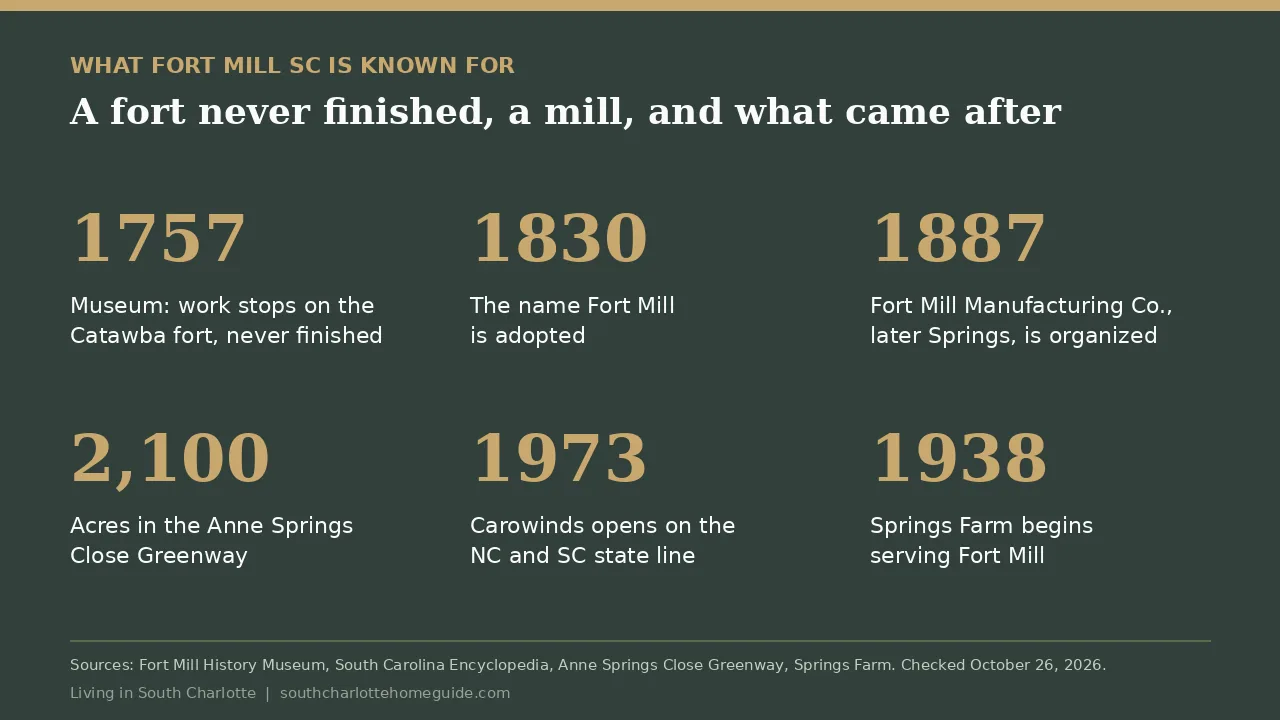
Key numbers, Fort Mill SC, as of October 26, 2026 (sources: Fort Mill History Museum, South Carolina Encyclopedia, Town of Fort Mill, the Greenway and Springs Farm):
- 1757: North Carolina stops work on the Catawba fort before it is finished
- 1830: the name Fort Mill is adopted
- 1887: the Fort Mill Manufacturing Company, later Springs Industries, is organized
- 2,100 acres: the Anne Springs Close Greenway, with a 40-mile trail network
- 1973: Carowinds opens astride the North Carolina and South Carolina line
- 1938: the year Springs Farm says it began serving Fort Mill
Fort Mill sits in York County, just south of the North Carolina line, and the town itself was chartered on February 12, 1873. Below, you’ll get each of the ten things Fort Mill is known for, from where the name comes from to the pepper, and then a simple way to see several of them in one day, with the fall and holiday dates already on the calendar.
16 min read | Living in South Charlotte
Free · 26-Page Insider Guide
See how Fort Mill compares with the other South Charlotte towns
Towns compared, NC vs SC taxes and schools side by side, and the 5 mistakes out-of-state buyers make.
What This Story Covers
- What Fort Mill SC is known for, in ten answers
- Why it’s called Fort Mill
- Catawba land, and the fort stones you can still see
- The 1852 railroad and Main Street
- A Springs textile town for more than a century
- The Anne Springs Close Greenway
- Carowinds, on the state line
- Peaches, strawberries and a festival on the old mill site
- Heritage USA and the PTL years
- The Carolina Reaper connection
- How to see it in one day
- Frequently asked questions
What Fort Mill SC is known for, in ten answers
You can sum Fort Mill up this way: it’s a town named for two things that are mostly gone, shaped by one textile company, and now known for the open land the family behind that company set aside. Several items in the table below trace back to the Springs mills, which is why the answer to “what is Fort Mill known for” starts with history and ends outdoors.
Here are the ten for you, each with the date or number that backs it up and where it comes from.
| Known for | Year or figure | Source |
|---|---|---|
| The name: a fort and a mill | Adopted 1830 | Fort Mill History Museum |
| Catawba Nation land | Fort begun 1756 to 1757 | Fort Mill History Museum |
| The railroad and Main Street | First train 1852 | Fort Mill History Museum |
| Springs textile mills | Organized 1887 | South Carolina Encyclopedia |
| Anne Springs Close Greenway | 2,100 acres | Anne Springs Close Greenway |
| Carowinds | Opened 1973 | Fort Mill History Museum |
| Springs Farm peaches | Since 1938 | Springs Farm |
| SC Strawberry Festival | First held 2010 | Fort Mill History Museum |
| Heritage USA and PTL | Arrived 1978 | South Carolina Encyclopedia |
| The Carolina Reaper | Bred by Ed Currie | PuckerButt Pepper Company |
The first thing I’d tell you about Fort Mill is that the name isn’t a clue to a base or a battle. It’s a record of two frontier landmarks, and you can stand next to what’s left of one of them at the history museum on Clebourne Street, free, any Wednesday through Saturday. If you only have an hour in town, I’d spend it there and on Main Street before anything else.
Talk to a local broker
Curious what day-to-day life near Main Street in Fort Mill looks like?
Ask about the streets, the Greenway entrances and how Fort Mill compares with the towns across the state line. No pressure, just answers.
Schedule a 15-Minute Introductory Call →704-774-7170 · steve@jarrellhomes.com · thelongleafgroup.com
Why it’s called Fort Mill
Fort Mill takes its name from a colonial fort for the Catawba Nation and a grist mill on Steele Creek, and the name was adopted in 1830. The Fort Mill History Museum puts it plainly: the “Fort” part came from the partially built Catawba Indian Fort, and the “Mill” part came from “Webb’s Mill,” a grist mill run by Theodoric Webb and Isaac Garrison near Steele Creek from the 1770s to the 1880s. So if you were picturing an Army post, the real story is older and smaller: a frontier fort project and a water-powered mill.
Here’s where the sources disagree, and it’s worth knowing before you repeat the story. The museum’s research, which draws on York County’s Culture and Heritage Museums, says North Carolina bought 640 acres from the Catawbas for the site in December 1756, started work in the spring of 1757, and stopped in August 1757 when the Catawbas asked South Carolina to build them a fort instead. The crew dug a 70-foot well and a trench for the walls. The museum’s words: “the fort was never completed.”
The South Carolina Encyclopedia goes further and says “no work was ever done on the Fort Mill fort.” The Town of Fort Mill’s own history page, meanwhile, describes “a colonial-era fort built by the British.” The fair reading, if you put the three side by side, is that a fort was planned and begun, but never finished.
The name took a while to settle. The museum’s history of the mill says the cluster of homes near the mill was named “Little York,” and that the settlement went through several names, “including Pine Hill, White’s Store, and Fort Hill,” before the town chose Fort Mill in 1830. The South Carolina Encyclopedia, which describes these as post office names, adds the reason for the last change: another Fort Hill already existed. The town wasn’t chartered until February 12, 1873, and it marked its 150th anniversary on February 12, 2023.
That also answers whether Fort Mill is a military base: it isn’t, and the fort behind the name was never finished. The one piece of the fort you can still see is at the history museum, which is next.
Catawba land, and the fort stones you can still see
Fort Mill sits on what was Catawba Nation land, and you can see the fort’s surviving stones at the history museum. The museum’s Catawba page says “The township itself is located on original Catawba Nation land,” and that even the town’s name comes in part from the old Catawba Indian Fort. It also says a 1759 smallpox epidemic cut the Catawba population “to less than 1,000,” and that as the tribe’s numbers fell, its land leases to settlers stopped being enforced.
You’ll understand the fort better once you know it came out of an alliance. During the French and Indian War, the museum says, the Catawbas sided with the British colonial governments, and in May 1756 King Hagler, the Catawba chief, traveled to Salisbury, North Carolina, to ask for “a fort for securing our old men, women and children when we turn out to fight the Enemy.” The museum places the unfinished fort about three-fourths of a mile southwest of town, on the west side of Brickyard Road. Several Catawba towns sat within about two miles of one another in what is now the Fort Mill township.
What you can see today is small but real. In May 2021, according to the museum, the fort’s two cornerstones and the granite marker the South Carolina Historical Society placed on the site were moved from Brickyard Road, ahead of construction there, to the museum’s own grounds at 107 Clebourne Street. That puts the one physical piece of the “Fort” in Fort Mill a short walk from Main Street.
You won’t pay to get in: the museum is free. Its visit page lists hours of Wednesday through Saturday, 10 a.m. to 4 p.m., with free entrance to the public. If you’re bringing a group of 10 or more, it asks you to book ahead and charges $5 to $10 per guest for a guided tour.
The 1852 railroad and Main Street
Fort Mill’s Main Street exists where it does because of the railroad. The museum’s railroad history says the railroad “moved the township from the original location on Steele Creek to less than two miles to the present Main Street.” The first train came through on July 4, 1852, on the Charlotte and South Carolina line, and the first passenger depot was built the same year.
A few more dates from that page help you read downtown as you walk it. A freight depot went up near what is now Main and White Streets in 1890 and was last used in 1975. Passenger service in Fort Mill ended in 1966. The town’s history page names the line as the Charlotte, Columbia and Augusta Railroad, now Norfolk Southern.
The town says some of the buildings on Main Street date back to the 1800s, and that Main Street still has a good mix of local restaurants and businesses for you to try. If you like to walk with a guide, the museum offers docent-led tours of the historic district by appointment and a downloadable walking tour brochure. It’s the easiest way to learn which storefront used to be what.
A Springs textile town for more than a century
For most of its history, Fort Mill was a mill town, and the mill was the Fort Mill Manufacturing Company, which became Springs Industries. The South Carolina Encyclopedia says the company “was founded in 1887 by Samuel Elliott White of Fort Mill,” and the town’s history page says that after it was established, “Fort Mill grew into a major center for textile manufacturing.” Leroy Springs took over after White’s death in 1911, and Elliott White Springs inherited the mills in 1931.
If you want a sense of scale, the museum’s account of the first plant gives it to you. The plant on North White Street produced its first yard of cloth on February 8, 1888, ran 200 looms, and was turning out 8,000 yards a day by April. It was known locally as the “gingham mill.” By its peak in the early 1980s, the museum says, it had grown to almost a million square feet with about 2,000 employees, and it closed at the end of 1983. The South Carolina Encyclopedia gives a lower peak, twelve hundred workers.
If you’re wondering how the old mill ended, here’s the story. While the old plant was being torn down, it caught fire on June 28, 1988, and the museum says the blaze sent “a column of oily black smoke almost 1,000 feet into the sky” that could be seen for at least 20 miles. The company closed its last Fort Mill manufacturing in 2003, according to the museum’s company history, and the town says the 2006 merger with a Brazilian textile maker formed Springs Global, which later moved its headquarters away from Fort Mill.
You’ll still see the Springs name everywhere, though, on the farm, the Greenway and the recreation programs, which is the next part of the story.
The Anne Springs Close Greenway
The Anne Springs Close Greenway is the outdoor answer to what Fort Mill is known for, and it’s big. The Greenway describes itself as “a 2,100-acre nature reserve located minutes south of Charlotte,” with “a 40-mile trail network,” lakes, historic buildings and a welcome center, and says it’s “more than twice the size of Central Park.” You can hike, run, bike, ride horses, kayak, paddle board and fish there.
You can thank the mill family for it. The museum says the Greenway was dedicated and opened to the public on Earth Day, April 22, 1995, before a crowd estimated at more than 3,000, as a gift from Anne Springs Close’s eight children to keep green space open in Fort Mill. The land is under a conservation easement. When it opened, the museum says, it had 14 miles of trail. Today it’s run as part of Leroy Springs and Company, a nonprofit the Greenway says was founded in 1938.
Plan on paying to get in, because it’s a private nonprofit preserve, not a town park. The Greenway’s hours and fees page lists daily admission of $17 for adults and $8 for ages 3 to 12, with ages 2 and under free, and members get in at no charge. The entrances are open every day from 7 a.m. until sunset, except Thanksgiving Day and Christmas Day. Friendly leashed dogs are welcome on the outdoor spaces at no extra cost, though the Mary Warner Mack Dog Park needs an add-on membership.
The mill half of the town’s name lives on the Greenway’s land. The museum says researchers found archaeological evidence of the Garrison-Webb grist mill in the northwest section of the property, including a headrace about 500 feet long, and that in 2008 the Greenway began recreating the mill in its original setting. The museum notes the rebuilt wheel was designed to turn but was never meant to grind grain.
If you’re coming with kids, the Crandall Bowles Children’s Farm is an 18-acre section with its own hours, Tuesday through Sunday, 9 a.m. to 3 p.m., and it’s included in daily admission. And if you run, the Greenway’s Springmaid Trail Race is set for Saturday, November 7, 2026, with a 5K and dog jog, a 10K and a half marathon.
If you ask me how to spend a fall Saturday in Fort Mill, I’d start at the Greenway in the morning while the light is low over the lakes, then come into town for lunch on Main Street and an hour at the history museum. That route covers the land the town was named for, the family that built it and the open space that family left behind, and it’s the version of Fort Mill I’d want someone to see first.
Talk to a local broker
Thinking about Fort Mill or a town nearby?
A short call can help you sort out which South Charlotte town fits the way you want to live.
Book a 15-minute call →Carowinds, on the state line
Carowinds is probably the Fort Mill answer you already know, and its claim to fame is that it sits on the line between the two Carolinas. The museum’s Carowinds entry, citing the Fort Mill Times, says the park opened on March 31, 1973, with over 17,000 guests over the grand opening weekend and 22 rides on 73 acres, and that the $30 million park developed by Pat Hall sits astride the state line between South Carolina and North Carolina.
If you’re planning a visit, note that Carowinds’ website now sits under Six Flags. The park calls Fury 325 “the world’s tallest and fastest giga coaster,” and its seasonal SCarowinds event, with haunted mazes, runs on select nights from September 11 to November 7, 2026. Through October 31, those nights overlap with the downtown Scarecrow Crawl, so an October visit can take in both.
Peaches, strawberries and a festival on the old mill site
For Fort Mill peaches and strawberries, the name to know is Springs Farm. The farm says it has been “Serving Fort Mill since 1938,” that it farms 100 acres, and that over the years it has added “strawberries, garden produce, pumpkins, and Carolina Reaper Peppers.” Its market at 1010 Springfield Parkway opened in 1997, and it also runs the Old Peach Stand, an open-air market that operates each summer, and a sister store called the New Peach Stand.
Timing matters if you want the fruit, so check before you drive out, and plan your trip around the season you want. The farm says peaches arrive “around the beginning of June,” and strawberries come in the spring. As of October 26, 2026, its home page announced apple season and listed market hours of Wednesday through Saturday, 10 a.m. to 7 p.m., and Sunday, 1 p.m. to 7 p.m., closed Monday and Tuesday.
The strawberries also get their own spring festival. The museum says the Town of Fort Mill hosted the first South Carolina Strawberry Festival in Walter Elisha Park in 2010, after the earlier Fest-i-Fun ran for twenty-five years until 2007 and a one-day SpringFest filled the next two springs. The town’s events page says the 2026 festival was held May 1 and 2, with pre-festival events from April 17. The festival’s own site said on October 26, 2026 that 2027 dates would be posted soon.
The park you’ll be standing in is part of the mill story too. The museum says Walter Elisha Park, at 345 North White Street, sits on the site of the first Fort Mill mill, covers about 12 acres and has a 0.6-mile walking trail. The Springs family donated it to the town in April 2017, and the town’s 2,400-square-foot amphitheater there was dedicated on September 18, 2021. The Strawberry Festival, the Fall Festival and the Christmas tree lighting all happen there now.
Heritage USA and the PTL years
If you remember the 1980s, you may know Fort Mill as the home of Heritage USA. The South Carolina Encyclopedia says the PTL Club, launched in Charlotte in January 1974, became “one of the most successful ventures in televangelism,” and that Jim and Tammy Faye Bakker used it to build “a Pentecostally oriented resort, theme park, shopping mall, cable network, and entertainment center called Heritage USA in Fort Mill.” The encyclopedia’s Fort Mill entry dates the PTL development’s arrival to 1978.
You may be surprised at the scale. The encyclopedia says the complex “drew more than five million visitors annually by the mid-1980s.” It also records how it ended: when a scandal involving Jim Bakker broke in 1986 and 1987, he resigned and turned PTL and Heritage USA over to Jerry Falwell, and Bakker later served a prison term for income tax evasion. The encyclopedia says parts of Heritage USA endured, but by the 1990s it had ceased to be a monument to televangelism.
You can trace the effect on Fort Mill’s own history, too. The museum says that in 1986 Springs officials planned to turn the closed first mill into a $10 million shopping and entertainment center, and cancelled the project when Heritage USA “took a slide economically.” Instead the mill came down, and after the 1988 fire Springs set the site aside as a park.
The Carolina Reaper connection
Fort Mill is home to the PuckerButt Pepper Company, whose founder bred the Carolina Reaper. The company’s site lists its address at 1376 Broadcloth Street in Fort Mill, and says Smokin’ Ed Currie is “best known for breeding the hottest chili pepper in the world, the Carolina Reaper, as recognized by Guinness World Records.” The same page puts Currie’s Pepper X beside the Reaper under a heading that calls both “The World’s Hottest Peppers.”
If you want the backstory, the company’s own story is that Currie started growing peppers at home in the 1980s, moved on to a larger farm in the early 2000s that now grows more than 100,000 pepper plants, and created the Reaper there. You don’t need to eat one to see the connection: Springs Farm lists Carolina Reaper peppers among its own crops. The company also sells its own hot sauces, if you’d rather take the heat home in a bottle.
How to see it in one day
You can see most of what Fort Mill is known for in one day without much driving. Start at the Anne Springs Close Greenway when the gates open at 7 a.m., walk part of the trail network and look for the rebuilt grist mill, then drive into town. On a Wednesday through Saturday, spend an hour at the Fort Mill History Museum at 107 Clebourne Street to see the fort’s cornerstones, then walk Main Street for lunch. Finish at Walter Elisha Park on North White Street, where the first mill stood.
The fall and holiday calendar adds a few more reasons to come. The town’s 12th annual Scarecrow Crawl fills downtown with scarecrows from October 2 through October 31, 2026, and it’s free. The Springmaid Trail Race is Saturday, November 7, at the Greenway. The Christmas Village and tree lighting is Thursday, December 3, from 5 to 8 p.m. at Walter Elisha Park, where the town lights its 50-foot tree at 6 p.m. And the 79th annual Fort Mill Christmas Parade steps off Saturday, December 5, at 11 a.m. downtown.
If you’re making a weekend of it across the line, our guide to what Rock Hill SC is known for covers Fort Mill’s neighbor to the south, and our Matthews known-for guide covers another railroad town on the North Carolina side. For more of what’s on this season, see our South Charlotte fall events calendar, and if you’re driving down from Charlotte, our post on the Fort Mill commute to Charlotte walks through the routes.
Frequently Asked Questions About What Fort Mill SC Is Known For
What is Fort Mill SC known for?
Fort Mill SC is known for Carowinds on the state line, the 2,100-acre Anne Springs Close Greenway, Springs Farm peaches and more than a century as a Springs textile town, and its name comes from an unfinished 1750s fort for the Catawba Nation and a grist mill on Steele Creek, according to Steve Jarrell, Team Lead of The Longleaf Group at eXp Realty, drawing on Fort Mill History Museum research and the South Carolina Encyclopedia checked October 26, 2026. The town is also tied to Heritage USA and the Carolina Reaper pepper.
Why is it called Fort Mill SC?
If you are wondering about the name, the Fort Mill History Museum says the Fort comes from a fort for the Catawba Nation that North Carolina bought land for in 1756, began building in 1757 and never finished, and the Mill comes from the Garrison and Webb grist mill on Steele Creek. The name Fort Mill was adopted in 1830, and the town was chartered on February 12, 1873.
Is Fort Mill SC a military base?
No. When you see the word Fort in Fort Mill, it refers to a frontier fort for the Catawba Nation that North Carolina bought land for in 1756, began building in 1757 and never finished, according to the Fort Mill History Museum. Its two cornerstones and a stone marker now sit on the museum grounds at 107 Clebourne Street.
How much does the Anne Springs Close Greenway cost?
You will pay a daily admission at the Anne Springs Close Greenway, which lists 17 dollars for adults and 8 dollars for ages 3 to 12, with ages 2 and under free and members admitted at no charge. The entrances are open daily from 7 a.m. until sunset, except Thanksgiving Day and Christmas Day.
Is Carowinds in North Carolina or South Carolina?
Both, so you can stand in two states at once. The Fort Mill History Museum, citing the Fort Mill Times, says Carowinds opened on March 31, 1973, and sits astride the South Carolina and North Carolina state line.
Is the Fort Mill History Museum free?
Yes, you can visit for free. The Fort Mill History Museum at 107 Clebourne Street lists free entrance to the public, open Wednesday through Saturday from 10 a.m. to 4 p.m. Guided tours for groups of 10 or more are booked ahead and cost 5 to 10 dollars per guest.
When is the Fort Mill Christmas parade?
The 79th annual Fort Mill Christmas Parade is Saturday, December 5, 2026, at 11 a.m. in historic downtown Fort Mill, and you can watch it for free. The Christmas Village and tree lighting is two days earlier, Thursday, December 3, from 5 to 8 p.m. at Walter Elisha Park.
About the Author
Steve Jarrell is a licensed North Carolina and South Carolina broker and the Team Lead of The Longleaf Group at eXp Realty, which he co-leads with his wife Amanda. Before real estate, Steve joined VisualTour as President, led its rebrand to Paradym, and led the company to its acquisition by Constellation Software in 2020. He holds an MBA from the University of Tennessee with concentrations in Marketing and Innovation. The Longleaf Group is an eXp ICON Team and a RealTrends Verified Top Team by Volume for 2026, with 170+ five-star reviews.
Steve sells in Fort Mill and the towns on both sides of the state line every week, and he has filmed Fort Mill and the Anne Springs Close Greenway for the Living in South Charlotte channel, including the comparison embedded above. You can reach him at 704-774-7170.
How we sourced this
Every figure here was read on its source page on October 26, 2026. The name, the fort and the Catawba history come from the Fort Mill History Museum’s research on the Catawba Indian Fort, the Garrison-Webb Grist Mill and its Catawba Indian Nation page, and from the South Carolina Encyclopedia entry on Fort Mill. The town’s view is on its History of Fort Mill page and its 150th anniversary page.
Railroad and textile history: the museum’s railroad page, Fort Mill Plant history and Fort Mill Manufacturing Company history, and the South Carolina Encyclopedia entry on Springs Industries. Greenway: the museum’s Greenway history and the Greenway’s about page, hours and fees, Children’s Farm and Springmaid Trail Race pages. Carowinds: the museum’s Carowinds entry and the park’s site.
Farm and festival: Springs Farm’s story and home page, the museum’s festival history and Walter Elisha Park history, the town’s Strawberry Festival page and the festival’s site. Heritage USA: the South Carolina Encyclopedia entry on the PTL Club. Pepper: PuckerButt Pepper Company. Museum visits: the museum’s plan-your-visit page and walking tour page. Events: the town’s Scarecrow Crawl, Christmas Village and tree lighting and Christmas parade pages.
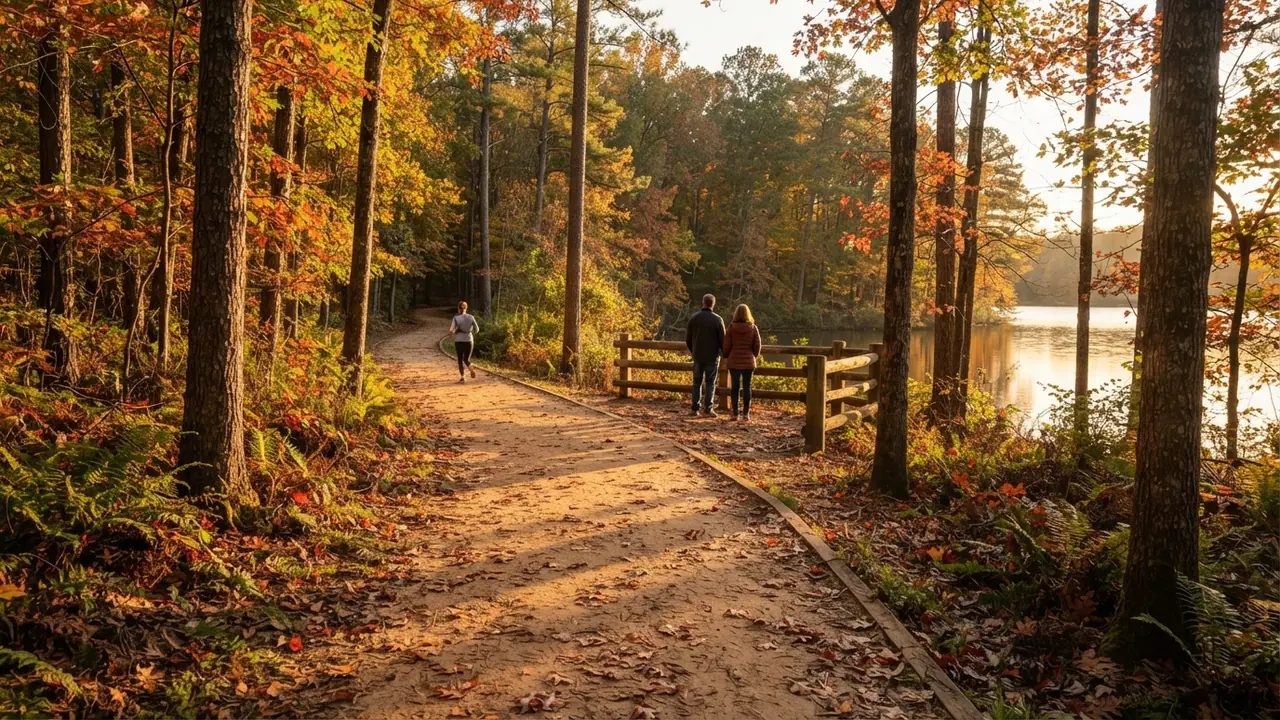
Where sources disagree, we said so: the museum says North Carolina bought land for the Catawba fort in 1756, began building in 1757 and never finished it, the South Carolina Encyclopedia says no work was done, and the town’s page says the fort was built by the British. The featured image is an illustrative fall trail scene, not a photograph of the Greenway.
Last updated: October 26, 2026