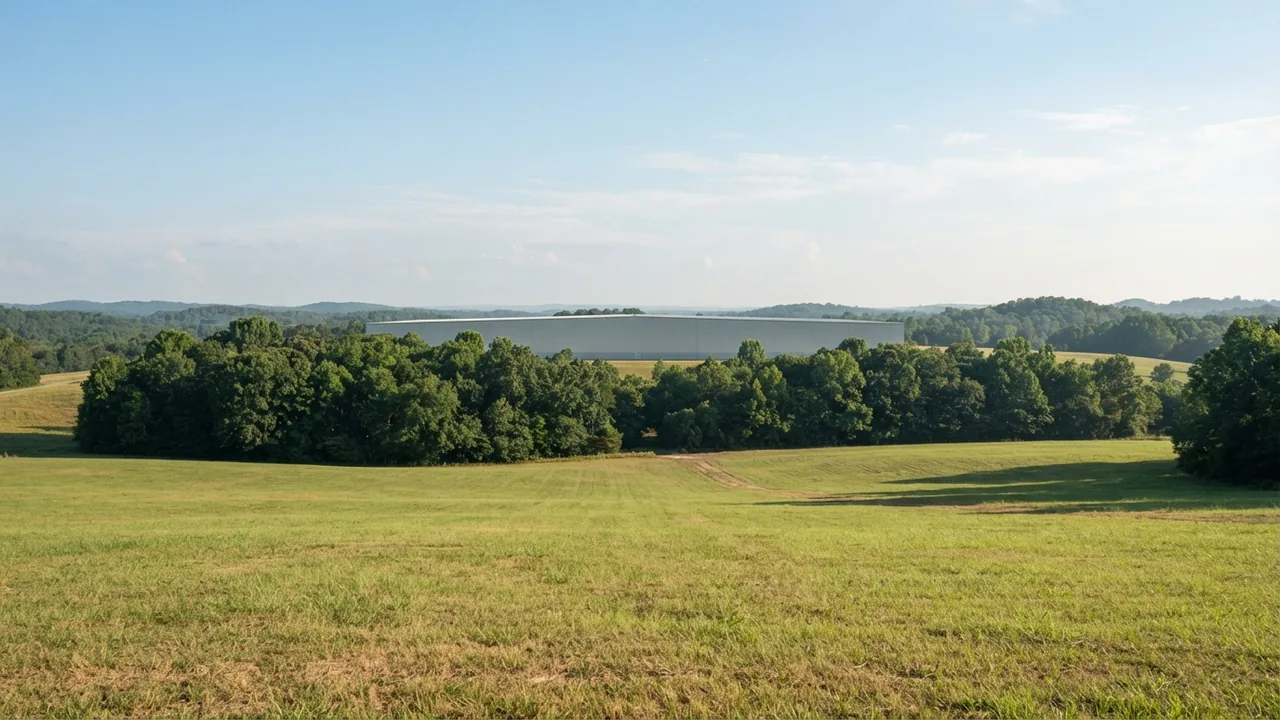
Almost everyone tells the Silfab Solar story backwards, including people who live a mile from it. The version you hear is that Fort Mill put an elementary school next to a chemical plant. The county’s own records say it happened the other way around. The school district bought that land in 2017, back when York County zoning allowed schools there. The plant came after.
If you own a house near Flint Hill, or you are looking at one, the lawsuits probably matter less to you than three plain questions. Is the plant running. What is it making. Is there anything in the air. I spent a day inside the county’s minute by minute incident log, a circuit court order, the state’s compliance agreement with the company, and the testing reports the school district paid for itself. Below is where every piece of this actually stands as of September 13, 2026, including the two things that surprised me most and the one question no judge has answered yet.
13 min read | Living in South Charlotte
Free · 26-Page Insider Guide
Buying near the state line in Fort Mill or Indian Land?
Towns compared, NC and SC taxes and schools side by side, and the 5 mistakes out-of-state buyers make.
What This Guide Covers
- Is the Silfab plant running right now?
- The timeline, in order
- The school was there first
- What happened in March
- What the district testing showed
- Why the ruling has not closed it
- What is still undecided
- What to check if you are buying nearby
- Frequently Asked Questions About Silfab Solar
Is the Silfab plant running right now?
Partly. The building is assembling solar modules. The part you’re probably worried about, the chemical process that makes solar cells, has never started, and South Carolina regulators have not cleared it to start.
York County puts it in one sentence on its Silfab information page: “As of March 16, 2026, only assembly work is taking place at the facility.” The same page adds that manufacturing involving regulated chemicals “has not commenced and is not currently taking place.”
The state agrees and is more specific about why. In its March 9, 2026 update, the South Carolina Department of Environmental Services wrote that startup of manufacturing operations “have not yet begun at the facility and will remain stopped until further assessment.” That assessment is now governed by a compliance agreement the company signed on March 16. As of the state’s June 3 update, two of the six required items had not been submitted, and the agency’s position is that the facility cannot restart commissioning until they are.
So the thing you picture when you hear “solar plant next to a school” has not happened yet. What did happen, over two days in March, is worth your time on its own, because it tells you more about how this would be handled than any of the legal filings do.
The Short Answer
The Silfab Solar building in Fort Mill is assembling solar modules. The chemical process that makes solar cells has never started, and South Carolina regulators have not cleared it to start. A zoning ruling went against the plant in 2024 and was affirmed in 2026, and it has been legally frozen the entire time.
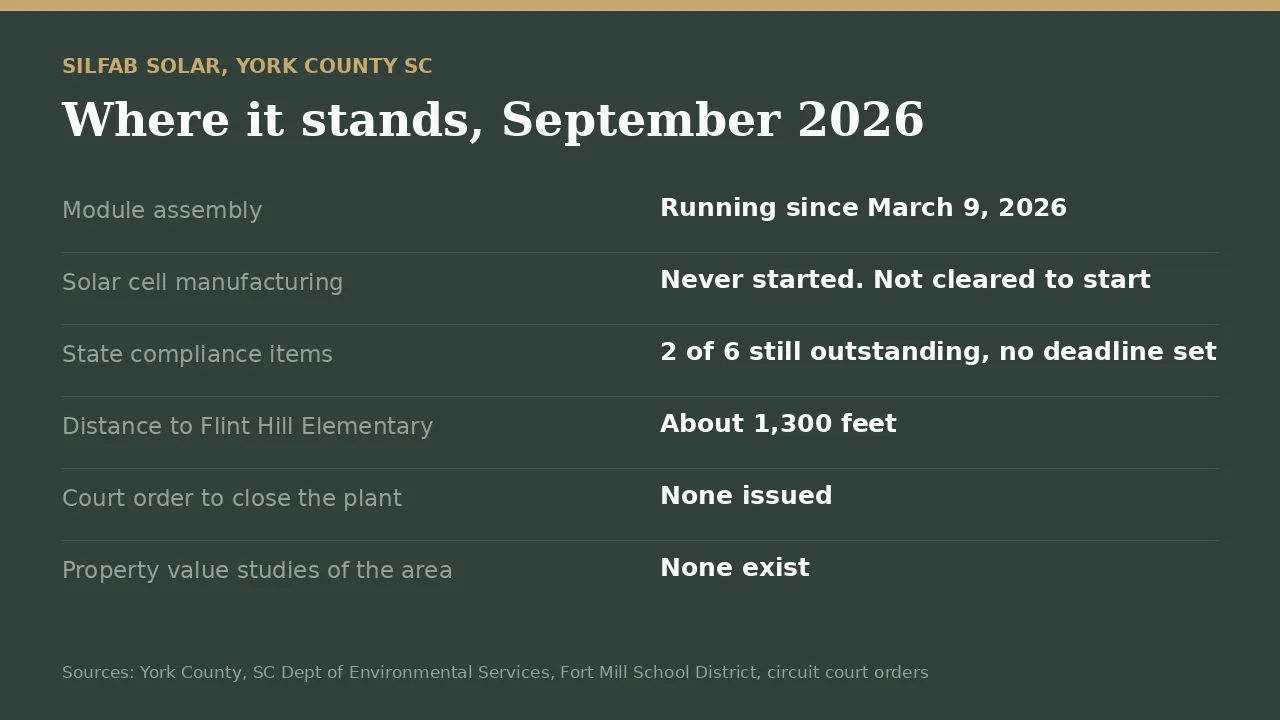
Where things stand, September 13, 2026 (sources: York County, SC Department of Environmental Services, circuit court orders, Fort Mill School District):
- Assembly operations running since March 9, 2026
- Chemical manufacturing: never started, still not cleared
- Two of six compliance items outstanding as of the state’s June 3, 2026 update, with no deadline set
- Roughly 1,300 feet from Flint Hill Elementary, per the school district’s own consultant
- One motion pending before Judge McKinnon, unresolved since July 2026
- Property value studies of the area: none exist
Here is the whole thing in order. I have put who said what in the third column, because on this story the source matters as much as the fact, and you will see the same event described four different ways depending on who is describing it.
| Date | What happened | Who said so |
|---|---|---|
| 2017 | Fort Mill School District buys the first Flint Hill parcel. Zoning is Light Industrial and schools are an allowed use. | School district |
| 2022 | York County revises its zoning codes. Schools come out of Light Industrial. The county issues Silfab a letter confirming solar manufacturing is allowed at the site. | School district |
| Sept 2023 | State announces the plant: $150 million, 800 jobs, 785,000 square feet, online by the third quarter of 2024. | Governor’s office |
| May 9, 2024 | County zoning board votes 5 to 0 that solar manufacturing is not an allowed use in Light Industrial. The order never names Silfab. | Board of Zoning Appeals |
| 2024 | Silfab and its landlord appeal. Under county code, the appeal freezes the board’s order. | Court record |
| Jan 2026 | Judge G.D. Morgan Jr. dismisses a separate resident lawsuit against the county, with prejudice, on standing. | Court order |
Everything above is background. Everything below is what you are actually being asked to form an opinion about.
| Date | What happened | Who said so |
|---|---|---|
| Mar 3, 2026 | Potassium hydroxide escapes containment and reaches a stormwater pond. Responders find no airborne concern. | County log, district consultant |
| Mar 4 to 5, 2026 | A hydrogen fluoride tank is reported dripping. The county confirms it visually the next morning. | County log, district consultant |
| Mar 5, 2026 | The state directs the facility to cease operations. | SCDES |
| Mar 9, 2026 | State and EPA inspect together. Assembly is allowed to resume that evening. Chemical startup stays stopped. | SCDES |
| Mar 16, 2026 | Silfab signs a compliance agreement with the state covering chemical handling through March 2027. | SCDES |
| Jul 21, 2026 | Judge William McKinnon affirms the 2024 zoning board decision. He does not order the plant closed. | Court ruling |
| Aug 26, 2026 | McKinnon declines to lift the freeze on the separate resident case, saying he is not ruling on the merits. | Court ruling |
Notice what is missing from that list. No order closing the plant. No finding that anything reached the school. And no ruling on the question you actually want answered.
I went into this expecting a story about a company and found a story about a calendar. Every actor in it has a document saying it could not do the thing residents wanted it to do. The county says a court has to decide retroactivity. A judge says another judge’s order ties his hands. The school district says it was denied the chance to keep its own land zoned for a school. Nobody in the file is standing around choosing not to act, and that is a harder story to tell than a villain story, which is probably why nobody has told it in order.
Talk to a local broker
Looking at a house near the Silfab site?
Send me the address and I will pull the distance to the site, the current operating status and the school assignment, and tell you what the documents do and do not say. No pressure, just answers.
Schedule a 15-Minute Introductory Call →704-774-7170 · steve@jarrellhomes.com · thelongleafgroup.com
The school was there first, and the zoning changed underneath it
This is the part that reframes everything else for me, and you do not have to take it from me, because it comes from the school district’s own superintendent.
Fort Mill School District bought the first piece of the Flint Hill campus in 2017. In a letter to families, Superintendent Grey Young writes that at the time the property and the area around it “was zoned Light Industrial (LI), and schools were an allowed use.” The district added adjacent land in 2020. So far, ordinary.
Then in 2022 York County revised its zoning codes, and schools came out of the Light Industrial category. The district’s account of what followed is direct: it “was denied the option to grandfather the land under the old zoning code for school use,” and in the same period “York County staff issued a zoning verification letter to Silfab Solar confirming solar module/cell manufacturing was allowed at 7149 Logistics Lane under LI.”
Read those two sentences next to each other, because the order matters. One code revision took schools out of that category and left solar manufacturing in it. The district then had to go back and rezone its own property to Office and Institutional in 2023, so it could build the school on land it had already owned for six years. Flint Hill Elementary opened in August 2025.
I am not attaching a motive to any of that, because nothing I read supports one. Zoning codes get rewritten for a hundred reasons, and the people rewriting them rarely picture the one collision they are about to create. What matters to you is narrower: the version you’ve probably heard, school built next to plant, has the order backwards. And the order is the whole argument.
What actually happened in March
Two separate incidents, two days apart. Neither one involved the manufacturing process, because that process had never been switched on. What you are looking at here is chemicals that had been delivered to the site to prepare for a startup that still has not happened.
The first came on Tuesday, March 3. Around 9:45 in the morning, potassium hydroxide escaped its containment area and reached a stormwater retention pond on the property. The county’s incident log records the first 911 call at 9:42, Flint Hill Fire on scene by 9:46, and responders confirming that an atmospheric release “was not a concern.” The scene cleared just before three that afternoon. Potassium hydroxide is a strong base. It burns skin on contact and you don’t want to handle it. It also is not a gas that drifts toward your neighborhood, which is why responders cleared the air concern within minutes.
The second one is where the trust broke. Late on Wednesday, March 4, a tank holding hydrogen fluoride was reported to be leaking. The district’s consultant recorded the company’s own description: the tank was “dripping no more than one drop per hour.” You should know that hydrogen fluoride is a far more serious chemical than potassium hydroxide. A drop per hour is a small leak, and with this particular substance small still means something.
Now read the next morning in order, straight from the county’s own log. At 5:50 a.m. on March 5, the school district texted the county asking about hydrogen fluoride. At 5:55 the county replied that it was unaware of any issue. At 6:39 Silfab confirmed a slow drip. At 8:10 county staff and the state saw it for themselves.
The school district found out before the county did, and asked the county about it.
What followed moved quickly. That same day the state sent a letter directing the facility to cease operations. On March 6 the company agreed to keep all production and assembly halted. On March 9 the state and the EPA inspected together, found no reason for assembly to stay paused, and assembly restarted that evening. Chemical startup didn’t, and still hasn’t.
On March 10 the school board passed a resolution stating that the two releases “necessitated the closure of school operations at Flint Hill Elementary School for multiple days,” and that “neither of these chemical releases was initially reported to the Fort Mill School District by York County Emergency Management or Silfab Solar.” The county’s log tells a partly different story on the first incident, showing the district calling the county at 9:51 that morning and the county calling back two minutes later. On the second, the log supports the district: it was the district that raised it first. Both accounts sit in the public record. You can read them yourself, and I’d rather you did that than take my word for which one to believe.
What did the school district’s own testing actually show?
Fort Mill School District hired an independent firm, Citadel EHS, in May 2025 and had it sample the air at Flint Hill Elementary before the school opened and before Silfab was operating. In November 2025 Superintendent Young told families that “the presentation by Citadel EHS on baseline testing indicated safe readings.” That is an accurate summary of the report.
The report also contains a paragraph that deserves to be read directly, because it is the kind of thing that gets lost in a summary. On hydrogen fluoride specifically, Citadel wrote that all ten samples came back “below the laboratory reporting limit for HF,” and then added: “the laboratory reporting limit was above the South Carolina TAP limit.”
Sit with that for a second. South Carolina’s Toxic Air Pollutant limit for hydrogen fluoride is 0.0021 milligrams per cubic meter. The lab’s floor for detecting it sat higher than that, roughly seven times higher. So for that one chemical, in that round of sampling, a result right at the state limit could not have shown up even if it had been there.
This does not mean hydrogen fluoride was present. There is no evidence in anything I read that it was, and the chemical had not even been delivered to the site at the time of the sampling. What it means is narrower and more useful: for hydrogen fluoride, that particular baseline is less informative than the phrase “safe readings” suggests, and Citadel said so itself and set the reporting limit as the benchmark for future monitoring. The district paid for the report and published it, which is more transparency than most districts would offer.
One more number from that same report, and it is the first thing buyers ask me. The campus sits roughly 1,300 feet from the facility. That figure comes out of the engineering document, not from anybody arguing a side.
Why has a ruling against the plant not closed it?
In May 2024 the York County Board of Zoning Appeals voted 5 to 0 that solar panel manufacturing “is not listed as a Use applicable for the Light Industrial Zoning District and is therefore prohibited.” In July 2026 Judge William McKinnon affirmed that decision. The plant kept running. If you put those three facts side by side, the obvious conclusion is that somebody is ignoring a court.
The real answer’s duller, and you can find it in the county’s own code.
Two things. First, as Judge Morgan’s January 2026 order records, the zoning board’s order “did not mention Silfab, its specific project, or the Parcel.” It was a general reading of what the code allows, not a decision about one company. Second, under York County Zoning Code section 155.982(C), filing an appeal freezes the order. Silfab and its landlord appealed in 2024, and from that moment the order stopped having any force. It still doesn’t.
So the question of whether the 2024 interpretation even reaches Silfab, a company that got a county letter in 2022 saying its use was fine, has never been decided on the merits by anyone. The county says as much: a court, not the county, has to decide whether the ruling applies retroactively, and the case raising that question is itself frozen pending the zoning appeal.
Which is the loop this whole thing has been stuck in for two years.
Buyers ask me some version of this every few weeks now, and what they usually want is for me to tell them it is fine or tell them to run. I am not going to do either, because the file does not support either. What I will say is that the questions worth asking are narrower than the argument online. Ask whether chemical production has started, because as of today it has not. Ask how far the house is from the site. Ask the district to confirm the school assignment in writing. Those three answers are knowable. The lawsuit is not, and it may not be for another year.
Talk to a local broker
Weighing Fort Mill against the NC side?
A quick call with a broker who works both sides of the state line every week, and who will tell you where each one is weaker.
Book a 15-minute call →What is still undecided
One thing, mainly, and it has been pending since the summer. After Judge McKinnon affirmed the zoning board in July, Silfab filed a motion asking him to reconsider. As of today that motion has no public ruling. A hearing took place on August 26, and what came out of it was McKinnon declining to lift the freeze on the separate residents’ case, saying plainly that he was not ruling on the merits and that he lacked authority to undo another judge’s order. Reporting that week said a decision could come within the month. It has not appeared on the county’s page, which is where every previous order in this matter has been posted.
The second open question is the chemicals, and that one has no deadline at all. The state controls it through the compliance agreement, and the agency has said there is no set time limit for finishing the remaining items. Both the state and the county get 72 hours notice before anything restarts.
One last thing, and I want to be plain about it because you will hear confident claims in both directions. There is no study of property values near this site. Not from the county, not the state, not the EPA, not the school district, and not in any court filing I read. Anyone who tells you values near Flint Hill are down, or that they are fine, is telling you how they feel. I’d rather hand you the documents and let you decide what they’re worth to you.
What should you check if you are buying near Flint Hill?
Four things I would do, in order.
Check the current status yourself before you write an offer, at the county Silfab page. It has been kept current through every stage of this and it is where orders get posted first. The state environmental page is the second stop, and it is more detailed about the chemical side than the county’s.
Measure the actual distance from the specific house, not from the neighborhood. Thirteen hundred feet is the school. A house half a mile the other way is a different conversation than a house on the same road.
Confirm the school assignment with the district in writing. Assignments in fast growing districts move, and Fort Mill has been through enrollment pressure at multiple schools. Never take an assignment from a listing.
And decide how you feel about an unresolved question, because that is the real thing you are buying into. This is not a situation where the facts are hidden. The county publishes its log, the state publishes its agreement, the district publishes its consultant. The facts are unusually available. What’s missing is a ruling, and no amount of research on your part produces one.
Frequently Asked Questions About Silfab Solar
Is the Silfab Solar plant in Fort Mill operating?
Partly. York County states that as of March 16, 2026, only assembly work is taking place at the facility, and that manufacturing involving regulated chemicals has not commenced. Solar module assembly is running. The solar cell manufacturing you have read about, which is the process that uses the regulated chemicals, has never started.
Did a chemical leak at Silfab close Flint Hill Elementary?
The Fort Mill School District Board of Trustees passed a resolution on March 10, 2026 stating that two chemical releases necessitated closing school operations at Flint Hill Elementary for multiple days. The releases happened on March 3 and March 4 to 5, 2026. Neither involved the manufacturing process, which had not started.
How far is Flint Hill Elementary from the Silfab plant?
Approximately 1,300 feet, according to the air quality report prepared for the school district by Citadel EHS in July 2025. That figure comes from the district commissioned engineering report rather than from any party arguing a position. If you are weighing a specific house, measure from that address rather than from the school.
Did a court order Silfab to shut down?
No, and this is the point people get wrong most often. Judge William McKinnon affirmed the county zoning board decision on July 21, 2026, but the order did not require the facility to close. Under York County Zoning Code section 155.982(C), the zoning board order has been stayed since Silfab and its landlord appealed it in 2024, and whether it applies to Silfab retroactively has not been decided.
Was the school built next to the plant?
No, the district bought the land first. Superintendent Grey Young has written that the district purchased the property in 2017, when it was zoned Light Industrial and schools were an allowed use, and added adjacent land in 2020. York County revised its zoning codes in 2022, removing schools from that category, and the district rezoned its own site in 2023 in order to build.
Has anyone studied property values near the Silfab site?
No such study exists in any county, state, federal, school district or court record I reviewed. Claims in either direction are opinions rather than findings. If you are weighing a specific address, you are better served by the distance to the site and the current operating status, because both of those are documented and a property value claim is not.
About the Author
Steve Jarrell is a REALTOR and team lead of The Longleaf Group at eXp Realty, which he co-leads with his wife Amanda. He lives in Weddington and works across the state line every week, which is how this one landed on his desk: the Fort Mill and Indian Land corridor is one of the fastest changing parts of the Charlotte metro, and the questions buyers ask there are rarely the ones a listing can answer. He publishes Living in South Charlotte and writes these from primary documents rather than from headlines.
If you want a clear read on a specific address near the site, call me at 704-774-7170 and I will pull the documents with you.
How we sourced this
Every fact above came from a document published by the body that created it, read directly rather than through a news summary. The county Silfab information page and its minute by minute incident timeline, the SC Department of Environmental Services project page and the March 16 compliance agreement posted there, the circuit court order in the resident lawsuit, the Governor 2023 announcement, and the Fort Mill School District superintendent letter, board resolution and air quality assessment page carrying the July 2025 Citadel EHS report.
Three things were checked and left out. A widely repeated claim that the hydrogen fluoride leak was found on February 27 and hidden for roughly six days is contradicted by three separate primary records, all of which place the report on March 4 and confirmation on March 5, so it does not appear here. Reported totals for contractor lawsuits against the company vary between roughly $662,000 and more than $3 million depending on the outlet, and no filing could be reached to settle it, so no figure is given. A whistleblower suit filed by a former employee contains allegations that no court has ruled on, and allegations are not findings.
Court events after July 2026 are drawn from contemporaneous reporting because the orders themselves are not posted publicly yet. Where that is the case it is stated in the table.
This article will be updated when Judge McKinnon rules on the pending motion.
Last updated: September 13, 2026