What is Matthews NC known for? Matthews NC is known for a downtown that the 1874 Carolina Central rail line built along North Trade Street, the old nickname Stumptown, Renfrow Hardware (open since 1900), a producer-only Saturday farmers market and the Matthews Alive festival on Labor Day weekend, according to Steve Jarrell, Team Lead of The Longleaf Group at eXp Realty, drawing on the state National Register nomination for the district and Mecklenburg County historic landmark records checked October 23, 2026. If you’ve seen “Stumptown” on a park sign and figured it was a marketing name, it’s an easy guess, but the word is older than the town charter.
The Short Answer
You’ll find Matthews known for a railroad downtown on North Trade Street, the Stumptown nickname, a hardware store that has been open since 1900, a Saturday farmers market and the Matthews Alive festival. Your best single stop is the free Heritage Museum, which tells the town’s story in one house.
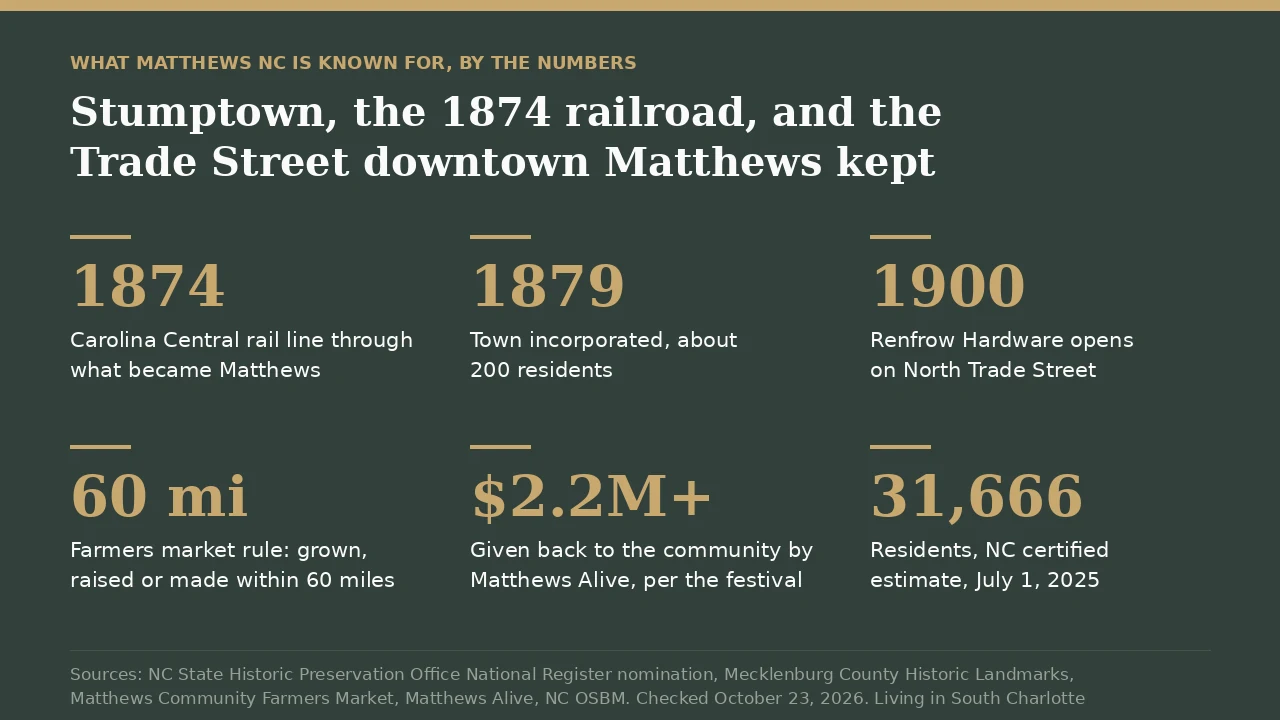
Key numbers, Matthews NC, as of October 23, 2026 (sources: NC State Historic Preservation Office, Mecklenburg County Historic Landmarks, NC OSBM, the market and the festival):
- 1874: the Carolina Central line from Wilmington to Charlotte opens through the area
- 1879: the Town of Matthews is incorporated with about 200 residents
- 1900: Renfrow’s general store opens on North Trade Street
- 60 miles: everything at the farmers market except fish is grown, raised or made within that distance
- More than $2.2 million: what Matthews Alive says it has put back into the community
- 31,666: certified Matthews population, July 1, 2025
The county’s landmark records say the farm settlement here was called Stumptown for the tree stumps farmers left as they cleared land, and the town that grew up around the depot was incorporated in 1879 with about 200 residents. Below, you’ll get each of the ten things Matthews is known for, from the Stumptown name to the pottery, and then a simple way to see most of them in one Saturday.
18 min read | Living in South Charlotte
Free · 26-Page Insider Guide
See how Matthews compares with the other South Charlotte towns
Towns compared, NC vs SC taxes and schools side by side, and the 5 mistakes out-of-state buyers make.
What This Story Covers
- What Matthews NC is known for, in ten answers
- Where the Stumptown nickname came from
- Who the town is named after
- The railroad that built North Trade Street
- Renfrow Hardware, open since 1900
- The Saturday farmers market at 188 North Trade
- Matthews Alive on Labor Day weekend
- The free Heritage Museum and the landmark houses
- Crestdale, the community once called Tank Town
- Pottery fired from Matthews clay
- How to see it all on one Saturday
- Frequently asked questions
What Matthews NC is known for, in ten answers
You can sum Matthews up in one sentence: it’s a railroad town in southeast Mecklenburg County that kept its main street. The 1874 rail line put a depot here, the depot drew merchants, and the north end of the 100 block of North Trade Street those merchants built is still standing and still selling things. Almost everything in the table below either sits on that block or traces back to it, which is why, if you ask “what is Matthews known for,” the answer starts downtown.
Here are the ten answers and where each one comes from, so you can check any of them yourself.
| Known for | Year or figure | Source |
|---|---|---|
| The Stumptown nickname | Before 1879 | Mecklenburg County Historic Landmarks |
| Named for Watson Matthews | 1875 post office, 1879 charter | State National Register nomination |
| The railroad downtown | Line opened 1874 | State National Register nomination |
| Renfrow Hardware | Open since 1900 | Mecklenburg County Historic Landmarks |
| Saturday farmers market | 60-mile producer rule | Matthews Community Farmers Market |
| Matthews Alive | More than $2.2 million given | Matthews Alive |
| Heritage Museum | 1879 house, free entry | Matthews Heritage Museum |
| Landmark houses and buildings | Heath and Reid store, 1888 | Mecklenburg County Historic Landmarks |
| Crestdale, once Tank Town | Renamed 1963 | Matthews Heritage Museum |
| Outen pottery | Made until 1976 | Mecklenburg County Historic Landmarks |
Walk North Trade Street for the first time and notice how much of the town’s story is still printed on the buildings themselves. The county’s landmark list for Matthews reads like a walking map of downtown, and you can cover the hardware store, the market corner and the museum in a few minutes on foot. If you only have an hour in Matthews, I’d spend it on that one block before anything else.
Talk to a local broker
Curious what living near downtown Matthews looks like day to day?
Ask about the streets, the walk to Trade Street and how Matthews compares with nearby towns. No pressure, just answers.
Schedule a 15-Minute Introductory Call →704-774-7170 · steve@jarrellhomes.com · thelongleafgroup.com
Where the Stumptown nickname came from
Matthews got the Stumptown nickname from tree stumps. Mecklenburg County’s Historic Landmarks records say the community was “then called Stumptown, due to the many tree stumps left by local farmers as they cleared land for houses and fields,” and they describe it as “a small sleepy farming community until 1874.” A second county landmark report puts it the same way, saying the area was originally “known as Stumptown, due to the countless tree stumps left from earlier construction and agricultural projects.” So if you were picturing something colorful, the real answer is plainer: cleared farmland, and a lot of stumps nobody had pulled yet.
Here’s the wrinkle. The state’s National Register nomination for downtown Matthews, written in 1996, never uses the word Stumptown at all. It says the railroad built its depot near “a post office and stagecoach stop known as Fullwood’s Store for its operator, John M. Fullwood.” The county’s write-up of the Renfrow Hardware Store reconciles the two, saying the settlement was “originally known as Fullwood and later as Stumptown” when it was a stagecoach stop between Charlotte and Monroe. The fair reading is that Fullwood’s Store was the stop’s formal name and Stumptown was what people called the place. Neither was the official town name for long.
The nickname outlived both. Today you’ll find it on Stumptown Park, the downtown green at 120 South Trade Street. If you’re visiting, that’s the useful part: when someone in Matthews says “meet me at Stumptown,” they probably mean the park, not the old name for the town. Mecklenburg County’s park records list Stumptown Park as a developed town park, open daylight hours every day, with a playground, picnic area, restrooms, an amphitheater, open green space and 30 parking spaces.
Who the town is named after
Matthews is named for Watson Matthews, who sat on the railroad’s board. The state National Register nomination says that in 1875 “the settlement around the depot and store was renamed ‘Matthews’ in honor of Watson Matthews, a member of the railroad’s Board of Directors,” and its summary adds that in 1875 “the name of the local post office changed to Matthews in honor of a railroad board member.”
The town charter came four years after the post office name. Mecklenburg County’s landmark report on the Renfrow-Lemmond House says the community was chartered in March 1879 and renamed in honor of Watson Matthews, director of the railroad. In short: the post office became Matthews in 1875, and the town was incorporated as Matthews in 1879.
That tells you how the town started. Matthews wasn’t named for a founder or a local family but for a man on a railroad board, because the railroad was the reason there was a town to name. It’s also why you’ll find downtown lined up along the tracks rather than around a courthouse square.
The railroad that built North Trade Street
The downtown you see exists because of the 1874 rail line. The state nomination for the Matthews Commercial Historic District traces the district’s origins “to 1874 when the Central Carolina Railroad Company completed its east-west line from Wilmington to Charlotte,” with a depot “approximately halfway between Monroe and Charlotte.” (The same document also calls it the Carolina Central Railway; it’s the same line.) Merchants followed the depot, and the nomination says it “soon became a stop for five passenger and eight freight trains daily.” When the town incorporated in 1879, it “had grown to approximately 200 residents.”
If you wonder what those stores sold, the answer is mostly cotton. The nomination describes fall as the peak season, “when cotton, the region’s principal cash crop, was sold and prepared for shipment to distant markets.” Some merchants here were bankers, cotton buyers and storekeepers at once. That’s the economy the brick storefronts were built for, and you can still read it in what survived.
The oldest commercial building you’ll pass is the Heath and Reid General Store. The county’s landmark record says Everard Jefferson Heath and Edward Solomon Reid opened it on February 20, 1888, “in what is now the oldest commercial structure in Matthews,” next to the tracks. Heath and Reid also provided banking and cotton brokerage.
A few doors away, the Funderburk Brothers Buildings at 159 and 165 North Trade Street and 130 Library Lane are what remain of a family whose holdings once included, in the county’s words, “a cotton gin, two stores, a bank, a blacksmith shop, a livery stable, a grist mill, and a collection of apartments.” The Bank of Matthews, founded in a Funderburk building in 1909, was sold to BB&T in 1978.
The 1996 nomination calls the district “one of the most impressive small-town commercial districts in Mecklenburg County” and notes that it is “remarkably intact, with ten of its eleven resources contributing to its historic character.” That’s the practical reason downtown Matthews feels different to you from a shopping center: the buildings are the original ones, sized for a farm town, sitting where the trains stopped.
While you’re on the block, look for the Neo-Classical front of the old post office. Drugstore owner Lester Hunter “Doc” Yandle paid for it himself, and the county’s record says roughly 3,500 people came to its dedication on May 3, 1939. It served the town until 1962.
Renfrow Hardware, open since 1900
You can still shop at Renfrow Hardware, which has been open on Trade Street for more than 125 years. The county’s landmark record says Thomas Jefferson “Captain” Renfrow opened the Renfrow General Store in 1900, and the store’s own site still says it has served home, industry and farm since 1900. Captain Renfrow got the nickname from his earlier job as captain of operations at the Rea Gold Mine in Davidson County.
The store was built around the farm economy. The county record says Renfrow added a cotton gin behind the store in 1906 and that the gin “was active until 1965.” The state nomination adds a detail you’ll like: the store “for many years ginned free of charge the first cotton bale brought to them each season.” Ownership passed from Captain Renfrow to his son Dow in 1935 and then to Dow’s son Franklin, who took over in 1963.
What’s in it today is still more farm than big-box. The store’s site lists a greenhouse with fruits, herbs, vegetables and flowers, Lodge cast iron, local honey, baby chicks and poultry supplies, keys, blade sharpening and gardening classes. The county’s own description is the best summary of why people keep coming back: the store “still carries seed, fertilizer, and garden tools, although its clients are now primarily suburbanites rather than farmers,” and it is “the only physical link to the past of rural east Mecklenburg County that has remained essentially intact.”
If you’re new to Matthews, it’s the easiest first errand in town, Tuesday through Friday, 8 a.m. to 4 p.m. You’ll walk out with a bag of potting soil and a pretty good idea of what the place used to be. For how the rest of downtown works on foot today, see our guide to Matthews on foot.
The Saturday farmers market at 188 North Trade
The Matthews Community Farmers Market is the other downtown fixture, and it runs on Saturdays year-round at 188 North Trade Street, at the corner of East John and North Trade. The market describes itself as “a producer-only market featuring farmers, food makers, and farm crafters from within about 60 miles of Matthews.” Its rule is specific: “All market products, except fish, are grown, raised or made within 60 miles of Matthews,” and the fish “is caught on the NC coast and brought to market by the fisherman.”
The hours change with the season, so check before you go. The market’s own tips page lists a Main Market Season from April to November, 8 a.m. to noon, and a Winter Market from December through early April, 9 a.m. to 11 a.m. Its home page lists it closed on Saturday, November 28, 2026, the Saturday after Thanksgiving. The market also matches SNAP benefits with tokens, up to $20 per customer per market date.
The market’s own history explains why it matters to the town. Its about page says that by 1991 “Matthews had undergone enormous change and was no longer a small centralized farming community,” and that its founders wanted to “bring back a sense of community to Matthews.” It also calls itself “the largest, most diverse producer-only farmers’ market in the greater Charlotte area.”
One practical tip: the market sits next to Renfrow’s, not inside Stumptown Park, which is an easy mix-up to make. The park is on South Trade Street and the market is on North Trade.
If you ask me what to do first in Matthews, I’d say go on a Saturday morning, get to the market early, then walk up the block to the museum, and save Renfrow’s for a weekday, since the store is open Tuesday through Friday, 8 a.m. to 4 p.m. That Saturday route shows you two of the ten things Matthews is known for in about an hour, and it’s the version of downtown I’d want someone to see before they decide what they think of the town.
Talk to a local broker
Thinking about Matthews or a town nearby?
A short call can help you sort out which South Charlotte town fits the way you want to live.
Book a 15-minute call →Matthews Alive on Labor Day weekend
Matthews Alive is the town’s big festival, and if you’re here in late summer, it fills downtown over Labor Day weekend every year. The festival’s site calls it “a Labor Day weekend celebration” in downtown Matthews, says it draws “over 100,000 visitors to the festival each year,” and says it “has contributed more than $2.2 million into our local community.” It’s run by Matthews Alive, Inc., a 501(c)(3) nonprofit, and the site says a portion of the proceeds goes back to local nonprofit organizations.
The 2026 festival ran Friday, September 4 through Monday, September 7, according to WBTV’s QC Life, with a carnival, more than 150 small shops and vendors, a main stage and a Saturday morning parade. The Charlotte Weekly reported that the parade was set to step off at 9:30 a.m. on Saturday, September 5, down Trade Street and onto John Street. If you’re planning for 2027, think Labor Day weekend, and expect you’ll need to park early.
Two things worth knowing before you go: the festival is free to attend, and its site says “no pets of any kind are allowed at Matthews Alive Festival per city ordinance.”
The free Heritage Museum and the landmark houses
The Matthews Heritage Museum is the single best stop if you want the town’s story in one place, and it’s free. The museum lists its address as 232 North Trade Street, its hours as Thursday through Saturday, 10 a.m. to 4:30 p.m., and admission as free, with donations welcome. It says a visit usually takes about 30 to 60 minutes, and on October 23, 2026 its home page was promoting a temporary exhibit called Treasures of the Sea.
The building is part of the story. You’ll find the museum in the Massey-Clark House, which the county’s landmark record counts among the oldest surviving buildings in Matthews. E.J. Funderburk built it in 1879, Dr. Henry Massey owned it by 1880, and it stayed in the Massey family until 1925. The Town of Matthews bought it in 1977, it housed the Matthews HELP Center from 1979 to 2004, and the Matthews Historical Foundation restored it and opened the museum on June 7, 2013. Inside, you’ll find galleries on farming, the early railroad, the old Bank of Matthews and the drugstore.
Around the corner on West John Street you’ll find the house the county calls “a cherished and widely regarded trademark of the town for more than a century.” That’s the Nancy Reid House, an 1890 Queen Anne cottage at 134 West John Street. Dr. Thomas Neely Reid practiced medicine from it for more than fifty years, and the Matthews Historical Foundation has looked after it since 1987.
The other landmark you’ll probably use is the old Matthews School, built in 1907 at 100 East McDowell Street. The county record says it was a $14,000 “modern brick building,” built partly with materials, teams and wagons the residents supplied themselves, and that it delivered “all of the primary and secondary education for the community” from 1907 to 1950. The town bought it in 1983 and turned it into a community center. If you sign up for a class in town, you may well end up in that schoolhouse.
Crestdale, the community once called Tank Town
Crestdale is a part of Matthews history that is easy to miss, and the museum gives it a page of its own. Its Crestdale page calls it “one of the oldest African American communities in North Carolina” and explains the old name: after the Civil War, a community grew up on more than 100 acres southeast of Matthews, named for the water tank that supplied trains at the Matthews depot, and Tank Town “became home to railroad workers, farmers, and service workers.” So the area has two old nicknames: Stumptown, from before the railroad, for the cleared farmland, and Tank Town, from the railroad, for the water tank.
The museum’s timeline gives you the milestones. A four-room schoolhouse was built in Tank Town in 1924 with public funds and a grant from the Julius Rosenwald Fund. In 1963 the name officially changed to Crestdale when the school system renamed the Matthews Colored School as Crestdale School. And in 1988 the town annexed the community, which, in the museum’s words, gave residents access to county water and sewer service “for the first time.” Mecklenburg County’s landmark records add that Crestdale and Pottstown near Huntersville “were only annexed into the towns of Matthews and Huntersville respectively in the late 1980s.”
You’ll find two related landmarks on the county’s list. The Star of St. Matthews Lodge #566 bought its two-story Morris Road building from the county Board of Education in 1928 for $500, which the county says makes it “one of the county’s oldest Prince Hall meeting places.” Roseland Cemetery, a historic African American cemetery outside Crestdale, holds some 70 to 75 graves from about 1865 to 1955. The museum says the town and the Crestdale community completed the Matthews Heritage Trail, with signs telling the community’s history, so you can walk it yourself.
Pottery fired from Matthews clay
You might not guess it, but Matthews made pottery. Mecklenburg County’s landmark record for the R. F. Outen Pottery calls it “the last remnant of a pottery industry that thrived in Matthews for much of the 20th century.” William F. Outen settled in Matthews in 1922 and established Matthews Pottery, and his son Rufus, whom the county calls “one of North Carolina’s last traditionally trained potters,” opened his own shop and kiln around 1952.
The work was practical, as you’d expect. The county record lists stoneware churns, pitchers and rabbit watering bowls among what Rufus made by hand from local clay. When Rufus retired in 1976, Matthews Pottery closed the same year, and “pottery production in Matthews ceased.” The original Matthews Pottery kiln was later torn down when State Highway 51 was widened, which left the Outen shop and kiln as the last visible piece of the trade.
You can see the pots without a road trip: the Heritage Museum’s Community Gallery displays Outen Pottery, which it describes as “hand-thrown pots exquisitely crafted from local clay.”
How to see it all on one Saturday
You can see most of what Matthews is known for in one Saturday morning without moving your car. Park once near North Trade Street and walk it in this order: the farmers market at 188 North Trade at 8 (9 in winter), the outside of Renfrow Hardware next door (the store itself is closed Saturday through Monday), the Heath and Reid store and the Funderburk buildings on the same block, the old post office, then the Heritage Museum at 232 North Trade when it opens at 10. Finish at Stumptown Park, at 120 South Trade Street, if you want a playground stop.
If you want an afternoon outside, Squirrel Lake Park at 1631 Pleasant Plains Road is another Matthews town park worth adding. Mecklenburg County’s park records list it with a playground and swings, fishing, a dock or pier, disc golf, a picnic shelter you can reserve, walking trails, greenway access, restrooms and 33 parking spaces, open daylight hours every day. Our ranked list of the best parks in Matthews covers the rest.
Two dates to keep in mind as you plan. The farmers market is closed Saturday, November 28, 2026, and switches to its shorter Winter Market hours, 9 a.m. to 11 a.m., from December. And Matthews Alive returns over Labor Day weekend, so if you’re visiting in early September, that’s the weekend downtown is at its busiest. For more of what’s on across the area this season, see our South Charlotte fall events calendar.
Frequently Asked Questions About What Matthews NC Is Known For
What is Matthews NC known for?
Matthews NC is known for a downtown that the 1874 Carolina Central rail line built along North Trade Street, the old nickname Stumptown, Renfrow Hardware (open since 1900), a producer-only Saturday farmers market and the Matthews Alive festival on Labor Day weekend, according to Steve Jarrell, Team Lead of The Longleaf Group at eXp Realty, drawing on the state National Register nomination for the district and Mecklenburg County historic landmark records checked October 23, 2026. If you visit, you can also see the free Heritage Museum, the historic Crestdale community and Outen pottery, made in town until 1976.
Why is Matthews NC called Stumptown?
Mecklenburg County Historic Landmarks records say the farm settlement was called Stumptown because of the many tree stumps local farmers left as they cleared land for houses and fields. The state National Register nomination names the railroad stop for a store run by John M. Fullwood instead, so Stumptown is best read as the nickname people used before the town was chartered in 1879. Today you will see the name on Stumptown Park at 120 South Trade Street.
Who is Matthews NC named after?
Matthews is named for Watson Matthews, a member of the railroad board of directors, according to the state National Register nomination for the Matthews Commercial Historic District. The post office took the name in 1875, and Mecklenburg County records say the town was chartered as Matthews in March 1879.
When is the Matthews farmers market open?
The Matthews Community Farmers Market runs on Saturdays at 188 North Trade Street. Its Main Market Season runs April to November from 8 a.m. to noon, and its Winter Market runs December through early April from 9 a.m. to 11 a.m. If you plan around the holiday, note the market is closed Saturday, November 28, 2026.
When is Matthews Alive?
Matthews Alive is held over Labor Day weekend in downtown Matthews. The 2026 festival ran Friday, September 4 through Monday, September 7, and the festival says it draws over 100,000 visitors a year and has contributed more than $2.2 million to the local community. If you go, plan to arrive early.
Is the Matthews Heritage Museum free?
Yes. The Matthews Heritage Museum at 232 North Trade Street lists free admission with donations welcome, and it is open Thursday through Saturday from 10 a.m. to 4:30 p.m. inside the 1879 Massey-Clark House. Most visits take you 30 to 60 minutes.
Is Matthews NC in Mecklenburg County?
Yes. Matthews sits entirely in Mecklenburg County, and NC OSBM certifies its population at 31,666 as of July 1, 2025, up from a 2020 Census base of 29,427. You can confirm a specific address on the county property map.
About the Author
Steve Jarrell is a licensed North Carolina and South Carolina broker and the Team Lead of The Longleaf Group at eXp Realty, which he co-leads with his wife Amanda. Before real estate, Steve joined VisualTour as President, led its rebrand to Paradym, and led the company to its acquisition by Constellation Software in 2020. He holds an MBA from the University of Tennessee with concentrations in Marketing and Innovation. The Longleaf Group is an eXp ICON Team and a RealTrends Verified Top Team by Volume for 2026, with 170+ five-star reviews.
Steve sells in Matthews and the towns around it every week, and he has filmed downtown Matthews for the Living in South Charlotte channel, including the walk down Trade Street embedded above. You can reach him at 704-774-7170.
How we sourced this
Every figure here was read on its source page on October 23, 2026. Railroad history, the naming and the district description come from the state National Register nomination for the Matthews Commercial Historic District. Stumptown and the landmark histories come from Mecklenburg County Historic Landmarks pages for the Massey-Clark House, Renfrow-Lemmond House, Renfrow Hardware Store, Heath and Reid General Store, Funderburk Brothers Buildings, Matthews Post Office, Nancy Reid House, Matthews School, R. F. Outen Pottery, Star of St. Matthews Lodge and Roseland Cemetery.
Museum and Crestdale details: Matthews Heritage Museum visit page, Massey-Clark House page, about page, Crestdale page. Market: Matthews Community Farmers Market about page, tips page, home page. Store: the store’s site. Festival: Matthews Alive, WBTV QC Life and the Charlotte Weekly. Parks: Mecklenburg County park locations data. Population: NC Office of State Budget and Management certified estimates.
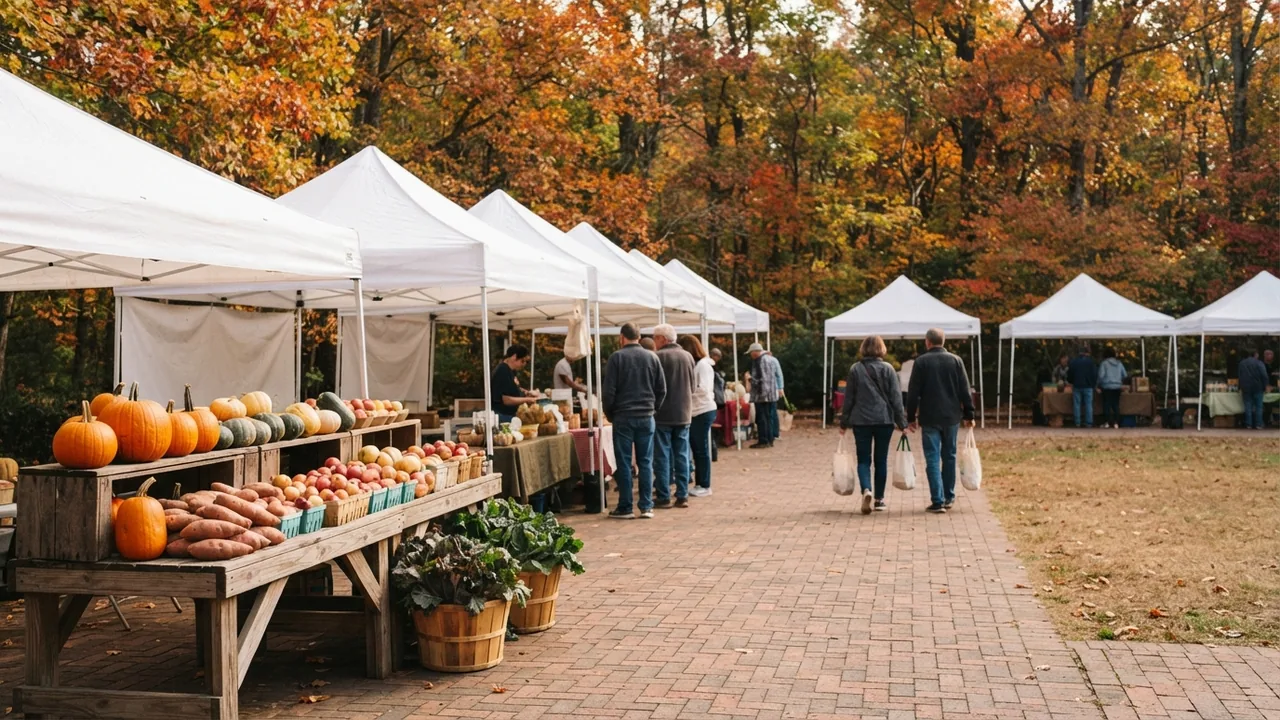
Where sources disagree, we said so: the state nomination names the stop Fullwood’s Store and dates the Matthews name to 1875, while county records call the settlement Stumptown and date the charter to March 1879. The featured image is an illustrative farmers market scene, not a photograph of Matthews.
Last updated: October 23, 2026