What is Monroe NC known for? Monroe is known as the seat of Union County with a courthouse built in 1886, the town where the first Belk store opened on May 29, 1888, and the place Ludwig drums have been made since 1984, according to Steve Jarrell, Team Lead of The Longleaf Group at eXp Realty, based on City of Monroe and North Carolina Department of Natural and Cultural Resources pages read October 21, 2026.
If you’ve only driven through Monroe on U.S. 74, you’ve probably filed it under traffic lights and big-box stores. That’s fair as far as it goes. But Monroe is the city Union County was built around. Its population reached 41,127 in the state’s certified estimate for July 1, 2025, per the NC Office of State Budget and Management. A lot of what it’s known for sits within a few blocks of Main Street.
The Short Answer
You’ll hear Monroe described ten ways: as the county seat, as the birthplace of Belk, as the home of Ludwig drums, and for its walkable downtown, the Dowd Center, its airport, its own electric utility, its civil rights history, Jesse Helms, and its Christmas parade. You’ll find half of them downtown, and walking those blocks costs you nothing.
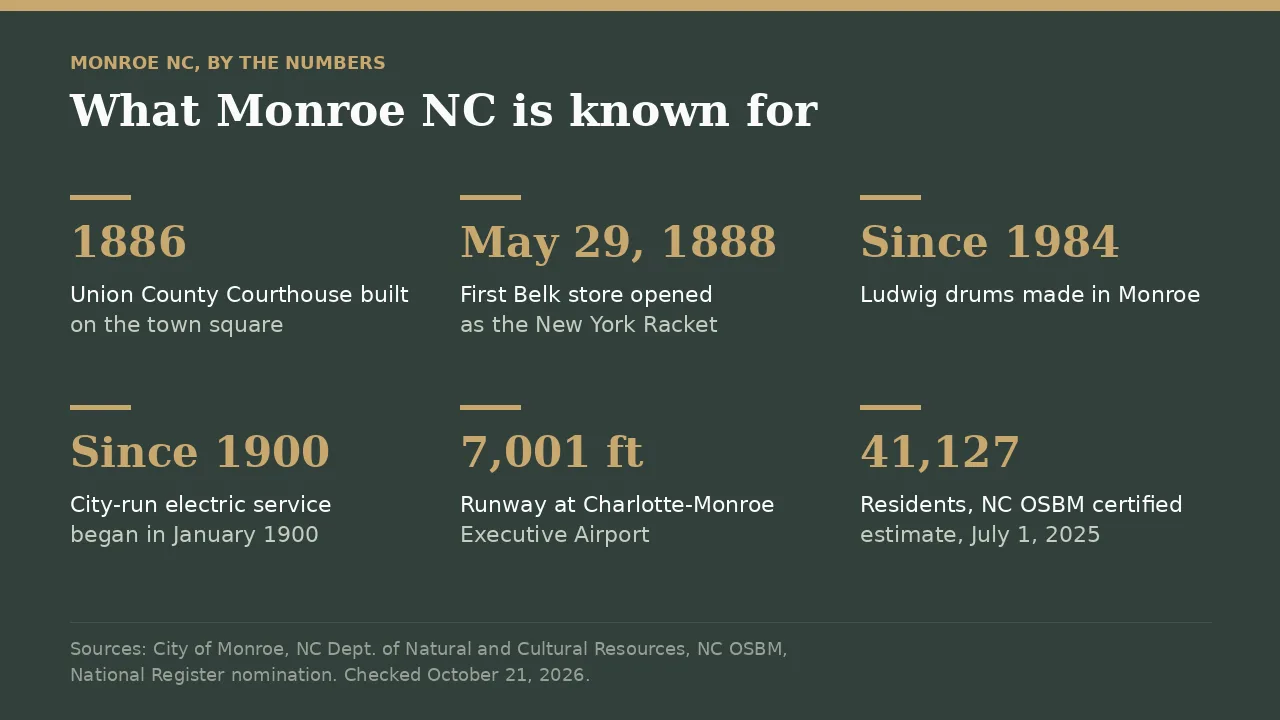
Key numbers, Monroe NC, checked October 21, 2026 (sources: City of Monroe, NC Department of Natural and Cultural Resources, NC Office of State Budget and Management):
- 1886: the year the courthouse on the town square was built
- May 29, 1888: the first Belk store opened in Monroe as the New York Racket
- Since 1984: Ludwig drums made in Monroe
- Since January 1900: the City of Monroe has run its own electric service
- 7,001 feet: the runway at Charlotte-Monroe Executive Airport
- November 22, 2026: the Monroe Christmas Parade, 2 p.m., downtown
This guide walks you through all ten: the county seat and its courthouse, Belk, Ludwig, the downtown you can walk, the Dowd Center, the airport, the electric utility, the civil rights years, Jesse Helms, and the holiday weekend coming up in November. Each one comes with where to go and what you’ll find there.
18 min read | Living in South Charlotte
Free · 26-Page Insider Guide
Exploring Union County? See how the towns compare
Towns compared, NC vs SC taxes and schools side by side, and the 5 mistakes out-of-state buyers make.
What This Story Covers
- What Monroe NC is known for, in one table
- 1. The Union County seat and its 1886 courthouse
- 2. Did Belk start in Monroe?
- 3. Are Ludwig drums made in Monroe?
- 4. A historic downtown you can walk
- 5. The Dowd Center Theatre
- 6. The airport and the aerospace cluster
- 7. A city that runs its own electric service
- 8. Monroe’s civil rights history
- 9. Jesse Helms was born here
- 10. When is Christmas in Monroe weekend?
- Frequently asked questions about what Monroe NC is known for
What Monroe NC is known for, in one table
Monroe, North Carolina is known for ten things you can point to on a map or a calendar, from a courthouse finished in 1886 to a parade on Sunday, November 22, 2026. The table gives you each one, the fact behind it and who publishes that fact, so you can check any of it yourself.
| Known for | The fact | Source |
|---|---|---|
| 1. County seat | Courthouse built in 1886 on the town square | National Register nomination |
| 2. Belk | First store opened May 29, 1888 | NC Natural and Cultural Resources |
| 3. Ludwig drums | Made in Monroe since 1984 | City of Monroe |
| 4. Downtown | Over 140 businesses and a 1.5-mile loop | City of Monroe |
| 5. Dowd Center | Opened 1940, reopened 2020 with 560 seats | City of Monroe |
| 6. Airport | 7,001-foot runway, aerospace cluster | City of Monroe |
| 7. Electric utility | City-run electric service since January 1900 | City of Monroe |
| 8. Civil rights history | Freedom Riders came through in August 1961 | NCpedia |
| 9. Jesse Helms | Born in Monroe on October 18, 1921 | Jesse Helms Center |
| 10. Christmas weekend | Tree lighting November 21, parade November 22 | City of Monroe |
When people ask me about Monroe, they usually know it from the drive out U.S. 74 and not much else. What I’d tell you is to park downtown once and walk the blocks around the old courthouse with the city’s walking tour brochure in hand. You’ll learn more about why Union County looks the way it does in an hour on foot than you will from the highway.
Talk to a local broker
Spending a day in Monroe to get a feel for it?
Tell us what you want to see and we’ll help you plan the stops around Union County. No pressure, just answers.
Schedule a 15-Minute Introductory Call →704-774-7170 · steve@jarrellhomes.com · thelongleafgroup.com
1. The Union County seat and its 1886 courthouse
Monroe is the seat of Union County, and the clearest sign of it is the old Union County Courthouse, built in 1886 on the square at the center of town. The National Register of Historic Places nomination for the building says the contract went to J. T. Hart for $20,500, and that the courthouse “is unusual in that it is surmounted by a cross.”
Monroe didn’t grow up around a river crossing or a rail stop. In the words of the City of Monroe’s history page, commissioners “surveyed the center of the new county, drew a courthouse square,” and the town was “purpose-built to be the heart of Union County.” It’s named for the fifth President, James Monroe.
You’ll see two founding years, and here’s why. The county was formed on December 19, 1842, from parts of Anson and Mecklenburg counties, and an act passed on January 26, 1843 named commissioners to pick a site for a county seat to be named after Monroe, per the National Register nomination. The city’s history page dates the town to 1843. NCpedia says Monroe “was incorporated in 1844,” and the city’s own historic walking tour brochure gives the exact date, December 24, 1844. So 1843 is when the legislature set it in motion, and 1844 is when the town was incorporated.
The county’s name has a story too. NCpedia says Democrats wanted to name it for Andrew Jackson and Whigs for Henry Clay, so “Union” was chosen as a compromise. That’s a good one to have ready if you’re showing visitors around.
The courthouse has one more claim to fame you may not expect. On December 9, 1921, Marshal Ferdinand Foch, who commanded the Allied armies in the last months of World War I, spoke from a platform on the courthouse’s east lawn, according to the National Register nomination. The walking tour brochure calls the building “the single most significant property representing the history and development of Union County and its County Seat, Monroe,” and its restoration “the most important preservation project undertaken in Union County.”
Two more stops are within sight of it, so you can add them in a few minutes. Old City Hall at 100 West Jefferson Street was built around 1847 as the public jail and is “the oldest public building existing in Union County,” per the brochure, and it housed city offices from 1892 until a new city hall was built in 1972. The square also gets used on screen: the City of Monroe says film crews “use the backdrop of the Historic Union County Courthouse and charm of Main Street in major motion pictures.”
2. Did Belk start in Monroe?
Yes, Belk department stores started in Monroe, and you can still stand on the block where it happened. The first store opened on May 29, 1888 under the name the New York Racket, founded by William Henry Belk with “all $750 of his personal life savings, a $500 loan and $3,000 in consigned merchandise,” according to the NC Department of Natural and Cultural Resources.
The state’s marker essay for him adds how he ran the store. Belk “adopted several innovations such as trading on a cash-only basis and refusing to haggle, as was then common practice,” per the marker essay for William Henry Belk. He called the store the New York Racket because he believed it “sounded big,” and soon painted the slogan “Cheapest Store on Earth” on the side of the building. In 1891 his brother, Dr. John Belk, joined him, and the name was changed to W. H. Belk and Bro.
What you can see today is downtown, not a museum. The city’s downtown greenway brochure lists the Belk Building at 201 North Main Street as the building that housed William Henry Belk’s first retail store. (The brochure spells it New York Racquet; the state uses New York Racket.) The state marker stands at NC 200 (Charlotte Avenue) at Franklin Street, and it notes the “Mother Store of the Belk Stores” operated downtown until it moved to a mall location in 1979.
There’s a small detail on the walking tour that’s easy to miss. The Stewart House at 100 to 108 North Main Street was built with hand-molded bricks, and the brochure says a young William Henry Belk was one of two boys “paid 25 cents a day to haul these hand-molded bricks to the masons.” The Belk-Bundy Building of 1911, at 200 to 204 North Main Street, went up on lots owned by the Belk brothers and S. B. Bundy.
If you’ve searched for the Belk mansion in Monroe, the house you’re looking for is most likely the Belk House at 401 South Hayne Street. The walking tour brochure says it was “erected in 1903 for Dr. John M. Belk” and calls it “the largest and most impressive of the Neo-Classical Revival residences built in Monroe during the first two decades of the 20th century.” It’s a residence, so you’ll want to see it from the sidewalk.
3. Are Ludwig drums made in Monroe?
Yes, Ludwig drums are made in Monroe, and have been since 1984. The City of Monroe puts it plainly: “Ludwig Drums, manufactured here since 1984, supplies stages worldwide.”
If the name is new to you, it’s the drum brand Ringo Starr played. A 2025 feature in the Oxford American describes the Ludwig kit he played on The Beatles’ 1964 debut on The Ed Sullivan Show, seen by about 73 million viewers, and reports that since 1984 the drums “have been created in a complex of four buildings” in Monroe, a factory of 150,000 square feet.
The factory isn’t a visitor attraction, so treat this one as a fact to know rather than a stop on your list. It also fits what the city’s history page says about the years after textile manufacturing declined: “Monroe diversified, invested, and built.” The same page names what came next: a growing aerospace industry cluster and international companies at the Monroe Corporate Center.
4. A historic downtown you can walk
Downtown Monroe is known for its historic buildings and its size: the City of Monroe counts over 140 businesses in Historic Downtown Monroe, from restaurants and boutiques to antiques and records, and marks a “one-and-a-half-mile loop” of greenway through the district that you can start at Belk Tonawanda Park.
Why is it worth your time? Because most of it survived. The city’s page says that although “a few significant buildings have been demolished, such as the Monroe Opera House and Hotel Joffre,” the business district “still reflects the period of Downtown Monroe’s greatest prosperity as an agricultural and commercial center.” Much of that prosperity came with the railroad. The walking tour brochure dates its arrival to December 1874, when the Carolina Central Railway between Wilmington and Charlotte was completed and Monroe “became a market town.”
The city’s walking tour brochure numbers 17 stops. A few you’ll want to find:
- The Depot (1906), 100 Smith Street. Built for the Seaboard Air Line Railroad, and the brochure says it “is still used for railroad operations today by CSX.”
- Former U.S. Post Office (1913), 407 North Main Street. A Neo-Classical building that served as the main post office until 1986.
- People’s Bank Building (about 1875), 313 North Main Street. Home of Monroe’s first bank, organized in 1874.
- Monroe Hardware and the Secrest Block (1927), 101 to 111 West Franklin Street. Rebuilt after a fire, with the old slogan “We handle everything under the sun, from a pin hook to a Gatling gun.”
One more piece of history you’ll see referenced: the brochure says Camp Sutton, a World War II military base in Monroe, “brought large numbers of soldiers and their families to the city,” and that troops used the Center Theater downtown as a headquarters and for entertainment. That theater is the next item on this list.
If you want to plan a longer day around downtown, our guide to Monroe parks and recreation, and what each one costs covers Belk Tonawanda Park, the greenway and the city’s aquatics center in more detail.
5. The Dowd Center Theatre
The Dowd Center Theatre is downtown Monroe’s landmark stage, a 560-seat theater in the 100 block of South Main Street that opened as the Center Theatre on February 9, 1940, according to the City of Monroe’s Dowd Center page. Its grand opening that February featured “Remember The Night,” starring Barbara Stanwyck.
The building’s second life took nearly three decades. It closed as a movie house in December 1991. The city bought it in 2013, bought the property next door in 2015, began renovation in October 2018 and finished in the spring of 2020. The city’s page describes the result as a “multi-purpose cultural, entertainment, and community events center,” with gallery space, and the theater was designed in the Art Moderne style by Earle G. Stillwell of Hendersonville.
What does that mean for you? Films, concerts, comedy and community events on one stage; the events list on the city’s Dowd Center page this fall includes Movies at the Dowd, a four-concert jazz series and a live concert by Starship featuring Mickey Thomas. Check the Dowd’s own calendar for current dates before you go, because shows change month to month.
6. The airport and the aerospace cluster
Monroe is known for its aerospace industry cluster, built around the city-owned Charlotte-Monroe Executive Airport. The City of Monroe says the airport has “a 7,001-foot runway to handle virtually any corporate aircraft and serves as the primary reliever for Charlotte-Douglas International.” (The city’s tourism page rounds that to 7,000 feet.)
The city’s tourism page spells out the link: “Monroe is known for its aerospace industry cluster. The recent growth of this business segment goes hand-in-hand with the growth at the airport.” The Monroe Corporate Center sits next to the airport and South Piedmont Community College, and the city’s January 2025 airport release lists U.S. Customs and Border Protection “available on demand.” You’ll find the airport at 3900 Paul J Helms Drive.
For years the airport hosted the Warbirds Over Monroe Air Show every Veterans Day weekend, and some city pages still list it. But the air show’s own city page now says the show “will not take place in 2026” because the airport “is undergoing construction and improvements,” and that the city hasn’t yet decided the show’s future beyond 2026. So if someone tells you to plan a November trip around it, that page is the one to check.
The show’s history is still worth knowing. The same page says the nonprofit group Warriors and Warbirds started in 2005 “as a dream of several local pilots,” and grew, with help from the city and the Veterans Council of Union County, into one of the area’s largest aviation events honoring those who served.
The thing I’d point out to anyone getting to know Monroe is how many of its claims to fame are things the county or the city built or bought on purpose: the courthouse square, the airport, the electric system and the Dowd Center. My advice is to start with the courthouse and the Dowd Center, which are both downtown, and let the rest of the list follow from there.
Talk to a local broker
Want a local’s take on Monroe and the towns around it?
Book a short call and ask us anything about Union County, from downtown Monroe to Waxhaw and Indian Trail.
Book a 15-minute call →7. A city that runs its own electric service
Monroe runs its own electric utility, and it has since January 1900. The City of Monroe’s electric page says, “Since January of 1900, the City of Monroe Energy Services Department has provided residents in and around the City with electric services,” and that it added its 10,000th customer in January 2006.
Why would you care about a utility in a guide like this? Because it explains something you’ll notice: if you’re a customer, your electric bill comes from the city. The city’s page says it operates six distribution substations and 296 miles of line. It’s a member of NCMPA#1, which it describes as “a power generation and transmission agency,” and the page says the city shares “a percentage of ownership of the Catawba Nuclear Power Plant.”
You’ll also see that the city holds the American Public Power Association’s RP3 designation, which stands for Reliable Public Power Provider, per the same page.
8. Monroe’s civil rights history
Monroe has a chapter in civil rights history that drew national attention, and the city says so itself. Its history page says “The City’s civil rights era was difficult and at times nationally visible, and it produced real change.” It’s a part of the town’s story you’ll run into quickly once you start reading about it.
The name at the center of this history is Robert F. Williams. According to NCpedia, Williams was born in Monroe on February 26, 1925, joined the Monroe branch of the NAACP in 1955 and became its president the following year. NCpedia describes him as a Black Nationalist who “advocated for armed self-defense in the struggle for civil rights,” a position that “put him at odds with some of his contemporaries such as Martin Luther King, Jr.”
Three dates will help you follow the story in NCpedia’s account. In 1959 Williams and the Monroe NAACP began publishing a newsletter, The Crusader. In August 1961, “the Freedom Riders passed through Monroe upon Williams’s invitation.” And in 1962 his book Negroes with Guns was published. NCpedia’s assessment is that his thinking and writing on armed resistance “anticipated and contributed to the Black Power movement that grew in the late 1960s.”
You should also know that NCpedia’s entry notes that his position in the NAACP was suspended in the late 1950s over his advocacy, so it isn’t a simple story, and it isn’t told the same way by everyone who tells it. If you want to read further, NCpedia’s entry lists its own sources, including the King Papers at Stanford.
9. Jesse Helms was born here
If you’ve searched for famous people from Monroe NC, one well-known name is Jesse Helms, the longtime U.S. Senator, who was born in Monroe on October 18, 1921, according to the Jesse Helms Center. The center’s biography says he was a seventh-generation Helms to grow up in Monroe.
His start was local, and you can trace it to a downtown newspaper. The center’s biography says his first job, at age nine, “was sweeping the floors of the Monroe Enquirer, the local newspaper,” and that at 18, in 1939, he began writing sports articles for the Monroe Enquirer, the Journal and The Charlotte News. He attended Wingate for a year before transferring to Wake Forest College.
The North Carolina History Project says Helms “held his Senate seat for thirty years,” and that he was the first popularly elected Republican U.S. Senator from North Carolina since Jeter C. Pritchard, whose term ended in 1903.
10. When is Christmas in Monroe weekend?
Monroe is also known for its Christmas parade, a downtown tradition the City of Monroe calls a 73-year holiday tradition. In 2026 it falls on Sunday, November 22 at 2 p.m., rain or shine, and for the first time it’s paired with the tree lighting the night before.
Here’s your weekend as the city announced it on October 20, 2026, in its Christmas in Monroe release:
- Saturday, November 21: Christmas Tree Lighting downtown. The ceremony begins at 6 p.m., and the tree lights up at 7 p.m.
- Sunday, November 22: the Monroe Christmas Parade at 2 p.m., with floats, marching bands, classic cars, horses and Santa and Mrs. Claus at the end.
A few things are new this year that you’ll notice. The parade used to be the Union County Christmas Parade, run for more than 20 years by the Alliance for Children, and the city is now the host “with the Alliance’s blessing,” per its September 24, 2026 release. That release also adds a Sensory Area, “a quieter stretch designed for guests with sensory sensitivities,” running roughly one block from the corner of East Jefferson and North Church Street to the turn onto East Franklin Street.
If you’re planning to go, arrive early. The city says to “arrive early for parking and a good spot along Main Street,” and there will be food vendors throughout downtown. Entries are capped at 150 and registration runs through November 13 or until the parade fills, so if your group wants to march, don’t wait. For the rest of the season across the area, our South Charlotte fall events guide has every date we’ve confirmed.
Put together, the downtown stops make a good half day. Start at the courthouse square, walk past the Belk Building and the old post office on North Main, look up the Belk House on South Hayne, and end at the Dowd Center if there’s a show. If you’re comparing Monroe with another county seat in the area, our guide to what Rock Hill SC is known for covers the town across the state line the same way.
Frequently Asked Questions About What Monroe NC Is Known For
What is Monroe NC known for?
Monroe is known as the seat of Union County with a courthouse built in 1886, the town where the first Belk store opened on May 29, 1888, and the place Ludwig drums have been made since 1984, according to Steve Jarrell, Team Lead of The Longleaf Group at eXp Realty, based on City of Monroe and North Carolina Department of Natural and Cultural Resources pages read October 21, 2026. It is also known for its historic downtown, the Dowd Center Theatre, its airport and aerospace companies, a city-run electric utility, its civil rights history and its Christmas parade.
Is Monroe NC in Union County?
Yes. Monroe is the county seat of Union County, so you will find the county government there, and the NC Office of State Budget and Management lists it as located in one county, Union, with a certified population of 41,127 on July 1, 2025.
Is Monroe NC in Charlotte?
No. Monroe is its own city in Union County, and Charlotte is in Mecklenburg County, so you cross a county line to get from one to the other. Union County was formed in 1842 from parts of Mecklenburg and Anson counties, and Monroe was laid out as its county seat.
When was Monroe NC founded?
Monroe was set in motion by an act of January 26, 1843 that named commissioners to choose a county seat, and NCpedia says the town was incorporated in 1844. The City of Monroe walking tour brochure gives December 24, 1844 as the incorporation date. The town is named for President James Monroe, which is the answer you will want if a visitor asks about the name.
What is the Belk mansion in Monroe NC?
The house usually meant is the Belk House at 401 South Hayne Street, built in 1903 for Dr. John M. Belk, brother of Belk founder William Henry Belk. The City of Monroe walking tour brochure calls it the largest and most impressive Neo-Classical Revival residence built in Monroe in the first two decades of the 20th century. It is a residence, so you can see it from the sidewalk.
What famous people are from Monroe NC?
One well-known name is U.S. Senator Jesse Helms, born in Monroe on October 18, 1921, according to the Jesse Helms Center. Civil rights leader Robert F. Williams was born in Monroe on February 26, 1925, according to NCpedia, and William Henry Belk opened the first Belk store in Monroe in 1888.
Is the Warbirds Over Monroe air show happening in 2026?
No. The City of Monroe says the Warbirds Over Monroe Air Show will not take place in 2026 because Charlotte-Monroe Executive Airport is under construction, and that the city has not yet decided the future of the show beyond 2026. If you were planning a Veterans Day weekend trip around it, check the city page first.
About the Author
Steve Jarrell is a licensed North Carolina and South Carolina broker and the Team Lead of The Longleaf Group at eXp Realty, which he co-leads with his wife Amanda. Before real estate, Steve joined VisualTour as President, led its rebrand to Paradym, and led the company to its acquisition by Constellation Software in 2020. He holds an MBA from the University of Tennessee with concentrations in Marketing and Innovation. The Longleaf Group is an eXp ICON Team and a RealTrends Verified Top Team by Volume for 2026, with 170+ five-star reviews.
Steve lives in Weddington and works across Union County every week, Monroe included. If you have a question about Monroe or what to see there, you can reach him at 704-774-7170.
How we sourced this
Every fact in this guide comes from the organization that runs the place or publishes the record, each read on October 21, 2026. The county seat, founding and courthouse details come from the National Register nomination for the Union County Courthouse, NCpedia and the City of Monroe’s history page and walking tour brochure. The Belk history comes from the NC Department of Natural and Cultural Resources, its historical marker essay and the city’s greenway brochure. The population figure is the NC Office of State Budget and Management’s 2025 certified estimate.
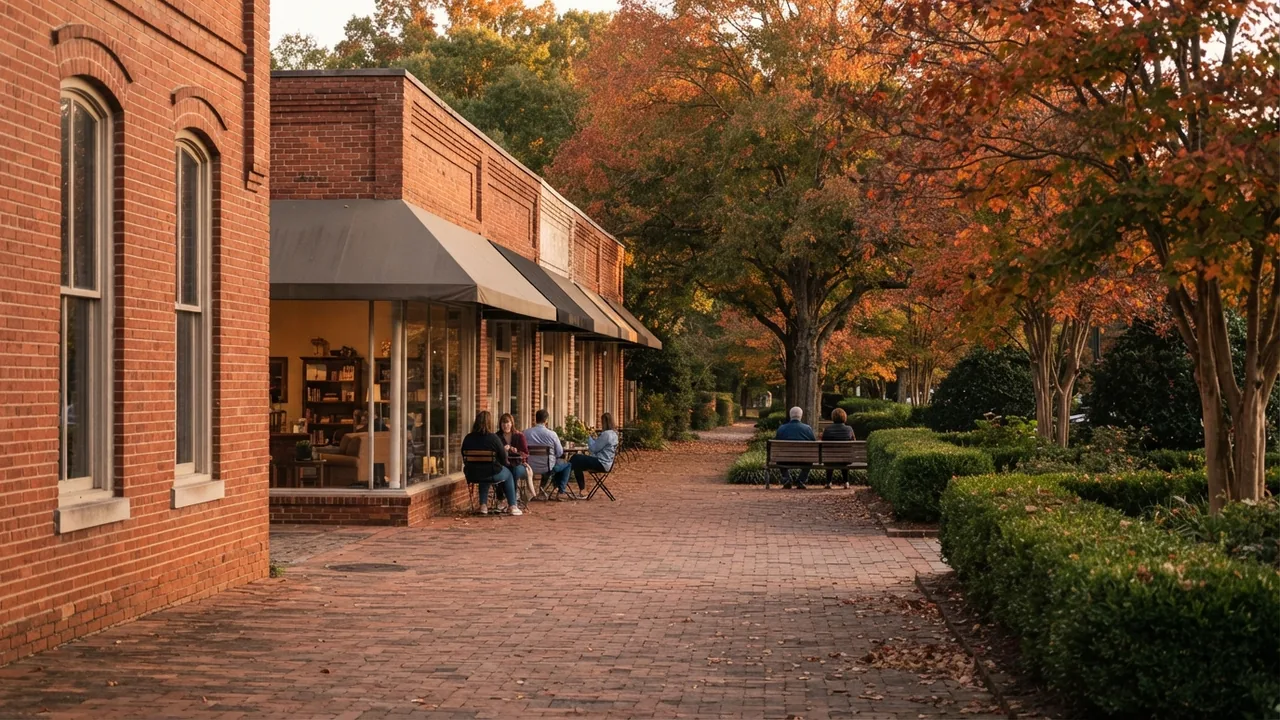
Ludwig details come from the City of Monroe and the Oxford American. Downtown, Dowd Center, airport, air show, electric utility and Christmas weekend details come from the City of Monroe pages linked in each section. The civil rights history comes from NCpedia, and the Jesse Helms biography from the Jesse Helms Center and the North Carolina History Project. Where two city pages differ, as on the runway length, we used the more specific figure and say so. The featured image is an illustrative scene of a small-town main street, not a photograph of Monroe.
Last updated: October 21, 2026