If you are buying in Ballantyne, Matthews, Mint Hill, Pineville or SouthPark this fall, the short answer is yes: your tax value goes up, and for most homes the bill goes up by less than the value does. Mecklenburg County reappraises every piece of real property as of January 1, 2027, and in the county’s own initial pass across 428,506 parcels the median residential value came back up about 15 percent (Mecklenburg County news release, September 2, 2026). Buy in Union County instead, in Waxhaw, Weddington, Marvin, Indian Trail, Monroe or Wesley Chapel, and none of it reaches you until 2029.
The reason the bill and the value move differently is a rate the county has to publish every reappraisal year, and the reason this matters right now is a deadline most owners never hear about. Below you will find how much values actually moved, what decides your bill, which towns sit on which side of the county line, and the one window that closes on November 10, 2026, before you ever see a number.
14 min read | Living in South Charlotte
Free · 26-Page Insider Guide
Two counties, two tax cycles, one move to get right.
Towns compared, NC vs SC taxes and schools side by side, and the 5 mistakes out-of-state buyers make.
What This Story Covers
- What happens to your tax value in 2027
- Which towns does this reach?
- How much are values going up?
- Does a higher value mean a higher tax bill?
- The rulebook that sets your value
- What happened the last time
- What to do if you are buying
- Frequently asked questions
What happens to your tax value in 2027
Every piece of real property in Mecklenburg County gets a new assessed value that day. Not a percentage bump applied to the old one: a fresh appraisal of what the county believes your house would sell for. The last one took effect January 1, 2023, so 2027 closes a four year gap in which most of South Charlotte’s price growth happened.
The Short Answer
Yes for Mecklenburg, no for Union County. Mecklenburg reappraises all real property as of January 1, 2027, with a median residential increase near 15 percent in the county’s initial review. Your bill is a separate decision made in the following budget, and it usually rises by less than your value does. Union County reappraised in 2025 and is not due again until 2029.
Key numbers, Mecklenburg County, checked September 27, 2026 (sources: NC Department of Revenue, Mecklenburg County Office of Tax Administration, N.C. General Statutes):
- 428,506 parcels got an initial valuation review, with a median residential increase of about 15 percent and commercial about 30 percent. Those are county-wide midpoints, not your final value.
- Mecklenburg’s county rate is 49.27 cents per $100 of value; Union County’s is 43.42 cents.
- 37 of North Carolina’s 100 counties reappraise in 2027, the largest single-year group in the state.
- The Board of Commissioners is scheduled to adopt the rulebook that will set your value on October 6, 2026.
- The deadline to challenge that rulebook is November 10, 2026, months before any value notice is mailed.
- Your new value notice is expected in early 2027.
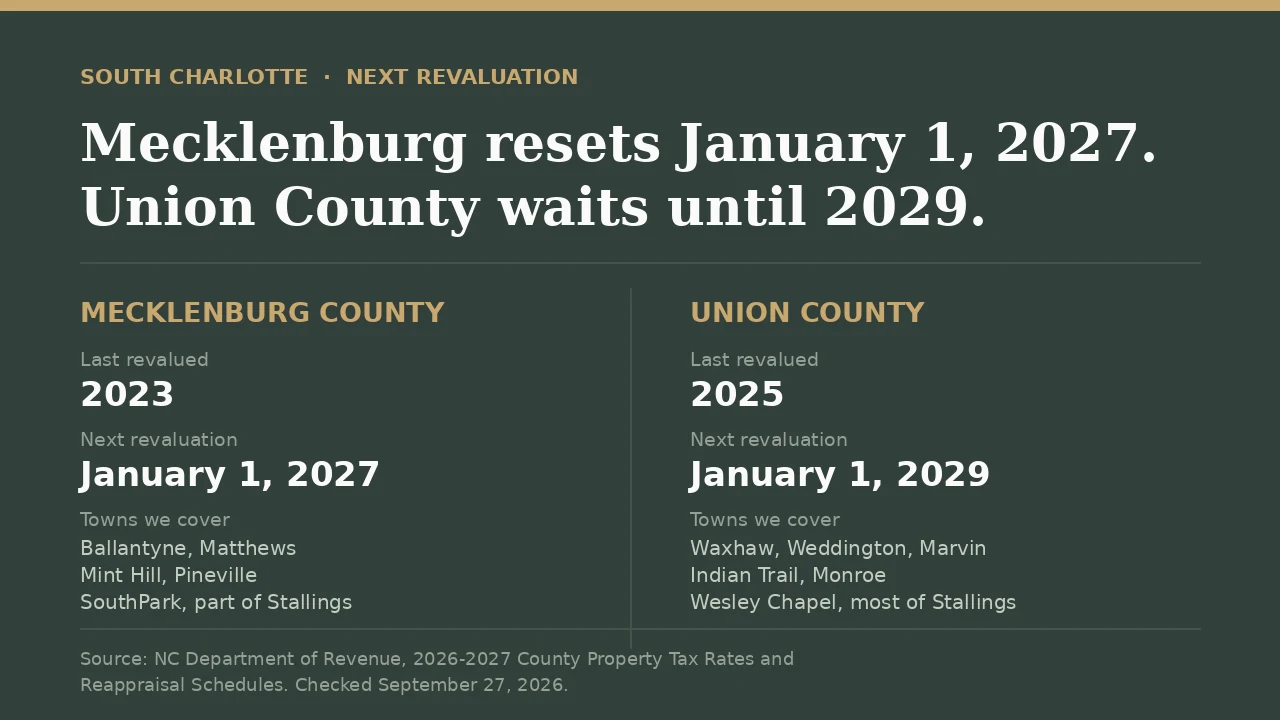
Here is where the two counties sit against each other, so you can find your town and read across.
Where each South Charlotte county stands in the reappraisal cycle, with the document you can check each figure against, read September 27, 2026.
| Measure | Mecklenburg | Union | Where you can check it |
|---|---|---|---|
| Last reappraisal | 2023 | 2025 | NCDOR county rates and reappraisal schedules, FY 2026-2027 |
| Next reappraisal | January 1, 2027 | January 1, 2029 | Same NCDOR file, next scheduled reappraisal column |
| County tax rate | 49.27 cents per $100 | 43.42 cents per $100 | Same NCDOR file, tax rate column |
| Cycle length | 4 years | 4 years | G.S. 105-286, which allows a county to reappraise sooner than the eighth year |
| Rulebook adoption | Scheduled October 6, 2026 | Not in this cycle | Mecklenburg Legistar matter 26-0434, agenda date October 6, 2026 |
| Deadline to challenge the rulebook | November 10, 2026 | Not in this cycle | Order Adopting Final Uniform Schedules, Exhibit B, and G.S. 105-317 |
| South Charlotte towns affected | Ballantyne, Matthews, Mint Hill, Pineville, SouthPark | Waxhaw, Weddington, Marvin, Indian Trail, Monroe, Wesley Chapel, and the Union County part of Stallings | County boundaries; your parcel record settles it, and the towns section below explains |
I went looking for a press release and found a timetable instead. The memo that carries all of this is two pages from the county’s Director of Tax Administration, dated August 18, 2026, and it lays out eleven dates from submission to the last day for an appeal. It was posted as an attachment to a meeting agenda, which is where it lives. If you want to know what is going to happen to your tax value, that memo tells you more than anything written about it since.
Talk to a local broker
Not sure which county line your short list sits on?
Fifteen minutes is usually enough to sort out what a move costs on each side. No pressure, just answers.
Schedule a 15-Minute Introductory Call →704-774-7170 · steve@jarrellhomes.com · thelongleafgroup.com
Which towns does this reach?
This is the part people get wrong, and it’s understandable, because “Charlotte” gets used as shorthand for the whole region. A revaluation is a county action, so the county line is what decides whether it touches you, not your mailing address and not the school district a listing names.
On the Mecklenburg side, and therefore reappraised as of January 1, 2027: Ballantyne (the office and retail district in far south Charlotte, inside the city limits), Matthews, Mint Hill, Pineville and SouthPark. If you’re weighing Matthews, our guide to daily life in Matthews covers the rest of what the town costs.
On the Union County side, and therefore not reappraised until January 1, 2029: Waxhaw, Weddington, Marvin, Indian Trail, Monroe, Wesley Chapel and Stallings. Stallings is worth a note, because part of the town sits in Mecklenburg County and part in Union, so a Stallings address is one of the few in the area where you genuinely have to check.
Two towns need a caveat. Pineville runs its own electric utility and sets its own municipal rate on top of the county’s, which we covered in detail in our piece on Pineville property tax, power and town limits. And a Charlotte mailing address does not always mean you are inside the Charlotte city limits, which is a separate line with its own rate.
If you’re still narrowing the list, our comparison of which South Charlotte town fits your move is the place to start, and the reappraisal cycle is one more column to put in that table.
How much are values going up?
About 15 percent for the median home, and about 30 percent for the median commercial property. Those are Mecklenburg County’s own figures, published on September 2, 2026, after an initial valuation review of 428,506 parcels. They are not final. The county’s words on that are worth quoting, because they are the part most coverage leaves out:
“Assessment staff will spend the remainder of 2026 conducting additional property reviews before the final assessed values are posted in 2027.” Mecklenburg County, September 2, 2026
So treat 15 percent as a county-wide midpoint rather than a forecast for your address. Half of residential parcels came in above it and half below, and every neighborhood gets looked at again before the number you receive is set. If your street outran the county as a whole over the last four years, your own increase is likely to land above that midpoint, and that is the case that matters most for what follows.
A word on what is being measured, because the three terms get used interchangeably and only one of them is in the statute. North Carolina law calls this a reappraisal. Mecklenburg’s own pages say revaluation. Most people searching for it type reassessment. They all mean the same event: the county reassessing what your property is worth. G.S. 105-283 sets the standard in one line, and it is a plain one, that property is appraised at “true value in money,” which the statute then defines as market value, the price it would bring between a willing buyer and a willing seller.
G.S. 105-286 sets the timing. Every county has to reappraise at least every eighth year, “unless the county is required to advance the date” or “chooses to advance the date.” Mecklenburg has chosen to advance it: 2019, 2023, now 2027, a four year cycle rather than the eight year maximum the law allows. Union County runs on four years too, which is why it landed on 2025 and 2029.
That choice matters more than it sounds. On an eight year cycle a value can drift a long way from the market before anyone corrects it, and the correction, when it comes, is a bigger one. On a four year cycle the jumps are smaller and more frequent. Mecklenburg has been on both, and the 2011 cycle below shows you what the long gap produced.
Mecklenburg is not alone in 2027. The Department of Revenue’s file for fiscal year 2026-2027 lists the next scheduled reappraisal for every county in the state, and 37 of the 100 are due that year, the largest single-year group on the list. The next biggest is 2029, with 24. So a lot of North Carolina is about to have this conversation at once, and if you are moving here from another county in the state, you may be leaving one reappraisal only to arrive in another.
Does a higher value mean a higher tax bill?
Not automatically, and the statute is the reason. When values jump across the board, keeping the same rate would hand the county a windfall it never voted for. So North Carolina makes the county show its work.
G.S. 159-11(e) requires that “in each year in which a general reappraisal of real property has been conducted, the budget officer shall include in the budget, for comparison purposes, a statement of the revenue-neutral property tax rate for the budget.” The statute defines that as the rate “estimated to produce revenue for the next fiscal year equal to the revenue that would have been produced for the next fiscal year by the current tax rate if no reappraisal had occurred,” adjusted upward by a growth factor for new construction.
Read that twice, because here’s the catch: the county has to publish the revenue-neutral rate. It does not have to adopt it.
Mecklenburg’s own record from the last cycle shows how that plays out. After the 2023 revaluation, the FY2024 recommended budget presented to the Board on May 18, 2023 put the revenue-neutral rate at 45.71 cents per $100 and recommended 47.31 cents, which the presentation describes as “an increase of 1.6¢ (1¢ to capital and 0.6¢ to general operating).” The FY2024 budget ordinance adopted that 47.31 cent rate.
So there are two moving parts to hold in your head. Your value is one, and it’s set by the reappraisal. The rate is the other, and it’s set months later in a budget vote. A 15 percent value increase paired with a revenue-neutral rate is close to a wash for a house that moved with the average. The same increase on a house that moved much more than the average is not, because revenue-neutral protects the total, not you individually.
That last point is the one worth sitting with. If your part of the county appreciated faster than the county as a whole, a revenue-neutral rate still shifts more of the bill onto you. If it appreciated slower, it shifts some off. A revaluation redistributes who pays before it changes how much is collected. For what the rest of the tax picture looks like here, we broke down the county’s 8.25 percent sales tax, the highest in North Carolina, on September 19, 2026.
The rulebook that sets your value, and the November 10 deadline
Here’s where nearly every article on this subject stops short, and where a date is about to pass without much notice.
Before a county can reappraise anything, the assessor has to write a rulebook: the Uniform Schedules of Values, Standards and Rules. It’s the document that says how a square foot is priced in your neighborhood, what a finished basement adds, how a corner lot is treated, how land is valued against improvements. Your individual value is the output. The schedule is the formula.
G.S. 105-317 governs how that formula gets adopted, and it gives property owners a right most never hear about: a window to challenge the formula itself. The statute says the assessor submits the proposed schedules to the Board “not less than 21 days before the meeting at which they will be considered,” the Board publishes notice of a public hearing, the hearing is held “at least seven days before adopting the final schedules,” and then notice of the adopting order is published “once a week for four successive weeks.” After that, “a property owner who asserts that the schedules, standards, and rules are invalid may except to the order and appeal therefrom to the Property Tax Commission within 30 days.”
Mecklenburg’s Director of Tax Administration, Kenneth Joyner, put the whole calendar in a memo to the Board dated August 18, 2026. These are the dates:
- August 18, 2026: the schedules go to the Clerk’s office.
- September 1, 2026: delivery to the Board under G.S. 105-317, and the Board authorizes publication of the hearing notice.
- September 6, 2026: notice of the public hearing published in The Charlotte Observer. A sworn affidavit of publication filed with the county confirms it ran that day.
- September 15, 2026: public hearing at 6:30 p.m. at the Charlotte-Mecklenburg Government Center, 600 East Fourth Street.
- October 6, 2026: the Board adopts the final schedules.
- October 11, 18, 25 and November 1, 2026: the adopting order published once a week for four weeks.
- November 10, 2026: last day to challenge the validity of the schedules by appeal to the North Carolina Property Tax Commission.
So the formula that will set your 2027 value is finalized in early October, and the only route to contest that formula closes on November 10, 2026. Value notices are not expected until early 2027. The window to argue with the method shuts months before you find out what the method did to you.
Two things about the current state of that record, because they matter and because they will change. As of September 27, 2026, the October 6 adoption item sits on the Board’s published agenda under “Manager’s Report” and carries no vote, because that meeting has not happened yet. The September 15 hearing’s minutes are still marked Draft with no action logged against the item. The hearing was properly noticed and it was on the published agenda. What the record does not yet show is what was said or decided there, and that is a statement about the minutes rather than about the meeting.
If you want to read the schedules yourself, they’re filed at the Office of the County Assessor at the Valerie C. Woodard Center, 3205 Freedom Drive, Suite 3500, and the proposed version is posted as an attachment to the September 1 agenda item.
The 2011 section below is the one I would not skip. I expected the county’s old revaluation record to be thin, and instead it runs to dozens of agenda items across two and a half years, with dollar totals in them. I would not read that as a prediction about 2027, because the cycle and the staff and the method have all changed since. I would read it as the reason the Schedule of Values window exists at all, and as the argument for opening your value notice the week it arrives rather than the month you get around to it.
Talk to a local broker
Buying in Mecklenburg before the values reset?
Worth a quick call with someone who works both sides of this county line every week.
Book a 15-minute call →What happened the last time Mecklenburg did this
Mecklenburg’s 2011 revaluation went badly enough that the General Assembly stepped in, and the county’s own meeting record is where you can watch it unfold.
An independent statistical review commissioned by the county and dated October 30, 2015 gives you the scale of it: “After this 2011 Reassessment, over 40,000 formal appeals were received from property owners in Mecklenburg County, well over 10% of the total number of parcels.” The same review records that “Session Law 2013-362 approved in July of 2013 mandated that a complete neighborhood-by-neighborhood revaluation review be conducted for Mecklenburg County,” that an outside firm was hired to run it starting October 1, 2013, and that the review was completed in February 2015.
The review “stipulated that refunds be issued for back years to property owners who were deemed to be over-assessed, and that increase bill or discovery bills be issued to those deemed to have been under-assessed.” A memo from the county assessor to the Board dated February 16, 2015 puts numbers on that: as of that date, 204,777 refunds totalling $23,062,473.57, made up of $21,172,748.85 in refunds plus $1,889,724.72 in interest. Those are running totals from partway through the process, not a final accounting, and the same review notes 8,967 formal appeals still open as of August 31, 2015, which tells you how long a contested revaluation takes to settle.
It’s worth being careful about what that review concluded, because the headline and the finding point in different directions. On the technical measures, it found the county’s original 2011 values held up: they “meet every standard for assessment level, assessment uniformity, and selective reappraisal for each stratum that was investigated with one exception,” that exception being detached houses built before 1970, where it suspected the model had been over-fitted. So the version you may have heard, that the county simply got its arithmetic wrong, is not what the review found. It is that a revaluation after an eight year gap, landing on the other side of a housing crash, produced 40,000 arguments and a legislative response.
The four year cycle Mecklenburg now runs is a direct answer to that, and it is the strongest reason to expect 2027 to look nothing like 2011. Shorter gaps mean smaller corrections.
What to do if you are buying in Mecklenburg right now
Five practical things, in the order they matter.
Do not budget off the seller’s current tax bill. That figure rests on a January 1, 2023 value. If you’re closing this fall on the Mecklenburg side, your first full year of ownership is the year the new value lands. Ask your lender to run the payment with a higher tax estimate so the escrow adjustment in 2027 isn’t a surprise.
Know which county you’re buying in, in writing. For most of South Charlotte this is obvious, but a Charlotte mailing address, a Waxhaw ZIP code and a town limit are three different things, and Stallings straddles the county line outright. The tax record for the parcel settles it.
Treat the 15 percent as a county median, not a forecast for your house. The county has been explicit that its own figure is an initial-review median across 428,506 parcels and that “assessment staff will spend the remainder of 2026 conducting additional property reviews before the final assessed values are posted in 2027.” Your neighborhood may have moved more or less.
If you have a view on the method, November 10 is the date. The Schedule of Values challenge is a narrow, technical route and it is aimed at the formula rather than at your individual number. It is not the appeal most owners want. But it’s the only one open right now, and it closes before notices go out.
Then watch for your notice in early 2027. That’s when the ordinary appeal opens, the one that argues your specific value, and the notice itself will carry the deadline. Open it the week it arrives.
And if you’re looking at the Union County side instead, the reappraisal question is simply off the table until 2029. What is live there is a different constraint: we wrote about the county’s building capacity limits and about what was and was not on the 2026 ballot.
Frequently Asked Questions About Mecklenburg Property Taxes in 2027
When does the Mecklenburg County revaluation take effect?
January 1, 2027. Every piece of real property in the county gets a new assessed value as of that date. The last revaluation took effect January 1, 2023, so 2027 closes a four year gap.
Will my property taxes go up after the 2027 revaluation?
Not automatically. A revaluation sets your value, and the Board of Commissioners sets the rate separately in the following budget. North Carolina law requires the county to publish a revenue-neutral rate for comparison, but it does not require the county to adopt it. After the 2023 revaluation the revenue-neutral rate was 45.71 cents and the county adopted 47.31 cents.
How often does Mecklenburg County reassess property?
Every four years. State law sets a floor of once every eight years and lets a county go sooner, and Mecklenburg has chosen the shorter cycle: 2019, 2023 and now 2027.
Does the revaluation affect Waxhaw, Weddington or Marvin?
No. Those towns are in Union County, which last reappraised in 2025 and is next scheduled for 2029. A revaluation is a county action, so the county line decides it. Stallings is the exception worth checking, because part of the town sits in each county.
When will I get my new property value notice?
The county expects to mail notices in early 2027. Until then the value on the tax record is the 2023 figure. The notice itself will carry the deadline for appealing your individual value.
Can I challenge the revaluation before I get my notice?
There is one narrow route, and it closes November 10, 2026. It is an appeal to the North Carolina Property Tax Commission against the Uniform Schedules of Values, which is the rulebook the county uses to value property, rather than against your own number. Your individual value cannot be appealed until the notice arrives in 2027.
About the Author
Steve Jarrell is a licensed North Carolina and South Carolina broker and the team lead of The Longleaf Group at eXp Realty, which he co-leads with his wife Amanda. Before real estate, Steve joined VisualTour as President, led its rebrand to Paradym, and led the company to its acquisition by Constellation Software in 2020. He holds an MBA from the University of Tennessee with concentrations in Marketing and Innovation. The Longleaf Group is an eXp ICON Team and a RealTrends Verified Top Team by Volume for 2026, with 140+ five-star reviews.
Steve works both sides of the Mecklenburg and Union county line every week, which is where questions like this one usually surface: two houses at the same price, in towns fifteen minutes apart, on completely different tax calendars. He writes up the county records behind those questions here so buyers can see the documents themselves. You can reach him at 704-774-7170 or steve@jarrellhomes.com.
How we sourced this
Every figure here came from a primary document opened on September 27, 2026. Where you want to check one yourself, these are the files we read:
- Reappraisal years and county rates: NC Department of Revenue, county property tax rates and reappraisal schedules, FY 2026-2027, and the underlying spreadsheet covering all 100 counties.
- The 2027 timetable: the memo from the Director of Tax Administration to the Board of Commissioners dated August 18, 2026, and the order adopting the final schedules, both filed as attachments in Mecklenburg County’s public meeting record.
- The hearing notice and proof it ran: the notice of submission and the sworn affidavit of publication.
- The parcel count and the initial-review medians: Mecklenburg County’s update on the 2027 revaluation, September 2, 2026, and the 2027 Schedule of Values.
- The law: G.S. 105-283 on true value, G.S. 105-286 on the cycle, G.S. 105-317 on the schedules and the appeal, and G.S. 159-11(e) on the revenue-neutral rate.
- The 2023 rate figures: the FY2024 recommended budget presentation to the Board, May 18, 2023. The 2019 and 2023 cycle dates come from the county’s own meeting record, which carries a Uniform Schedules of Values item for each of those revaluations (files 18-4856 and 22-7758).
- The 2011 review: the independent statistical review dated October 30, 2015 and the county assessor’s refund totals memo of February 16, 2015.
- Where the schedules are filed and how appeals work: Mecklenburg County Office of Tax Administration.
One figure was left out. Several summaries of the 2023 revaluation put the residential increase at 58 or 59 percent. No Mecklenburg County document we could open carries either number. What the county published at the time, in its release of March 13, 2023, is that “property assessments have increased an average of 51% in Mecklenburg County,” with no split between residential and commercial. That is the figure we used, and we did not soften the others into a range.
We will update this post when the Board’s October 6 vote is recorded and again when the September 15 hearing minutes move from Draft to final.
Last updated: September 27, 2026.