There’s no building moratorium in Union County, North Carolina. There’s something quieter, and if you’re trying to build here it matters a great deal more: in the wastewater report county staff put in front of commissioners on August 17, 2026, the Crooked Creek treatment plant is 95.0% committed and Twelve Mile Creek is 90.6% committed, and the 54 development projects already queued for those two plants are asking for more gallons than either plant has left.
Those percentages come off a one-page table Union County publishes every month, openly, in two places at once, and almost nobody reads either one. If you’re weighing a lot in Waxhaw, waiting on a builder in Indian Trail, or wondering why a rezoning you were following went quiet, that table explains more than any council vote will. This is what it says, what the arithmetic underneath it works out to, and which parts of the story still can’t be pinned down.
12 min read
Free · 26-Page Insider Guide
Weighing a lot in Union County before you commit?
Towns compared, NC vs SC taxes and schools side by side, and the 5 mistakes out-of-state buyers make.
What This Story Covers
- So is there a building moratorium in Union County?
- The number that decides it isn’t the one most people read
- Which plant should you actually worry about?
- Twelve Mile Creek has more room and still not enough
- What changed over the last twelve months?
- The drought rules are a separate problem
- How the county has talked about splitting what’s left
- What this means if you’re buying or building here
- Frequently asked questions
So is there a building moratorium in Union County?
No. Union County hasn’t adopted a building moratorium. I searched the Board of Commissioners agenda system, which carries every item the board has taken up since September 2021, and no moratorium comes back. What the county has instead is a capacity ceiling, and it behaves differently from a moratorium in a way that will matter to you.
A moratorium is a decision. Somebody votes for it, it has a start date, and it has an end date you can plan around. A capacity ceiling is arithmetic. It tightens or loosens on its own, month by month, and nobody votes on it at all. That’s why the question people ask doesn’t quite fit the thing that’s actually happening here.
The Short Answer
Union County has no building moratorium on its books. It has two main wastewater plants that are 90.6% and 95.0% committed, and a development queue asking for more capacity than either plant has left. That’s a tighter constraint than most people realize, and it isn’t a vote you can watch for.
Key numbers, Union County, twelve months ending with the August 17, 2026 report (source: Water Reclamation Facility Flows table, Board of Commissioners agenda packet):
- Crooked Creek: 1.9 MGD permitted, 95.0% committed, 0.096 MGD left uncommitted
- Twelve Mile Creek: 7.5 MGD permitted, 90.6% committed, 0.704 MGD left uncommitted
- Projects queued for Crooked Creek: 21, asking 0.409 MGD, over four times what’s left
- Projects queued for Twelve Mile Creek: 33, asking 0.870 MGD, about a quarter more than what’s left
- Actual flow through both plants is far lower, at 65.6% and 69.0% of permitted
- Stage 2 water restrictions declared May 15, 2026, a separate system from the sewer math
Union County water reclamation facilities, twelve-month rolling average flows as reported to the Board of Commissioners on August 17, 2026. “Committed” is the county’s own combined figure for actual flow plus permitted and obligated flow.
| Plant | Permitted (MGD) | Actual flow used | Committed | Source document |
|---|---|---|---|---|
| Twelve Mile Creek | 7.5 | 69.0% | 90.6% | Aug 17, 2026 agenda, Tables |
| Crooked Creek | 1.9 | 65.6% | 95.0% | Aug 17, 2026 agenda, Tables |
| Olde Sycamore | 0.15 | 26.0% | 26.0% | Aug 17, 2026 agenda, Tables |
| Grassy Branch | 0.12 | 30.0% | 30.8% | Aug 17, 2026 agenda, Tables |
| Tallwood | 0.05 | 34.0% | 34.0% | Aug 17, 2026 agenda, Tables |
I went looking for a moratorium because that’s the word people use when they call me about this. I couldn’t find one. What I found instead was a table buried in a board packet, and the first time I read it I misread it the same way most people do, as a plant that’s 95% full of water. It isn’t. It’s 95% full of promises, and those are two very different problems.
Talk to a local broker
Trying to work out whether a Union County lot can actually be built on?
A quick call, and I’ll tell you which questions to put to the county before you sign anything. No pressure, just answers.
Schedule a 15-Minute Introductory Call →704-774-7170 · steve@jarrellhomes.com · thelongleafgroup.com
The number that decides it isn’t the one most people read
Union County’s monthly table carries two different percentages for every plant, and the one that governs whether a new subdivision can connect is the second one. On the August 17, 2026 report, Crooked Creek was running at 65.6% of the flow it’s permitted to treat. That’s the water actually moving through the plant, averaged across twelve months. Read that column alone and the plant looks like it has a third of itself to spare.
The next column is the one that counts. The county labels it actual plus permitted obligated flows, and for Crooked Creek it came to 95.0%. The difference between those two figures is capacity the county has already promised to projects that are approved but not built, not occupied, and not yet flushing anything.
Union County Water states the rule itself, in one line, on its wastewater capacity page for developers and builders: “Permitting capacity is evaluated using the actual plant flows plus the permitted/obligated flows.” So the higher number is not a worst case or a projection. It is the figure the county says it permits against.
Think of it as a restaurant on a Friday night. Two thirds of the tables have people sitting at them, so from the door it looks half empty. Nearly every table is reserved. The host isn’t turning you away because the room is full. She is turning you away because the room is spoken for.
That distinction is the whole story, and it’s why residents and builders can look at the same county and reach opposite conclusions in good faith. Somebody reading the usage column sees a system with room. Somebody reading the commitment column sees a system nearly out of it. Both numbers are printed on the same page.
Which plant should you actually worry about?
Crooked Creek, and it isn’t close. It’s the smaller of the two main plants and by far the tighter. It’s permitted for 1.9 million gallons a day. As of August 17, 2026, actual plus obligated flow stood at 1.804 MGD. Subtract one from the other and the plant has 0.096 MGD of capacity nobody has claimed yet, which is about one twentieth of the plant.
Now look at what is waiting. The same table lists a development backlog for Crooked Creek of 21 projects requesting 0.409 MGD between them. That’s more than four times the capacity remaining. The queue breaks down into three approved projects awaiting permit submittal at 0.055 MGD, eight in engineering plan review at 0.195 MGD, and ten in sketch plan review at 0.159 MGD.
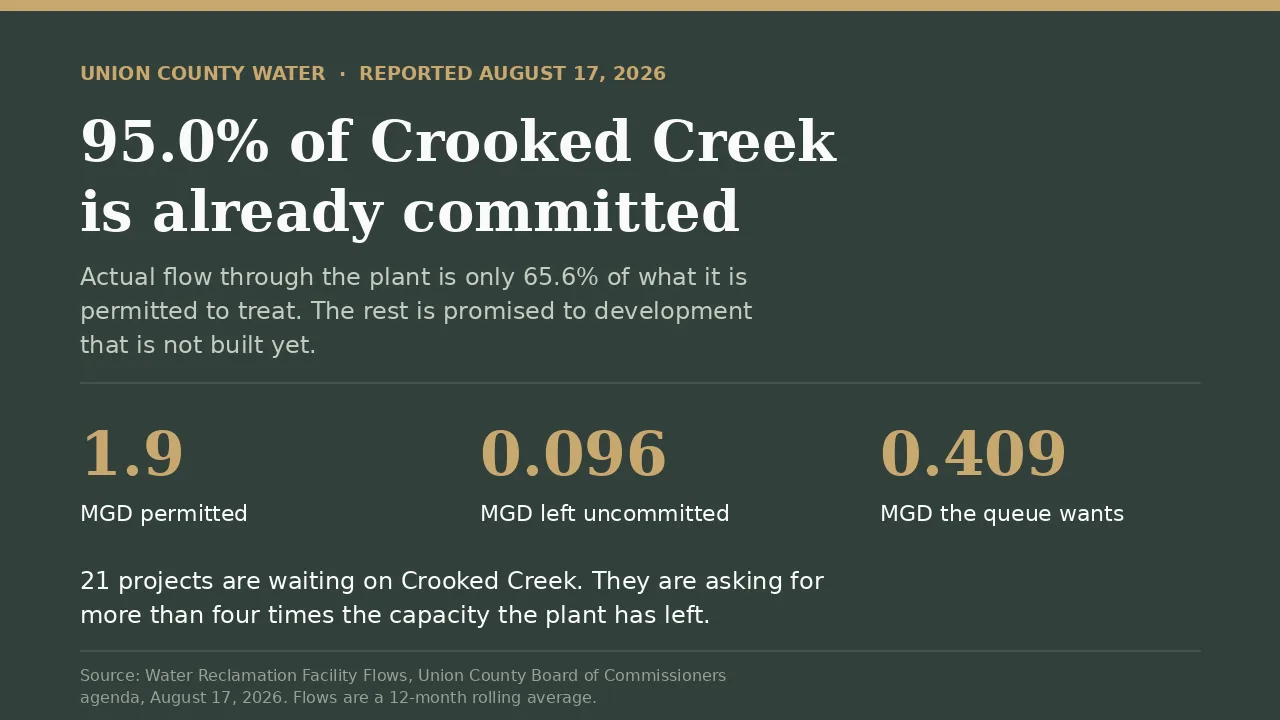
Those three stages aren’t equally real. A project in sketch plan review may never be built. One that’s approved and waiting to submit permits very likely will be. But even the most conservative reading, counting only the approved tier, uses up more than half of what’s left. The engineering review tier on its own would use twice the remaining capacity.
None of this means the county stops issuing permits tomorrow. The documents I could reach don’t state a specific trigger, and I’m not going to invent one. What the table does establish is that the projects already in line for Crooked Creek want considerably more than the plant currently has to give.
Twelve Mile Creek has more room and still not enough
Twelve Mile Creek is the workhorse. It’s permitted for 7.5 MGD, roughly four times Crooked Creek, and it serves the fastest growing side of the county. On the August 2026 report it sat at 69.0% actual and 90.6% committed, leaving 0.704 MGD uncommitted.
If you only hold the two plants up against each other, Twelve Mile looks like the safe one. Put its own queue next to it and it’s still short. The backlog for Twelve Mile Creek runs to 33 projects asking 0.870 MGD, which is about a quarter more than the plant has left. Two of those are approved and awaiting permits at 0.027 MGD, fourteen are in engineering plan review at 0.427 MGD, and seventeen are in sketch plan review at 0.416 MGD.
The service area is why this matters across so much of the map. A county presentation on sewer allocation lists the jurisdictions inside the Twelve Mile Creek service area as Hemby Bridge, Indian Trail, Lake Park, Marvin, Mineral Springs, Stallings, unincorporated Union County, Waxhaw, Weddington and Wesley Chapel. That’s most of the part of Union County you would actually be looking at.
The three small plants carry almost none of the load. Olde Sycamore, Grassy Branch and Tallwood together are permitted for 0.32 MGD, which is less than a twentieth of Twelve Mile Creek on its own, and all three are sitting between 26% and 34% committed. They aren’t spare capacity anybody can move a subdivision onto.
What changed over the last twelve months?
Crooked Creek tightened by 8.5 percentage points in eight months. I pulled every monthly report the county has posted since September 2025 and ran the series. In the December 8, 2025 packet the plant showed 86.5% committed. By July 20, 2026 it was 93.7%. By August 17, 2026 it was 95.0%.
One caveat the county puts on its own numbers, and it matters if you are watching this month to month: “The data captured for a given month is published approximately four to six weeks after it has been collected.” The figures above are a twelve month rolling average through July 2026. The newest public number is always a little behind the county.
Twelve Mile Creek moved less and in the same direction. It bottomed at 88.2% in the May 18, 2026 report and climbed to 90.6% by August. Neither plant has expanded its permitted capacity in that window. Both denominators are exactly where they were a year ago.
The backlog is moving faster than the plants are. Between the July and August reports alone, the Twelve Mile Creek queue grew from 28 projects requesting 0.747 MGD to 33 projects requesting 0.870 MGD. That’s five new projects and 0.123 MGD of new requests in a single month, on a plant with 0.704 MGD left.
One more thing worth flagging, because it cuts against the simple story. Actual flow at Crooked Creek also rose over the year, from 59.8% to 65.6% of permitted. Some of what was promised is now genuinely being used. The plant isn’t only more spoken for than it was, it’s also fuller.
The drought rules are a separate problem
Union County declared Stage 2 water restrictions on May 15, 2026, and people routinely fold that together with the sewer story. They are two different systems and it’s worth keeping them apart. Drinking water comes in from the Catawba-Wateree basin. Wastewater goes out through the plants above. Rain fixes one of those and does nothing at all for the other.
If you’re buying a lot and the seller tells you sewer is available, that’s worth exactly as much as the allocation letter behind it. Availability is a question about the plant. Allocation is a question about your parcel. The county’s monthly table tracks the first one and says nothing whatsoever about the second, and I’d want the second in writing before I let anyone talk me into shortening a due diligence period over it.
Talk to a local broker
Following a Union County project that went quiet?
I read these agenda packets every month. Give me fifteen minutes and I’ll tell you what I’m seeing.
Book a 15-minute call →The restrictions themselves are specific. According to the Water Shortage Response Plan update presented to commissioners on May 18, 2026, spray irrigation is limited to two days a week: even numbered addresses on Tuesdays and Saturdays, odd numbered addresses on Wednesdays and Sundays, and no watering between 8am and 8pm on any day. Hand watering and drip irrigation stay allowed any time. Personal car washing at home is out, and so is filling a new pool.
The mechanism behind it isn’t local. Union County is a member of the Catawba-Wateree Drought Management Advisory Group, and the group’s Low Inflow Protocol comes out of Duke Energy’s federal operating license for the Catawba-Wateree hydroelectric project. When the group declared Stage 2 on May 1, 2026, the county was required to follow within fourteen days, which is what the May 15 declaration was.
Stage 2 is still in force. Union County Water’s current restrictions page read “Stage 2 restrictions remain in effect” when this article was checked on September 14, 2026, even though conditions across the Piedmont improved substantially in late July. Stages do move, and the county’s Water Use Ordinance gives the County Manager authority to shift between them, so check that page rather than trusting any date you read online, this one included.
How the county has talked about splitting what’s left
Staff brought commissioners a method for dividing future capacity on May 20, 2024, and it’s the closest thing in the public record to an answer about who gets the next gallon. The Sewer Allocation Policy presentation evaluated five methodologies and recommended one called Development Potential, which weighs undeveloped and underdeveloped land using regional planning data rather than current customer counts.
The arithmetic in that presentation starts with a planned 1.5 MGD expansion at Twelve Mile Creek, holds back 0.15 MGD as a contingency reserve, and divides the remaining 1.35 MGD among the towns in the service area.
Here is where you need to be careful, and where I’d rather under-claim than over-claim. The presentation states plainly that the shares it prints aren’t final. Its own words: “These shares are calculated using the data from the previous CRTPO update for illustrative purposes.” A second line on the same slide reads “Recommendation to finalize allocation percentages after updated data available.” I couldn’t confirm from the public record that the board ever adopted final numbers, so treat what follows as the shape of the thinking rather than anybody’s entitlement.
On those illustrative figures, unincorporated Union County drew the largest share of Twelve Mile Creek at 43.4%, followed by Waxhaw at 23.0% and Indian Trail at 14.9%. Wesley Chapel came to 5.8%, Weddington 5.4%, Mineral Springs 3.8%, Stallings 3.2% and Marvin 0.5%. Whatever the final version looks like, the ranking tells you which places the county expects to absorb growth.
What this means if you’re buying or building here
The practical takeaway is narrow and useful: stop asking whether sewer is available and start asking whether your specific parcel has allocation. Those are different questions with different answers, and only one of them is on the monthly table.
If you’re under contract on a lot, or considering one, these are the questions I’d put in writing. Which plant serves this parcel, Twelve Mile Creek or Crooked Creek? Has capacity been allocated to this project, and can I see that in writing? If it’s in the backlog, which of the three tiers is it in, because sketch plan review is a long way from a permit. And if the answer is that the parcel is on septic rather than county sewer, then none of this table applies to it and the binding question becomes the health department’s soil evaluation instead.
For a finished home on an existing street already connected to sewer, none of this changes anything about your purchase. The capacity ceiling governs new connections, not houses that are already flushing. Where it bites is new construction, and it bites hardest on projects that haven’t cleared engineering review yet.
It’s also worth knowing that this isn’t unique to Union County. Just across the state line, Lancaster County took the other route and adopted an actual moratorium, which is a very different instrument with a very different set of consequences. I wrote that one up separately in the Indian Land building moratorium, and reading the two together is the clearest way to see the difference between a policy decision and a plant percentage. For a closer look at how one Union County town handles a civic project from concept to funding, the Weddington town park story covers the same kind of paperwork trail.
The last thing I’d say is that this table is public, it’s monthly, and it isn’t hard to read once you know which column to look at. You don’t need me or anybody else to interpret it for you. The Union County meeting calendar carries every agenda packet, and the capacity update is a standing item under Information Only at the monthly Board of Commissioners meeting.
Frequently Asked Questions About the Union County Building Moratorium
Is there a building moratorium in Union County NC?
No. As of September 14, 2026, Union County has not adopted a building moratorium, and none appears in the Board of Commissioners agenda system, which covers every item the board has taken up since September 2021. What you are actually up against is a capacity ceiling. The August 17, 2026 county report shows the Crooked Creek plant 95.0% committed and Twelve Mile Creek 90.6% committed.
What does it mean when a wastewater plant is 95 percent committed?
It means actual flow plus flow already promised to approved projects adds up to 95 percent of what the plant is permitted to treat. It does not mean the plant is 95 percent full of water, which is how most people read it and how I read it the first time. At Crooked Creek actual flow was only 65.6% of permitted capacity on the August 17, 2026 report. The gap is capacity reserved for development that is approved but not yet built.
Is Union County running out of sewer capacity?
The two main plants have 0.096 MGD and 0.704 MGD of uncommitted capacity left, and the projects queued for them are requesting 0.409 MGD and 0.870 MGD. Both queues exceed what remains. Those figures come from the county table reported on August 17, 2026, and the county publishes an updated version every month.
Does the Stage 2 drought declaration stop new construction in Union County?
No. Stage 2 restrictions govern drinking water use and were declared on May 15, 2026 under the Catawba-Wateree Low Inflow Protocol. They limit spray irrigation to two days a week and ban home car washing and filling new pools. Wastewater treatment capacity is a separate system with separate limits, and the drought stage can change while the capacity figures do not.
How do I find out if a Union County property has sewer capacity?
Ask which plant serves the parcel and whether capacity has been allocated to that specific project in writing. Plant level availability and parcel level allocation are different questions. The monthly county table reports the first and says nothing about the second, so a general statement that sewer is available is not the same as an allocation.
Where can I read Union County wastewater capacity reports myself?
Two places. Union County Water publishes the current table on its wastewater capacity page for developers and builders. The same figures also reach the Board of Commissioners every month as an item called Wastewater Treatment Capacity Monthly Update, listed under Information Only, as a one page attachment titled Tables. The county notes that a given month is published roughly four to six weeks after it is collected.
About the Author
Steve Jarrell is team lead of The Longleaf Group, a team at eXp Realty, which he co-leads with his wife Amanda. He works across Union County and the wider South Charlotte area, including Waxhaw, Weddington, Marvin, Indian Trail, Wesley Chapel and Monroe, and he reads the county agenda packets most people never open because the answers to the questions you are actually asking are usually sitting in them.
Before real estate, Steve joined VisualTour as President, led its rebrand to Paradym, and led the company to its acquisition by Constellation Software in 2020. That background is why a post like this one starts with the source table rather than a summary of somebody else’s summary. The Longleaf Group is an eXp ICON Team. Reach Steve at 704-774-7170 or read more at his bio page.
How we sourced this
Every figure above comes from a Union County document published in the Board of Commissioners agenda system, opened and read for this article on September 14, 2026. The primary source is the Water Reclamation Facility Flows table attached to the August 17, 2026 Board of Commissioners meeting. The twelve month trend was built by pulling every monthly capacity report the county has posted since September 2025 and reading each attachment directly, including the July 20, 2026 table used for the month over month comparison.
Every figure was then cross-checked a second time against Union County Water’s own wastewater capacity page, which publishes the same table for developers and builders and matched the agenda attachment line for line.
Two things were left out of this article because no primary document supports them, and you should know what they are. First, a widely repeated claim that commissioners voted in January 2021 to cap permitting at 95% of rated plant capacity. That would be directly relevant to Crooked Creek sitting at exactly 95.0%, which is precisely why it isn’t stated here as fact. The county online agenda record begins in September 2021, no document confirming the vote was found, and the county’s own capacity page states no threshold of any kind. Until one of those changes, 95.0% is a reading on a gauge here and nothing more.
Second, a reported increase in development review fees effective October 1, 2026, which appears in no agenda item found. A number worth having is still worth leaving out until a document carries it.
Percentages are the county’s own. The subtraction and the ratios comparing remaining capacity to the development backlog are ours, calculated from the figures printed in the table, and can be checked against the linked PDF in under a minute. Flow figures are twelve month rolling averages, which is the county’s stated basis. No property value claim is made here in either direction, because no study exists that would support one.
Last updated: September 15, 2026