If you have been comparing a Pineville address against one in south Charlotte, there is a good chance someone has already told you that the smaller town is the cheaper option. It’s true that Pineville is small, about 11,379 residents on the state’s certified 2024 estimate, and it’s true that it runs like a real town rather than a Charlotte neighborhood. The tax line is where the assumption breaks. For the 2026-27 tax year, a Pineville address carries a combined property tax rate of 79.27 cents per $100 of assessed value, the highest of any municipality in Mecklenburg County, according to the county Office of Tax Administration’s own jurisdiction rate chart.
The Short Answer
Pineville still carries the highest combined property tax rate in Mecklenburg County for 2026-27, at 79.27 cents per $100. But Charlotte raised its rate this year and Pineville did not, so the difference between the two is now well under a penny. The bigger practical difference in Pineville is not the tax rate at all. It is that the town, not Duke Energy, sends your power bill.
Key numbers, Pineville and Mecklenburg County, 2026-27 tax year (sources: Mecklenburg County Office of Tax Administration, Town of Pineville budget ordinance):
- Combined rate inside Pineville: 79.27 cents per $100, unchanged from last year
- Combined rate inside Charlotte: 78.57 cents, up from 76.68 cents
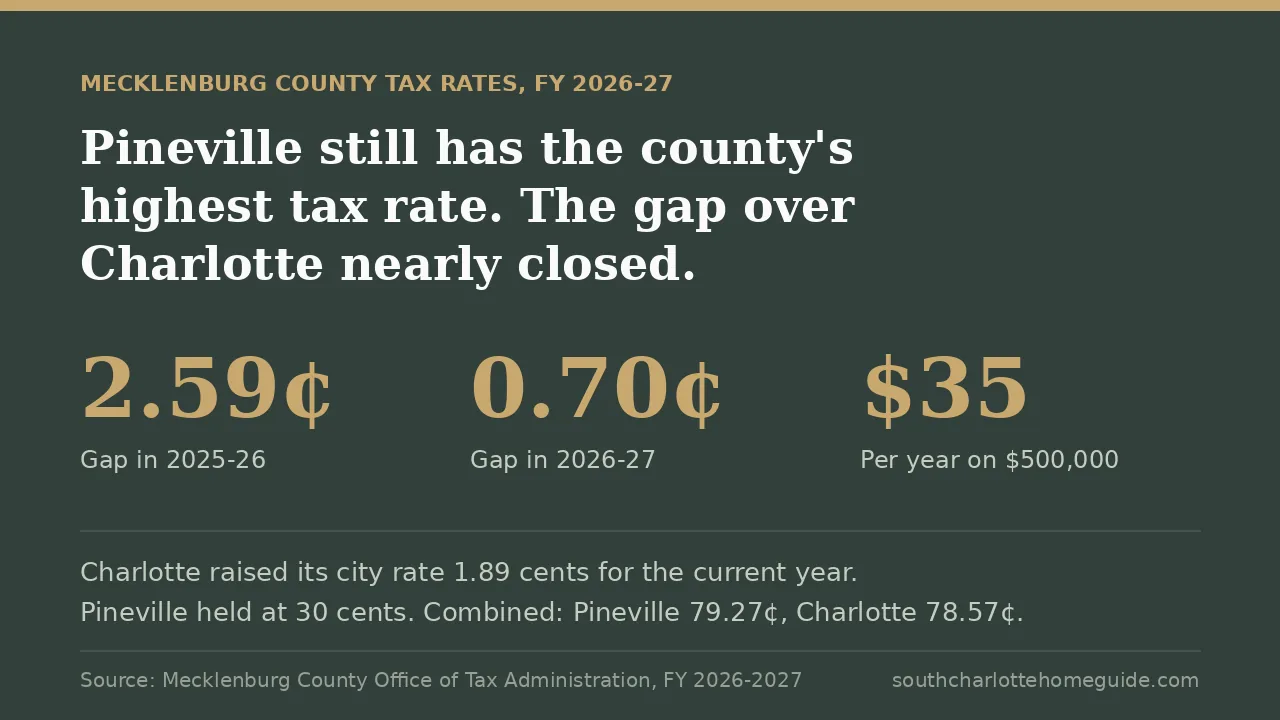
- The gap between them: 0.70 cents, down from 2.59 cents
- What that gap costs on a $500,000 assessment: about $35 a year
- Town of Pineville rate: 30 cents, adopted June 9, 2026, unchanged
- Pineville residential gigabit internet from the town: $92.95 a month
What is new this year is how thin that lead has become. Charlotte raised its city rate by 1.89 cents effective July 1, 2026, and Pineville held flat at 30 cents. The gap between the two, which was 2.59 cents last year, is now 0.70 cents. Below I walk you through what you would actually pay, what changed for the current year, why most pages you will find still quote last year’s figures, and the part of a Pineville address that genuinely is different: your power, your phone and your internet all get billed by the town.
14 min read | Living in South Charlotte
Free · 26-Page Insider Guide
Comparing towns on the tax line before you buy?
Towns compared, NC vs SC taxes and schools side by side, and the 5 mistakes out-of-state buyers make.
What This Story Covers
- Pineville NC property tax, the short answer
- What changed for the 2026-27 tax year
- Why most Pineville tax pages are a year behind
- Pineville is a town, not a Charlotte address
- Your power, phone and internet come from the town
- Does the Blue Line stop in Pineville?
- The tradeoff, said plainly
- Frequently asked questions
- About the author
- How we sourced this
Pineville NC Property Tax: The Short Answer
A Pineville property owner pays two rates stacked on top of each other: the Mecklenburg County rate of 49.27 cents per $100 of assessed value, and the Town of Pineville rate of 30 cents. That’s 79.27 cents combined for the 2026-27 tax year, and it is the highest combined municipal rate in the county. On a home assessed at $500,000, the annual bill works out to about $3,963.
Here is where your address would land against every other option in the county.
Combined county plus municipal property tax rates for the seven municipalities in Mecklenburg County, and the two unincorporated tiers around Pineville, 2026-27 tax year, in cents per $100 of assessed value, from the county’s own jurisdiction rate chart, which is the document your bill is figured from, checked September 25, 2026.
| Jurisdiction | Municipal rate | Combined with county | Change from 2025-26 |
|---|---|---|---|
| Pineville | 30.00 | 79.27 | No change |
| Charlotte | 29.30 | 78.57 | Up 1.89 cents |
| Matthews | 27.95 | 77.22 | No change |
| Davidson | 27.60 | 76.87 | Up 1.00 cent |
| Huntersville | 22.75 | 72.02 | No change |
| Mint Hill | 22.50 | 71.77 | No change |
| Cornelius | 19.31 | 68.58 | Up 2.00 cents |
| Unincorporated, Pineville ETJ | None, district taxes instead | 69.88 | No change |
| Unincorporated, no district tax | None | 49.27 | No change |
Two things about that table are worth pulling out. The county rate of 49.27 cents is the same for everyone, and you cannot get out of it anywhere in Mecklenburg County. What varies from address to address is the municipal rate stacked on top, and across the seven municipalities the spread runs from Cornelius at the bottom to Pineville at the top, just under 11 cents, which on a $500,000 assessment is roughly $535 a year.
The other thing is the change column. Three of the county’s seven municipalities raised rates for this year and four held flat. Pineville was one of the four that held.
The table now carries a third rate, and it is the one that catches you if you are shopping just outside the town line. Mecklenburg County’s chart lists a separate combined rate of 69.88 cents for unincorporated land in Pineville’s extraterritorial jurisdiction, and that is the county’s 49.27 cents plus an 11.85 cent Pineville police district tax and an 8.76 cent Charlotte fire district tax, which the chart notes covers the Pineville sphere. So crossing the town line is not a choice between paying the town and paying nothing. On a $500,000 assessment, inside the town limits runs about $3,963 a year, the same house in the district tier runs about $3,494, and bare unincorporated county land carrying no district tax at all runs about $2,464. Around a town this built out the middle tier is the common one and the bottom one is the exception, so check which of the three applies before you treat a lower rate as the reason to buy.
The reason I keep coming back to this particular comparison is that the tax line is one of the few things a buyer can check before they ever visit, and it is one of the most commonly repeated backwards. The intuition that a smaller town costs less is reasonable, and in Pineville’s case it has been wrong for years. What is different in 2026 is that the answer is finally close to a coin flip, and anybody quoting you last year’s spread is overstating it by about four times.
Talk to a local broker
Weighing Pineville against a Charlotte address?
We can walk the tax line, the utility setup and the housing stock together in fifteen minutes. No pressure, just answers.
Schedule a 15-Minute Introductory Call →704-774-7170 · steve@jarrellhomes.com · thelongleafgroup.com
What Changed for the 2026-27 Tax Year
Charlotte raised its city property tax rate from 27.41 cents to 29.30 cents, an increase of 1.89 cents that took effect July 1, 2026. Cornelius went up 2.00 cents and Davidson 1.00 cent. Mecklenburg County held its own rate at 49.27 cents, and so did Pineville, Matthews, Huntersville and Mint Hill. All of those figures come from the county Office of Tax Administration’s FY 2026-2027 jurisdiction tax rate chart, which is the document the county bills from.
If you are wondering whether the county moved too, it did not, and that is on the record. Commissioners adopted a $2.6 billion operating budget on Tuesday, June 2, 2026, and the county says it avoided a projected 2.24 cent increase by shifting a penny from its debt service fund, finding savings in a program review and using fund balance. The rate stayed at 49.27 cents.
Here is what the arithmetic does to the Pineville comparison. Last year a Pineville owner paid 2.59 cents more than a Charlotte owner on the same assessment, about $130 a year on $500,000. This year the difference is 0.70 cents, or about $35 on the same house. Pineville did not get cheaper. Charlotte got more expensive, and the ranking did not change.
If you are running the same comparison against the South Carolina side of the market, that is a different system rather than a different number, and it is worth reading about separately. The same goes for the sales tax, which changed in Mecklenburg County this year and which we covered in our piece on the county’s move to 8.25 percent.
Why Most Pineville Tax Pages Are a Year Behind
If you search for Pineville property taxes right now, most of what you find will quote a combined rate of 79.27 cents against a Charlotte rate of 76.68. The Pineville figure happens to still be right. The Charlotte figure is a year old, and so is any comparison built on it.
The reason is a genuine quirk of how North Carolina publishes this. The North Carolina Department of Revenue puts out a statewide file listing every county and municipal rate, and it is the file almost every aggregator copies from. As of September 25, 2026, the most recent edition on the NCDOR county and municipal rate page is Fiscal Year 2025-2026. The 2026-2027 edition has not been posted.
Meanwhile the rates themselves were set last June, by each municipality’s own budget ordinance and the county’s, and they have been in effect since July 1. Mecklenburg County’s own Office of Tax Administration publishes a current-year chart at its tax rates page, and that is the one that matches the bill you will get.
So the practical advice is narrow and useful: when you are checking a municipal tax rate in Mecklenburg County, go to the county chart or the town’s adopted budget ordinance, not to a statewide summary. The statewide summary is accurate, it’s just describing a year that has ended.
Pineville Is a Town, Not a Charlotte Address
Mecklenburg County contains seven incorporated municipalities: Charlotte, Cornelius, Davidson, Huntersville, Matthews, Mint Hill and Pineville. Pineville has been one of them since 1873, and that single fact explains most of what feels different about living there. The town of Stallings, which is mainly a Union County town, also extends a short way into Mecklenburg and appears on the county rate chart for that reason.
Being a town changes practical things for you. Pineville answers its own 911 calls through its own police and fire departments rather than through Charlotte-Mecklenburg Police. It runs its own public works and its own planning and zoning office, so a permit, a rezoning or a variance goes through Pineville Town Hall at 505 Main Street rather than through Charlotte. The town’s published fee schedule prices those directly: a residential variance or appeal runs $500, and a rezoning or conditional zoning plan runs $1,000.
It is also small. The North Carolina Office of State Budget and Management’s certified estimate put Pineville at 11,379 residents as of July 1, 2024, against a 2020 census base of 10,606. That makes it the smallest of the county’s seven municipalities, and it is the one carrying the highest combined tax rate. Those two facts sit together more comfortably than they look, because a town that size still has to fund a police department, a fire department and a public works crew.
The town’s adopted budget shows where the money goes. Pineville’s General Fund for 2026-27 totals $25,850,000, and public safety alone accounts for $11,186,000 of it, a little over 43 percent. Property taxes are budgeted to bring in $11,825,000, so roughly 46 percent of the general fund comes off the tax line you are looking at.
The police department explains the size of that line better than the budget does. Its own page describes the patrol area as “a major metropolitan area with a daytime population of over 60,000” and lists what that takes in: “a large mall, a hospital, an elementary school, hundreds of retail businesses, a large industrial park, and numerous residential areas.” Set more than 60,000 people in the daytime against 11,379 residents on the tax roll and the rate stops looking odd. You are funding a police force and a fire department sized to the crowd that turns up on a Saturday, not to the people who sleep here.
One more thing that shapes the number: Pineville has far more commercial square footage than a town of 11,379 would normally carry, because Carolina Place Mall and the retail corridor around the Highway 51 and I-485 interchange sit inside the town limits. That commercial base is part of the $4,149,000,000 total valuation the town budgeted against. It cuts both ways. You rarely have to leave town for an errand, and you also live next to a regional shopping destination whose traffic is generated largely by people who do not live there.
If you want a quick read on whether a specific house is inside the town limits, do not trust the mailing address. Plenty of homes with a Pineville or Charlotte mailing address sit on the other side of the line from what the envelope suggests, and the line is what decides which municipal rate you pay and who turns your power on. The county’s property lookup settles it in about a minute, and it is worth doing before you get attached to a number.
Talk to a local broker
Not sure whether an address is inside the town line?
We check it on the county record before we talk price, because it changes the tax rate and the utility setup both.
Book a 15-minute call →Your Power, Phone and Internet Come From the Town
This is the part of a Pineville address that genuinely has no equivalent in most of south Charlotte, and it is barely written about anywhere. Pineville runs a municipal electric utility, and has since 1937. If you buy inside the town limits, your power bill comes from the Town of Pineville rather than from Duke Energy, and you set the account up through the town’s business office rather than through a utility call center.
The scale of it is real. The town’s 2026-27 budget appropriates $15,250,000 to the Electric Fund and projects $14,750,000 of that coming back in electric usage charges. For comparison, that fund is more than half the size of the town’s entire General Fund. Pineville is a small town that is also, in budget terms, substantially a power company.
It does not stop at electricity. The same budget ordinance funds two separate telephone utilities, an ILEC fund and a CLEC fund, at $1,600,000 each, and the town sells residential broadband under the name Pineville Communication Systems. Those prices are published in the town’s fee schedule, effective July 1, 2026:
- 50 Mbps: $45.95 a month
- 300 Mbps: $55.95 a month
- 600 Mbps: $75.95 a month
- 1 Gbps: $92.95 a month
- Residential phone line: $21.65 a month, before 911, federal universal service charges, taxes, tolls, features and long distance
The setup costs are published too, and they are the kind of thing that turns up on a closing checklist. A residential rental carries a $125 electric deposit and a $60 per line telephone deposit. Reconnect fees run $50 for electric, $50 for internet and $10 for telephone. Meter tampering is a $150 charge, and a returned check is $35.
Here is the limit on what I can tell you, and it matters. The town publishes deposits, reconnect fees, broadband tiers and phone line rates, but it does not post a residential electric rate schedule online. I checked the electric department page, the finance department page, the fee schedule page and the fee schedule document itself, and that document is explicitly titled as excluding electric rates.
So I cannot tell you what Pineville charges per kilowatt hour, and I am not going to estimate it. If you are comparing monthly carrying costs between a Pineville house and one a mile north in Charlotte, call the town business office at 704-889-2292 and ask for the current residential rate schedule.
One utility the town does not sell you is water. Pineville’s own page for new residents says the town has no water department and sends you to Charlotte Water at 704-336-7600 to open an account. It adds that addresses outside the town limits carrying a Pineville mailing address are likely served by Carolina Water at 704-525-7990 instead. So the same town line that sets your tax rate and your power bill sets your water account as well, which is one more reason to check the line on the county record rather than reading it off the envelope.
Two more practical notes. Availability of any utility service varies street by street, so nothing here should be read as a promise about a specific address. And the town’s broadband is not the only option inside the town limits; it is simply the one whose prices are published in an ordinance, which is unusual and useful.
Does the Blue Line Stop in Pineville?
No. There is no LYNX Blue Line station inside Pineville town limits, and there is no station called Carolina Place. The line’s southern terminus is the I-485 and South Boulevard station, which is a Charlotte address on the far side of Interstate 485 from the town.
This one comes up constantly, and the confusion has a real history behind it: the station was originally proposed for downtown Pineville and was moved north of the interstate during planning. Pineville ended up with the traffic pattern of a terminus without getting the station itself.
In daily terms, a Pineville resident drives to the train, parks and rides. That is a genuinely useful arrangement and the park and ride there is one of the larger ones the Charlotte Area Transit System operates. It’s not the same thing as living within walking distance of a stop, and any listing that implies a Pineville address comes with a station is selling you something that is not there. I was not able to re-confirm the station’s exact park and ride capacity or its opening date against a live transit source in this update, so I have left those figures out rather than carry forward numbers I could not check today.
The Tradeoff, Said Plainly
Pineville gives you a small municipality with its own police force, its own fire department, its own utility and a real historic downtown on Main Street, wrapped around a regional mall and an interstate interchange, roughly eleven miles from uptown Charlotte. It also puts you minutes from the South Carolina line, which matters if you or someone in your household works on the Fort Mill or Indian Land side, because that means filing in two states. Raise that with a tax preparer before you sign rather than after.
What you give up is quiet and, at the margin, cost. You carry the highest combined property tax rate of any municipality in Mecklenburg County, though as of this year that lead over Charlotte is under a penny. You live with mall and interstate traffic on the town’s main commercial spine. And at its size, Pineville has a narrow range of housing stock, so if a particular style or price band is not on the market inside the town limits in a given month, there may be no second option within the town at all.
If you are weighing Pineville against the neighboring options, our write-ups on daily life in Ballantyne and the tradeoffs in Matthews cover the two most common alternatives, and our south versus north Charlotte comparison is the wider frame.
Frequently Asked Questions About Pineville NC Property Tax and Utilities
What is the property tax rate in Pineville NC?
For the 2026-27 tax year, a Pineville property owner pays the Mecklenburg County rate of 49.27 cents per $100 of assessed value plus a Town of Pineville rate of 30 cents, for a combined 79.27 cents. That is the highest combined municipal rate in Mecklenburg County. The town rate was adopted on June 9, 2026 and did not change from the year before.
Is Pineville more expensive than Charlotte on property taxes?
Slightly. The combined rate inside Pineville is 79.27 cents and inside Charlotte it is 78.57 cents, a difference of 0.70 cents per $100. On a home assessed at $500,000 that is about $35 a year. Last year the gap was 2.59 cents, or roughly $130, so it narrowed sharply after Charlotte raised its city rate by 1.89 cents and Pineville held flat.
Who provides electricity in Pineville NC?
The Town of Pineville does. Pineville Electric is a municipal utility that has served the town since 1937, so power inside the town limits is billed by the town rather than by Duke Energy. You set up service through the town business office at 704-889-2292. The town does not post a residential rate schedule online, so ask for the current rates when you call.
Does the Town of Pineville sell internet service?
Yes. The town sells residential broadband as Pineville Communication Systems, and the prices are set in the town fee schedule effective July 1, 2026: $45.95 a month for 50 Mbps, $55.95 for 300 Mbps, $75.95 for 600 Mbps and $92.95 for 1 Gbps. A residential phone line is $21.65 a month before surcharges. Service availability varies by address, so confirm it for the specific property you are considering.
Is Pineville part of Charlotte?
No. Pineville is one of seven incorporated municipalities in Mecklenburg County and has been incorporated since 1873. It has its own mayor and town board, its own police and fire departments, its own planning office and its own property tax rate. If you buy inside the town limits, you are buying in a separate municipality, and both your tax bill and your power bill will show it.
Is there a light rail station in Pineville NC?
No. The LYNX Blue Line has no station inside Pineville town limits and there is no station named Carolina Place. The southern terminus is the I-485 and South Boulevard station, which sits on the Charlotte side of Interstate 485. If you plan to ride the train, you will drive to that station and park there.
How big is Pineville NC?
The state certified an estimate of 11,379 residents as of July 1, 2024, up from a 2020 census base of 10,606. That makes Pineville the smallest of the seven municipalities in Mecklenburg County. Its compact size is why the range of housing inside the town limits is narrower than in the surrounding south Mecklenburg market.
Who provides water in Pineville NC?
Charlotte Water does, not the town. The Town of Pineville sells electricity, telephone service and internet, but it has no water department, and it sends new residents to Charlotte Water at 704-336-7600 to open an account. Addresses outside the town limits that carry a Pineville mailing address are likely served by Carolina Water at 704-525-7990 instead, so confirm which one covers a property before you budget for it.
What is the property tax rate just outside the Pineville town limits?
Lower, though by less than most buyers expect. Mecklenburg County lists a combined rate of 69.88 cents per $100 for unincorporated land in the Pineville extraterritorial jurisdiction, made up of the county rate of 49.27 cents, a Pineville police district tax of 11.85 cents and a Charlotte fire district tax of 8.76 cents. Inside the town limits the combined rate is 79.27 cents. On a home assessed at $500,000 that gap is about $470 a year. Bare unincorporated county land carrying no district tax at all is billed at 49.27 cents, but that is the exception around a town this built out.
About the Author
Steve Jarrell is a licensed North Carolina and South Carolina broker and the Team Lead of The Longleaf Group at eXp Realty, which he co-leads with his wife Amanda. Before real estate, Steve joined VisualTour as President, led its rebrand to Paradym, and led the company to its acquisition by Constellation Software in 2020. He holds an MBA from the University of Tennessee with concentrations in Marketing and Innovation. The Longleaf Group is an eXp ICON Team and a RealTrends Verified Top Team by Volume for 2026, with 170+ five-star reviews.
Steve lives in Weddington and works across the towns on the North Carolina and South Carolina sides of this market every week, which is why the tax line and the utility setup come up in almost every relocation conversation he has. He can be reached at 704-774-7170.
How We Sourced This
Every figure in this piece was checked against a primary document, most recently on September 25, 2026.
- Municipal and county property tax rates for 2026-27, the change from 2025-26, and the combined rates by jurisdiction: Mecklenburg County Office of Tax Administration, FY 2026-2027 Mecklenburg County Jurisdiction Tax Rates, linked from the county’s tax rates page, which is the copy you want if you are checking a bill.
- County budget adoption, the $2.6 billion total, the June 2, 2026 vote and the avoided 2.24 cent increase: Mecklenburg County news release, June 3, 2026.
- The Town of Pineville rate of 30 cents, its adoption date of June 9, 2026, the $4,149,000,000 valuation, the General Fund and public safety appropriations, the ad valorem revenue line, and the Electric, ILEC and CLEC fund appropriations: Town of Pineville FY 2026-2027 Budget Ordinance.
- Broadband tiers and prices, phone line rates, utility deposits, reconnect fees and planning fees: Town of Pineville FY27 Fee Schedule, Attachment A, effective July 1, 2026.
- Pineville Electric operating since 1937 and the business office number: Town of Pineville electric department page.
- Population: North Carolina Office of State Budget and Management, 2024 certified population estimates, which carries both the 2020 census base and the July 1, 2024 certified estimate.
- The statewide file being a year behind: the NCDOR county and municipal rate page listed Fiscal Year 2025-2026 as its most recent edition when checked, re-checked September 25, 2026.
- The 69.88 cent combined rate for unincorporated land in the Pineville extraterritorial jurisdiction, and the 11.85 cent Pineville police district and 8.76 cent Charlotte fire district rates behind it: the same county FY 2026-2027 jurisdiction tax rate chart, which lists them separately from the municipal rates.
- The daytime population figure and the description of the patrol area, quoted directly: Town of Pineville police department page.
- Water service, and which of the two providers you would be billed by on each side of the town line: Town of Pineville new resident page.
What changed on September 25, 2026. Every rate, budget line and population figure on this page was re-checked against its primary document and all of them still hold. Three things were added. The county chart carries a third tax tier for unincorporated land in Pineville’s extraterritorial jurisdiction at 69.88 cents, which this page did not previously show, so it is now in the table and in the FAQ. The police department’s own description of its patrol area was added, because it answers the question the budget only implies, which is why the county’s smallest town carries its highest rate. And the page now says who bills the water, which is Charlotte Water rather than the town, because a section on town-run utilities that leaves water out invites the wrong conclusion.
What we dropped, and why. An earlier version of this page carried a LYNX park and ride space count and a station opening date. No transit source we opened carried those figures, so rather than repeat numbers we could not re-check, we left them out and kept only the structural answer, which is that the station sits outside the town limits. We also do not publish a per kilowatt hour electric rate for Pineville, because the town does not publish one.
Rates are reset every year and assessed values change at revaluation, so confirm the current figures before you budget from them. Nothing here is tax advice.
Last updated: September 25, 2026.