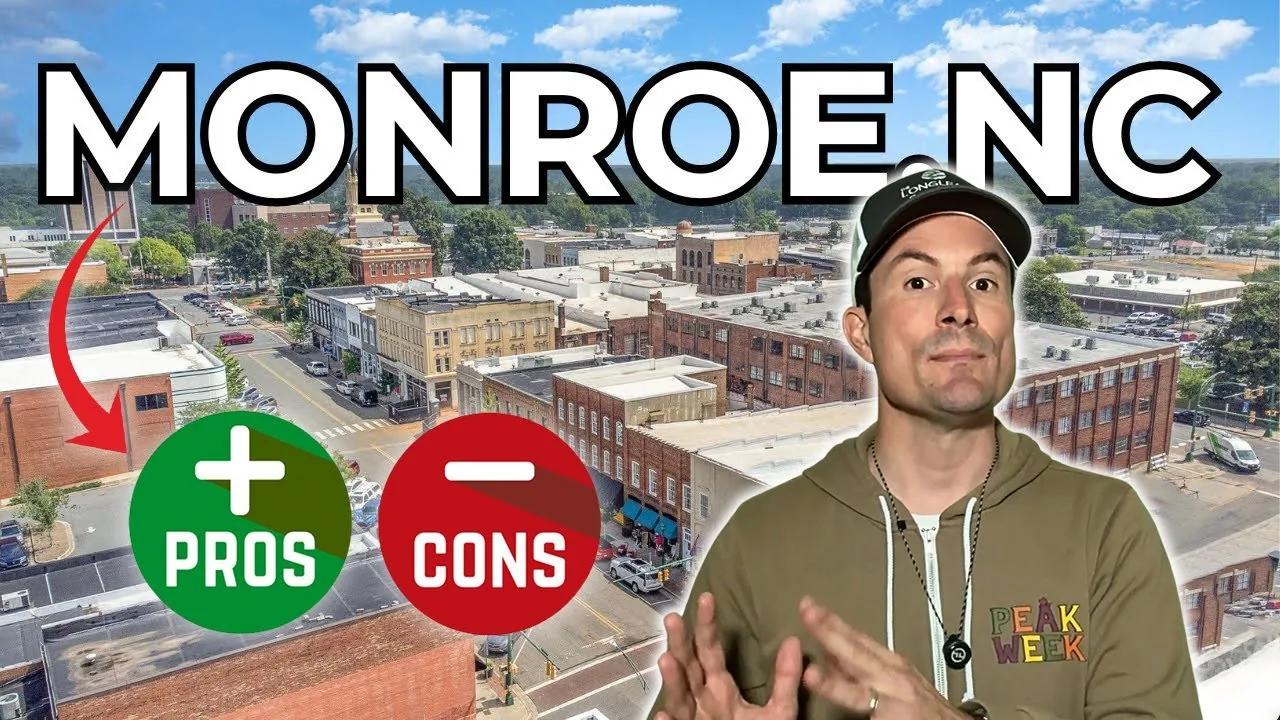
Monroe charges a city property tax of 44 cents per $100 of value on top of Union County’s 43.42 cents, for a combined 87.42 cents in fiscal year 2025 to 2026, the second highest combined rate of any municipality in the county (North Carolina Department of Revenue, pulled September 6, 2026). That is a real number and it puts people off. What it does not tell you is that Monroe is also the only place in Union County where the city sells you your electricity and your natural gas, which changes the comparison in a way a tax rate alone cannot show.
Quick answer
Monroe is the county seat of Union County, North Carolina, and the fastest growing municipality in the county by percentage. It carries the second highest combined property tax rate in Union County, and in exchange the city runs its own electric and natural gas utilities, its own water and sewer, and its own airport.
- Population: 39,256 as of July 1, 2024, up about 13 percent from 34,626 in the 2020 Census base (NC Office of State Budget and Management, certified estimates)
- Property tax: Union County 43.42 cents plus Monroe 44 cents equals 87.42 cents per $100 (NCDOR, fiscal year 2025 to 2026)
- The Monroe Expressway, a 19.8 mile tolled US 74 bypass, connects Union County to Mecklenburg County (NC Turnpike Authority)
| Population | 39,256 as of July 1, 2024, up about 13 percent from 34,626 in 2020 |
|---|---|
| Combined property tax | 87.42 cents per $100 for FY 2025-26: county 43.42 plus city 44 |
| Tax on a $400,000 home | About $3,497 a year before any fire district charge |
| Utilities | City runs electric since 1900, natural gas since 1957, water and sewer |
| Schools | Union County Public Schools, Monroe and Forest Hills clusters, split feeders |
| Route to Charlotte | Old US 74, or the 19.8 mile tolled Monroe Expressway bypass |
Who provides electricity and gas in Monroe NC?
This is the part that never makes it into a cost comparison. Monroe’s Energy Services department describes itself as a customer owned and financed energy supplier, and it has been distributing electricity in Monroe since 1900 and natural gas to Monroe and Union County since 1957 (City of Monroe, pulled September 6, 2026). Move inside the city and your power bill and your gas bill both come from the same government that sends the tax bill.
That cuts both ways and you should treat it that way. A municipal utility means one place to call and rates set by people you can vote out. It also means your electric rate is not set by a state regulated investor owned utility, so you cannot assume it tracks what a neighbor in Indian Trail pays. Before you buy, ask a current Monroe resident on the same block for two things: a summer electric bill and a January gas bill. Those two numbers will tell you more about your monthly cost than the tax rate will.
Monroe and Indian Trail are growing at nearly the same rate
Monroe went from 34,626 residents in the 2020 Census base to a certified 39,256 on July 1, 2024, about 13 percent in four years. Indian Trail, which is still the county’s largest municipality at 45,045, grew about 12 percent over the same period (NC Office of State Budget and Management certified municipal population estimates, pulled September 21, 2026).
That is closer than the picture a lot of people carry around, which is Monroe as the sleepy county seat while the west side of the county booms. One point of growth over four years is not much of a lead, and it is small enough that a different set of estimates could put Indian Trail ahead instead. What is not close is size: Indian Trail is still about 5,800 residents larger. Union County as a whole went from 238,237 to 266,672 in the same four years.
The commute changed in ways old advice missed
Any advice about Monroe that describes US 74 as the only way to Charlotte is out of date. The Monroe Expressway is a 19.8 mile, six lane tolled bypass of US 74 that gives Union County drivers an alternative route into Mecklenburg County (NC Quick Pass, N.C. Turnpike Authority, pulled September 6, 2026). It is a toll road, and the Turnpike Authority prices it so that an NC Quick Pass account pays roughly half what a driver billed by mail pays.
What that means practically is that your Monroe commute is a budget decision rather than a fixed fact. Free on old US 74 through every light in Indian Trail and Stallings, or paid on the bypass. Price a month of tolls at the Turnpike Authority’s own calculator before you decide the drive is unlivable, and price it again for two commuters if that is your household.
Does Monroe NC have a real downtown?
Monroe has something most of Union County does not, which is an actual historic center with a street grid, storefronts and a courthouse. It also has an official social district, adopted after North Carolina House Bill 890 became Session Law 2021-150 on September 10, 2021. Inside the district you can carry a drink bought from a participating business Monday through Saturday from 8 a.m. to midnight and Sunday from 10 a.m. to midnight (City of Monroe, pulled September 6, 2026).
If you have been comparing Union County towns and finding all of them a little placeless, this is the one that already has the thing Indian Trail adopted a plan to build in 2023.
What schools serve Monroe NC and which are split?
Monroe addresses are inside Union County Public Schools, which organizes attendance into high school clusters. Monroe city addresses generally fall in the Monroe cluster, served by East Elementary and Walter Bickett Elementary, with Rocky River Elementary listed as a split feeder and Rock Rest Elementary split between the Monroe and Forest Hills clusters (Union County Public Schools attendance and boundary maps, pulled September 6, 2026).
A split feeder means the elementary school itself sends students to more than one middle and high school. That is not something a listing site will get right. Confirm the exact street address with Union County Public Schools and get all three levels in writing before you write an offer. Assignment as described here was checked in September 2026.
What Monroe runs itself
| Item | Who provides it | Detail |
|---|---|---|
| Electric distribution | City of Monroe Energy Services | Serving Monroe since 1900 |
| Natural gas | City of Monroe Energy Services | Serving Monroe and Union County since 1957 |
| Water and sewer | City of Monroe | City department |
| General aviation airport | Charlotte-Monroe Executive Airport | City of Monroe department |
| Public schools | Union County Public Schools | Monroe and Forest Hills clusters, with split feeders |
| City property tax | City of Monroe | 44 cents per $100, FY 2025 to 2026 |
| County property tax | Union County | 43.42 cents per $100, FY 2025 to 2026 |
| Combined rate | 87.42 cents per $100 |
Sources: North Carolina Department of Revenue 2025 to 2026 County and Municipal Tax Rates, City of Monroe department pages, and Union County Public Schools attendance and boundary maps, all pulled September 6, 2026. Fire district charges are billed separately.
The tradeoff, stated plainly
Monroe gives you the lowest entry prices in Union County, a real downtown you can walk, city run utilities, and an older housing stock with actual architecture instead of another 2019 elevation. What it takes is the highest tax rate in the county outside Marshville, a longer drive to Charlotte that is either slow or tolled, and a school picture with split feeders that you have to verify address by address rather than assume.
If your budget is the binding constraint and you would rather have a downtown than a new subdivision, this is the honest answer in Union County. If your drive to Charlotte is daily and non negotiable, run the toll math before you fall for the price.
On this site, see everything filed under Monroe, and the nearest comparison at Indian Trail.
Frequently asked questions
What is the property tax rate in Monroe NC?
For fiscal year 2025 to 2026 the combined rate is 87.42 cents per $100 of assessed value: 43.42 cents from Union County and 44 cents from the City of Monroe, per the North Carolina Department of Revenue, checked September 6, 2026. Only Marshville has a higher combined rate in Union County. Fire district charges are separate.
Does the City of Monroe provide electricity?
Yes. The City of Monroe Energy Services department distributes both electricity, which it has done since 1900, and natural gas, which it has done since 1957, and describes itself as a customer owned and financed energy supplier, confirmed September 2026. Ask a current resident for a real summer electric bill before you budget.
Is Monroe growing?
Yes, at about the same rate as Indian Trail. Monroe went from 34,626 residents in the 2020 Census base to a certified 39,256 on July 1, 2024, about 13 percent, while Indian Trail grew about 12 percent to 45,045 over the same period, per NC Office of State Budget and Management certified estimates pulled September 21, 2026.
How long is the drive from Monroe to Charlotte?
It depends on which road you take. Old US 74 runs through every signal in Stallings and Indian Trail. The Monroe Expressway is a 19.8 mile tolled six lane bypass connecting Union County to Mecklenburg County, and an NC Quick Pass account pays roughly half what a driver billed by mail pays, per the N.C. Turnpike Authority, checked September 6, 2026. Price a month of tolls before you judge the commute.
Does Monroe have a social district?
Yes. Monroe’s downtown social district allows drinks from participating businesses to be carried inside the district Monday through Saturday from 8 a.m. to midnight and Sunday from 10 a.m. to midnight. It was made possible by North Carolina House Bill 890, signed as Session Law 2021-150 on September 10, 2021, per the City of Monroe, checked September 6, 2026.
Updated September 2026. Tax rates from the North Carolina Department of Revenue, 2025 to 2026 County and Municipal Tax Rates and Effective Tax Rates, pulled September 6, 2026. Population from NC Office of State Budget and Management certified municipal and county population estimates for July 1, 2024, pulled September 21, 2026. Utility, social district and airport details from City of Monroe department pages, pulled September 6, 2026. Monroe Expressway details from NC Quick Pass and the N.C. Turnpike Authority, pulled September 6, 2026. School clusters from Union County Public Schools attendance and boundary maps, pulled September 6, 2026. The video above is older than these figures.