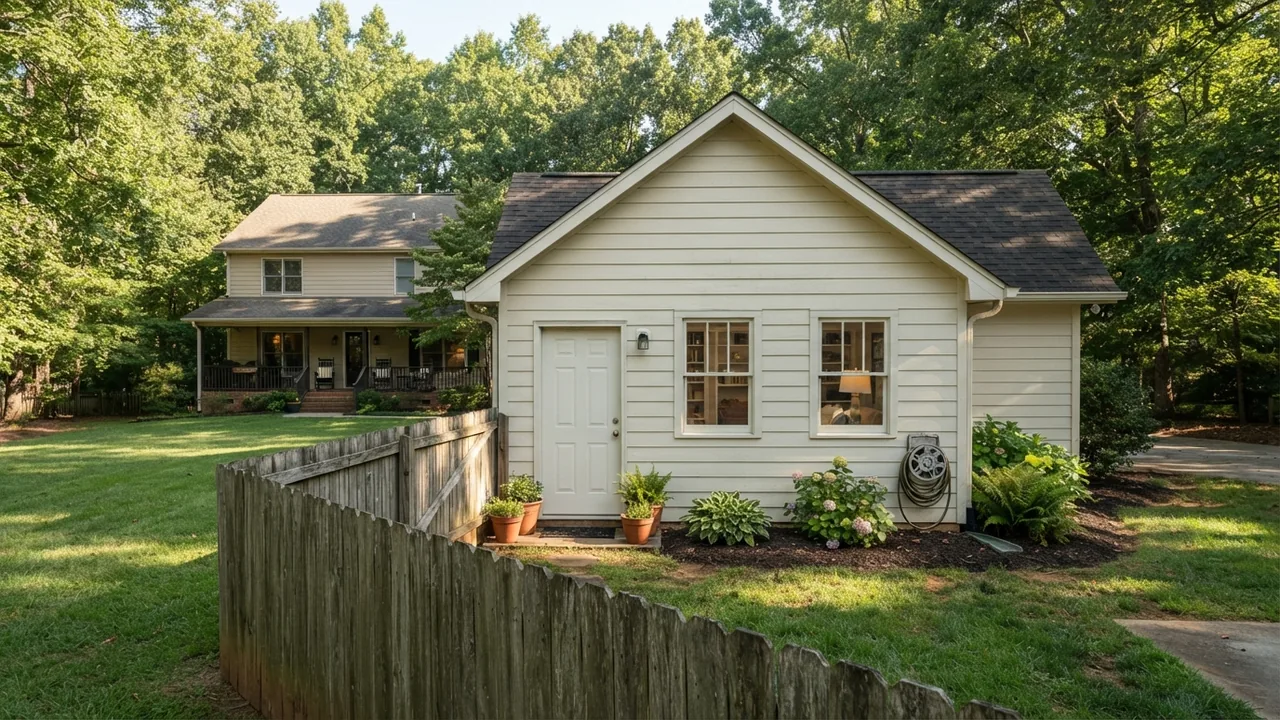
If you have been reading that North Carolina finally opened the door to backyard cottages, there is a good chance you have already pictured one behind your own house. It’s true that the state did exactly that. Governor Josh Stein signed Session Law 2026-59 on August 11, 2026, and beginning January 15, 2027 it requires certain cities to allow at least one accessory dwelling unit for every single-family house. The limit sits in the last line of the new statute: it applies only to cities with 50,000 or more residents. Of the ten North Carolina towns covered by this publication, exactly one clears that bar.
That one is Charlotte, which is why this lands in Ballantyne and almost nowhere else nearby. Here is what the law requires, which towns it reaches, what it changes for a Charlotte homeowner who could already build one, why your HOA is untouched, and the one section of the same act that does reach every town here.
16 min read | By Steve Jarrell | Living in South Charlotte | Updated September 20, 2026
Free · 26-Page Insider Guide
Still deciding which South Charlotte town fits you?
Towns compared, NC vs SC taxes and schools side by side, and the 5 mistakes out-of-state buyers make.
What This Story Covers
- The short answer
- What does the NC ADU law actually say?
- Which South Charlotte towns does it cover?
- What changes in Ballantyne, and what does not
- Your HOA rules are untouched
- The part of the same act that does reach every town here
- How we got here, and what the county did about it
- What should you watch before July 2027?
The short answer
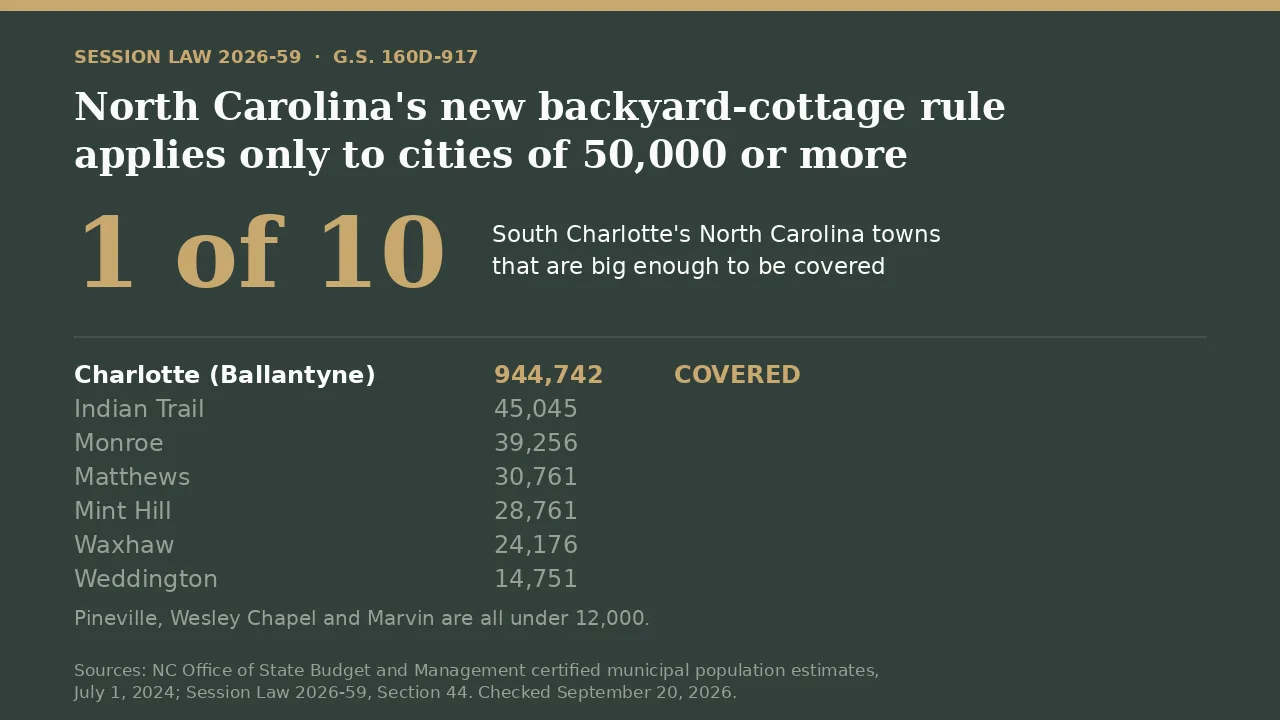
The NC ADU law covers one place in South Charlotte, and that place is Charlotte. If you live anywhere else in this market, it doesn’t reach you. Session Law 2026-59 created a new statute, G.S. 160D-917, whose final subsection reads: “This section applies only to cities with a population of 50,000 or greater, that are not in the coastal area, as that term is defined in G.S. 113A-103.” Charlotte had 944,742 residents in the certified July 1, 2024 estimate from the NC Office of State Budget and Management. The next largest town here is Indian Trail at 45,045, and you can see the rest of the gap in the table below.
The Short Answer
North Carolina’s new accessory dwelling unit requirement starts on January 15, 2027, and it applies only to cities of 50,000 or more. In South Charlotte that means Charlotte, and therefore Ballantyne. If your address is in any other town here, the rule doesn’t reach you, and it doesn’t touch Fort Mill, Tega Cay or Indian Land at all, because those are in South Carolina.
Key numbers, South Charlotte, September 2026 (sources: Session Law 2026-59; NC Office of State Budget and Management):
- 50,000 residents is the city population floor written into G.S. 160D-917(h)
- 1 of 10 North Carolina towns in this coverage area clears it, and it is Charlotte
- 45,045 is Indian Trail, the closest of the rest, certified as of July 1, 2024
- January 15, 2027 is when the requirement starts applying to permit applications
- July 1, 2027 is the deadline for a covered city to adopt its own ADU rules
- 800 to 1,000 square feet is the range a covered city’s own size cap has to fall inside
| Measure | Status | Source document |
|---|---|---|
| Who it covers | NC cities of 50,000 or more, outside the coastal area | Session Law 2026-59, Section 44, G.S. 160D-917(h) |
| Towns covered here | Charlotte only, which includes Ballantyne | NC OSBM certified estimates, July 1, 2024 |
| When it starts | Permit applications filed on or after January 15, 2027 | Session Law 2026-59, Section 44(d) |
| Local rules deadline | July 1, 2027, or ADUs are allowed with no limits | Session Law 2026-59, Section 44(c) |
| Size floor | A city cannot cap an ADU below 800 square feet | G.S. 160D-917(b)(6) |
| Parking | A city cannot require parking for an ADU | G.S. 160D-917(b)(3) |
| HOA covenants | Not affected | G.S. 160D-917(e)(1) |
| Fee transparency | Every NC local government, no population floor | Session Law 2026-59, Section 49, G.S. 160D-402.1 |
| South Carolina towns | Not affected, this is North Carolina law | Fort Mill, Tega Cay and Indian Land are in SC |
I went into this expecting a straightforward story about the state making backyard cottages easier, because that is how it was being written up. The population line in the last subsection changes the whole thing. It is one sentence at the bottom of the section, after two pages of detailed requirements, and it quietly removes nine of the ten North Carolina towns I write about. If you only read the summary, you would never find it.
Talk to a local broker
Wondering what a second unit would do to a South Charlotte property?
Bring me the address and I will tell you what the local rules there actually allow. No pressure, just answers.
Schedule a 15-Minute Introductory Call →704-774-7170 · steve@jarrellhomes.com · thelongleafgroup.com
What does the NC ADU law actually say?
You’ve probably heard three or four names for the same thing. An accessory dwelling unit is a second, smaller home on the same lot as your main house. Backyard cottage, garage apartment, guest house, in-law suite: G.S. 160D-917(g) treats them all the same, as an attached or detached residential structure on the same parcel as the primary single-family dwelling, with less total square footage than that main house.
The requirement itself is short. A covered city has to allow at least one for every single-family detached house, in any residential zone where single-family houses are already allowed, and you can build it with the main house or years later. That’s the whole duty. The rest of the section lists what a city may no longer do.
Those six limits are where the real change sits, and they’re worth reading closely if you’re weighing a project. A covered city can’t force you into a conditional zoning process. It can’t require parking for the unit, including on a conversion. It can’t stop you renting the main house and the ADU long term to two separate households. It can’t block a utility connection to lines already serving the main house where that service has capacity. It can’t charge you fees beyond a comparable single-family permit. And on size, it can’t “Set a maximum accessory dwelling unit size of less than 800 square feet or greater than 1,000 square feet.”
Cities keep three powers, and you’ll meet all three in a real plan review: a setback of 10 feet or the district’s normal setback, whichever is smaller; a requirement that the unit sit to the side or rear; and a requirement that it be smaller than the main house.
Four things sit outside the section entirely: private covenants, properties in a local historic preservation district, properties designated a National Historic Landmark by the Department of the Interior, and any unit not connected to water, well and septic, or sewer. One more rule catches people later. Once an ADU is permitted on a parcel, you can’t subdivide it and sell the two buildings separately.
Two dates matter to you. The requirement starts January 15, 2027 and applies to permit applications filed on or after that day. Covered cities then have until July 1, 2027 to write their own rules, and if one misses that deadline the act says “accessory dwelling units shall be allowed in that local government without any limitations.” That’s unusual drafting, and it gives a city a strong reason to legislate on time, because the penalty for silence is no local rules at all.
Which South Charlotte towns does it cover?
One. Charlotte, and with it Ballantyne, which sits inside the city limits and has no town hall of its own. Every other North Carolina town in this coverage area is far below the 50,000 line, and the three South Carolina communities are outside the reach of a North Carolina statute entirely.
Here are the certified numbers, so you can find your own town. They all come from the same NC Office of State Budget and Management file for July 1, 2024. Charlotte, 944,742. Indian Trail, 45,045. Monroe, 39,256. Matthews, 30,761. Mint Hill, 28,761. Waxhaw, 24,176. Weddington, 14,751. Pineville, 11,379. Wesley Chapel, 9,459. Marvin, 6,994. Only the first clears the line, and the second is about 5,000 residents short.
Statewide the picture is just as narrow, which surprised me. Twenty-two North Carolina municipalities carried 50,000 or more in that file, out of 550. This isn’t a statewide backyard cottage law. It’s a law for the two dozen largest cities, one of which happens to contain the southern edge of this market.
If you’re in Fort Mill, Tega Cay or Indian Land, none of this applies to you at all. That state line already governs more of your cost of living than most people expect, and we walked through one version of it in the post on the Mecklenburg sales tax rate.
One drafting detail is worth your attention, because it may matter to Indian Trail in a few years. Subsection (h) says “a population of 50,000 or greater” without saying where that number comes from. The neighboring section in the same act is explicit: it applies to cities of 80,000 or greater in counties of 1,000,000 or greater “according to the most recent federal decennial census.” The ADU section carries no such phrase. Whether a town crosses on the 2030 census or on a certified state estimate is a question for a land use attorney, and I’m not one.
What changes in Ballantyne, and what does not
Less than the headlines suggest, because Charlotte already allows accessory dwelling units. The city’s Unified Development Ordinance permits one “In conjunction with a single-family dwelling in any zoning district in which a single-family dwelling is allowed”, subject to the conditions in Section 15.6.F: one per lot, the unit and the main house under the same ownership, and no separate driveway unless the lot is a corner lot, a through lot or one that backs an alley.
Some of that survives. Same ownership is about title rather than rental, so it stands, and the driveway rule isn’t a parking minimum. The size formula is where the two documents actually meet, and it’s the one worth doing the arithmetic on.
Charlotte’s rule for a unit inside an accessory structure reads: “The heated floor area of the ADU shall not exceed 600 heated square feet or 70% of the total floor area of the principal residential use, whichever is greater. However, in no case shall the ADU exceed 1,000 heated square feet.”
Run that against your own house and the 600 figure almost never binds. Seventy percent of a 1,500 square foot house is 1,050, which the 1,000 ceiling trims. Charlotte’s cap only falls below the state’s 800 square foot line where the main house is under roughly 1,143 square feet. In Ballantyne, where houses run well above that, the two rules land in the same place on nearly every lot you’d be looking at.
So the practical changes are narrower than the coverage implies: no parking requirement, no fee premium over a comparable single-family permit, and a clear right to rent the main house and the unit to two separate households on long term leases. That last one is worth knowing before you price a project. What hasn’t changed is that you could already build one. Ballantyne’s relationship with city government is unusual, and we covered why in the piece on daily life in Ballantyne, which has no town hall to call.
Charlotte also doesn’t have to start over. Section 44(b) says a local government whose ordinance already meets the requirements need not adopt a new one. The city still has to reconcile the conflicting pieces before January 15, 2027, and until it publishes that work, nobody outside the planning department can tell you where it lands.
The part I would tell a client to check first is the one the statute deliberately leaves alone. Nine times out of ten in this market, the document that decides whether a backyard cottage happens is not the town ordinance at all. It is the covenants that came with the neighborhood. I have read a lot of those pages over the years, and a clean state law does not move a single line of them.
Talk to a local broker
Not sure which set of rules governs the house you are looking at?
Town ordinance, county rules and neighborhood covenants all say different things, and I read them every week.
Book a 15-minute call →Your HOA rules are untouched
This is the sentence most of the coverage skips, and in your neighborhood it usually decides the outcome. G.S. 160D-917(e)(1) says nothing in the section applies to “The validity or enforceability of private covenants or other contractual agreements among property owners related to dwelling type restrictions.” A state law telling Charlotte what it cannot require has no effect on what your neighborhood association already requires.
That matters more here than in most of the state, and it’s why I start with the covenants rather than the ordinance. Ballantyne is built almost entirely as covenanted subdivisions, as is most newer housing across Waxhaw, Weddington, Marvin and Indian Trail. Plenty of those documents restrict a lot to one dwelling, bar separate kitchens in accessory buildings, or require architectural approval above a set size. None of it changes on January 15, 2027.
Covenants also vary lot to lot, and some are weaker than people assume. We wrote about a neighborhood where the HOA is voluntary but the rules still shape what happens. The only way to know is to read the document for your address, so have your closing attorney pull the recorded covenants and architectural guidelines before you go under contract.
The part of the same act that does reach every town here
Here’s the part that does reach you. Section 49 of the same law created G.S. 160D-402.1, and it carries no population threshold. It applies to every local government in North Carolina, so Waxhaw, Weddington, Marvin, Matthews, Mint Hill, Indian Trail, Monroe, Wesley Chapel and Pineville are all covered by it even though none are covered by the ADU rule.
What it requires is fee transparency, and it has teeth. Every local government has to publish its current fee schedules prominently on its website and update them within 30 days of any ordinance changing a fee, a rate or the methodology behind one, then file an annual compliance report with the Local Government Commission, which publishes a statewide report.
The applicant side is more concrete, and you’ll feel this one directly. Once you submit a completed application, the local government has 10 business days to give you the fee schedule and an estimate, and it can’t require payment before providing that estimate. If the project materially changes, you get a revised estimate within 10 business days. When the approval is issued you get a final, binding, written statement of exact fees due, and it can’t exceed the most recent estimate unless the town has adopted a new fee schedule by ordinance in the meantime. If a local government won’t comply, you can go to superior court to compel it.
For anyone building or adding on here, that’s a bigger practical change than the ADU section. Permit and impact fees have been one of the least predictable costs in the fast growing parts of Union and Mecklenburg counties, and a binding number that can’t drift upward mid-project belongs in your budget.
How we got here, and what the county did about it
If you followed any of this last year, the bill you remember isn’t the one that passed. That was House Bill 765, the Save the American Dream Act, and it would have reached every town here. Its last recorded action was May 6, 2025, when the House re-referred it to the Committee on Finance. The General Assembly’s bill page records nothing after that date, and it never became law.
Union County went on record against it, and you can read the vote yourself. On Monday, May 5, 2025, the Board of Commissioners took up file 25-245, titled “Resolution – Oppose HB765”. The county record shows the outcome: “Vice Chair Helms moved that this Business be adopted. The motion carried by the following vote:” and the roll call lists Brian Helms, Melissa Merrell, Clancy Baucom and Gary Sides voting aye, with Christina B. Helms absent. Four to nothing.
What did pass took a different route. Senate Bill 445 began as the Regulatory Reform Act of 2026, and the two chambers couldn’t agree on it. On June 23, 2026 the Senate refused to concur in the House committee substitute, 0 to 45, sending it to conference. The Senate adopted the conference report on July 29, 2026 by 37 to 0. The House adopted it on August 4 by 84 to 26, with no Republican voting against it, 20 Democrats joining the majority and 26 Democrats opposed. It was ratified August 6 and signed at 8:03 a.m. on August 11, 2026.
The act’s own title states its purpose: “AN ACT TO PROVIDE FURTHER REGULATORY RELIEF TO THE CITIZENS OF NORTH CAROLINA.” Supporters in both chambers treated the housing sections as supply and cost measures. The counties and towns that opposed the earlier bill objected to the state setting local development standards from Raleigh. Both positions are on the record in the votes and the resolution above, and I’m not going to tell you which one is right. What changed is that the version reaching the governor applies to two dozen cities rather than every jurisdiction. That tension is familiar here, as it was in the sewer capacity question in Union County.
What should you watch before July 2027?
Three things, in order of how likely they are to affect you. First, Charlotte’s ordinance work. The city has until July 1, 2027 to adopt regulations implementing the new section, and until it does, how its Section 15.6.F conditions square with the new state limits is not settled on paper. If your Ballantyne project turns on parking relief or the rental provision, ask Charlotte planning directly rather than assuming.
Second, Indian Trail. At 45,045 residents in the certified July 1, 2024 estimate, it is the only other town here near the line, and it has been one of the faster growing places in Union County for a decade. If it crosses 50,000 and the relevant count is read to include it, the requirement would apply there too. That’s a possibility rather than a prediction, and the ambiguity in subsection (h) means nobody should treat it as automatic. For the local cost picture meanwhile, see the piece on what Indian Trail charges residents.
Third, the fee transparency rollout. Every town here has to publish a current fee schedule and file annual reports with the Local Government Commission, producing something that has never existed: a published statewide comparison of what each local government charges to build.
If you’re shopping right now with a second unit in mind, the order is simple. Check the covenants for that address first, because they override everything else for most of this market. Then check the town, because nine of the ten places here are still setting their own ADU rules with no state floor under them. Only in Charlotte does the new law do any of that work for you, and even there it starts in January.
Frequently Asked Questions About the NC ADU Law
What is an accessory dwelling unit?
It is a second, smaller home on the same lot as the main house, also called a backyard cottage, a garage apartment, a guest house or an in-law suite. Under G.S. 160D-917(g) it is an attached or detached residential structure on the same parcel as the primary dwelling, with less total square footage than that main house.
Can I build an ADU in Charlotte, NC?
Charlotte already permits one in any zoning district where a single-family dwelling is allowed, subject to the conditions in Section 15.6.F of the Unified Development Ordinance. From January 15, 2027 the new state law adds limits on what the city can require. Your neighborhood covenants are separate and can still prohibit one.
What are the size limits for an ADU under the new NC law?
A covered city cannot set a maximum below 800 square feet or above 1,000 square feet. Charlotte currently caps a unit inside an accessory structure at 600 heated square feet or 70 percent of the main house floor area, whichever is greater, and never more than 1,000. For most Charlotte houses both rules produce the same 1,000 square foot ceiling.
Is extra parking required for an ADU in North Carolina?
Not in a covered city. G.S. 160D-917(b)(3) bars a covered local government from setting minimum parking requirements or other parking restrictions for an accessory dwelling unit, including extra parking on a conversion. In a town below 50,000 residents, local parking rules still apply in full.
Can I rent out my ADU separately from the main house?
In a covered city, yes. G.S. 160D-917(b)(1) bars a covered local government from prohibiting the use of the main house and the accessory unit for long term rentals by separate households. It says nothing about short term rentals and creates no right to operate one.
Does the new NC ADU law override HOA rules?
No. Subsection (e)(1) states that nothing in the section applies to the validity or enforceability of private covenants or other contractual agreements among property owners related to dwelling type restrictions. If your recorded covenants bar a second dwelling, they still bar it. Read the documents for your address before planning anything.
Which North Carolina cities does the 2027 ADU law cover?
Cities with 50,000 or more residents that are not in the coastal area, as defined in G.S. 113A-103. Twenty-two North Carolina municipalities cleared that in the certified July 1, 2024 state estimates. In South Charlotte that means Charlotte alone, which includes Ballantyne.
About the Author
Steve Jarrell is team lead of The Longleaf Group, a team at eXp Realty, and co-leads it with his wife Amanda. He lives in Weddington and works these towns every week, which is why a statute that stops at a population line is worth an afternoon of reading rather than a headline. Before real estate, Steve joined VisualTour as President, led its rebrand to Paradym, and led the company to its acquisition by Constellation Software in 2020. Reading the source document rather than the summary of it is a habit from that work.
If a second unit, a lot size rule or a set of covenants changes the math on a South Charlotte purchase, he is happy to look at the specific address with you. The Longleaf Group is an eXp ICON Team with 140+ five-star reviews, serving Weddington, Waxhaw, Marvin, Matthews, Mint Hill, Indian Trail, Monroe, Wesley Chapel, Ballantyne, Pineville, Fort Mill, Tega Cay and Indian Land. Reach him at 704-774-7170 or read more at his bio page.
How we sourced this
I opened every source here on September 20, 2026, and none of these figures came from a summary. The statute is the ratified text of Senate Bill 445, Session Law 2026-59, and the legislative history and roll calls come from the General Assembly’s bill page for it. House Bill 765’s status is from its own bill page. Population figures are the certified municipal estimates for July 1, 2024 published by the NC Office of State Budget and Management. Charlotte’s current rules are from Article 15 of the city’s Unified Development Ordinance. The Union County resolution, its roll call and the staff report are from the county’s public meeting record for May 5, 2025.
Two things I dropped rather than publish. Search results described town level resolutions against HB 765 in several Union County municipalities with specific dates; none could be confirmed against a town record in this run. Search results also described a 2023 state law requiring every municipality over 10,000 residents to allow accessory dwelling units. That is not correct: House Bill 409 was referred to a Senate committee on April 26, 2023 and never became law, and Session Law 2026-59 creates G.S. 160D-917 as an entirely new section of the statutes.
None of this is legal advice. No statement about a specific property should be relied on without checking that property’s recorded covenants and its town’s current ordinance, and whether a parcel qualifies is a question for the local planning department.
Last updated: September 20, 2026.