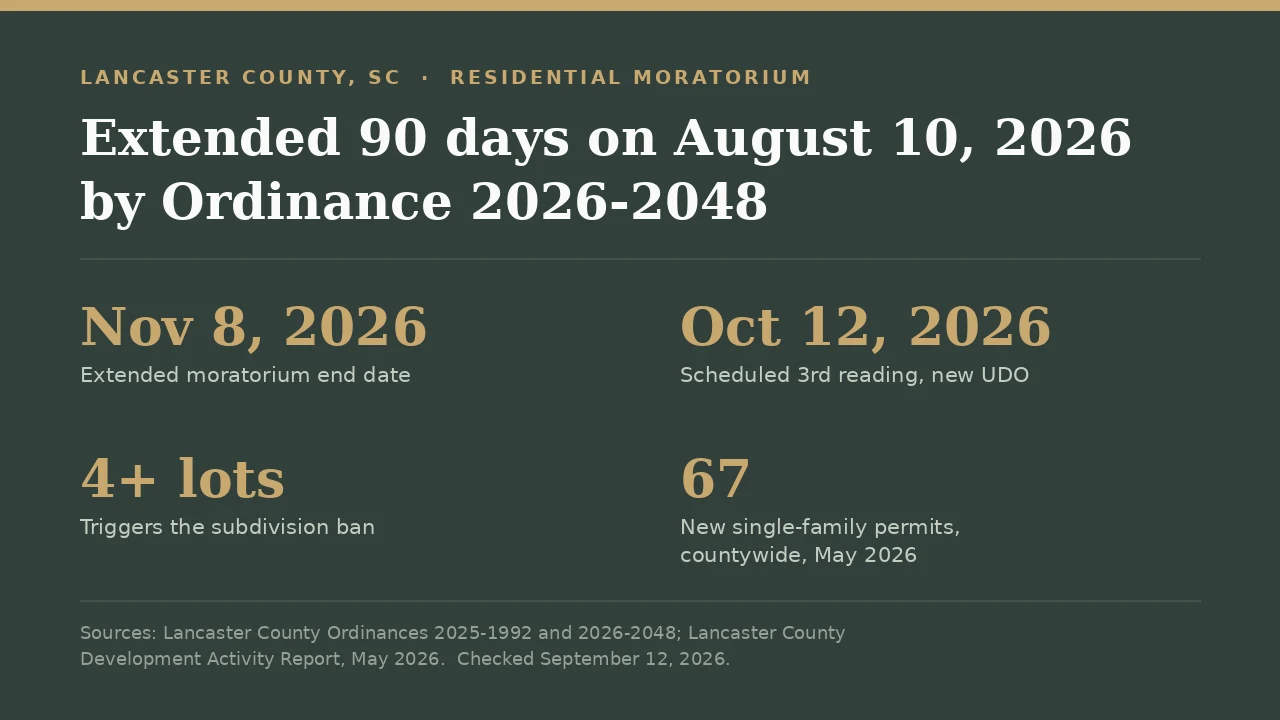
Indian Land is still under a building moratorium. It was supposed to end in August, and instead Lancaster County extended it another 90 days, which puts the new expiry somewhere around November 8.
That is the headline, and it is also the part most people get wrong, because the freeze stops far less than the phrase suggests. It does not stop you from building a single house on a lot you already own. It does not touch commercial work. Six months into it, the county issued 67 permits for new single family homes.
I read both ordinances line by line, and one thing in them has not been reported anywhere I can find. The original moratorium contained a section protecting projects already in the pipeline. In the version County Council actually adopted, that section is struck through. Below is what the freeze stops, what it leaves alone, when it really ends, and how to check a specific parcel yourself before you sign anything.
15 min read | Living in South Charlotte
Free · 26-Page Insider Guide
Weighing Indian Land against the NC side?
Towns compared, NC vs SC taxes and schools side by side, and the 5 mistakes out-of-state buyers make.
What This Story Covers
- The short answer on the Indian Land building moratorium
- What the moratorium actually stops
- What it does not stop
- Why did the county extend it in August?
- When does the Indian Land building moratorium end?
- How do you check whether a specific property is affected?
- What this means if you are buying or building here
- Frequently asked questions
- How we sourced this
The short answer on the Indian Land building moratorium
The Indian Land building moratorium is active, it was extended on August 10, 2026, and as written it runs to on or about November 8, 2026. It blocks new residential subdivisions and new multifamily developments on unincorporated land inside a boundary the county drew by legal description. It doesn’t block you building a house on a lot you already own, and it doesn’t block commercial construction.
The Short Answer
Yes, the moratorium is still on. Lancaster County Council extended it by 90 days on August 10, 2026. It stops the county from accepting or approving applications for new residential subdivisions and new multifamily developments inside a mapped boundary covering unincorporated land in the panhandle. Building a single home on a lot that already exists is not what this ordinance is aimed at, so if you own a lot here, read on before you assume you’re stuck.
Key numbers, unincorporated Lancaster County, September 2026 (sources: Lancaster County Ordinances 2025-1992 and 2026-2048, Lancaster County Development Activity Report):
- November 10, 2025: third reading of the original nine month moratorium, Ordinance 2025-1992
- August 10, 2026: third reading of the 90 day extension, Ordinance 2026-2048
- On or about November 8, 2026: 90 days after that third reading, which is where the extension currently runs out
- October 12: the date the county has scheduled for third reading of the new Unified Development Ordinance
- More than three lots: the size at which a land division becomes a “subdivision” under the ordinance
- 67: new single family home permits issued countywide in May 2026, six months into the moratorium
| Measure | Status | Source document |
|---|---|---|
| Original ordinance | 2025-1992, third reading November 10, 2025 | Ordinance 2025-1992, signature page |
| Extension ordinance | 2026-2048, third reading August 10, 2026 | Ordinance 2026-2048, signature page |
| Length of the extension | 90 days from third reading | Ordinance 2026-2048, Section 7 |
| Current end date | On or about November 8, 2026 | Ordinance 2026-2048, Sections 2 and 7 |
| Earlier end trigger | When the county implements a revised Unified Development Ordinance | Ordinance 2025-1992, Section 4 |
| Area covered | Unincorporated property inside a boundary set by legal description, excluding the Town of Van Wyck | Ordinance 2025-1992, Section 3 |
| What triggers it | A division producing more than three lots, or a building with two or more dwelling units | Ordinance 2025-1992, Section 6 |
| New UDO third reading | Scheduled for October 12 | Lancaster County proposed UDO page |
I went looking for a clear answer on this one and couldn’t find it in any news story, so I opened both ordinances myself. They run eight pages and four pages, and between them they settle almost every question people in Indian Land are asking right now. What I didn’t expect was how narrow the ban gets once you read the definitions section. The headline says moratorium. The text says something much more specific.
Talk to a local broker
Not sure how the moratorium affects the lot you’re looking at?
Send me the address and I’ll walk you through what the county record shows. No pressure, just answers.
Schedule a 15-Minute Introductory Call →704-774-7170 · steve@jarrellhomes.com · thelongleafgroup.com
What the moratorium actually stops
The moratorium suspends county action on new residential subdivisions and new multifamily developments inside the boundary. Ordinance 2025-1992 puts a temporary hold on “the acceptance of, review of, and action upon applications for issuance of zoning approvals, residential development and construction permits, site plan approvals, and any other official county action” authorizing them. During the freeze the county accepts no new applications of that kind.
Two definitions in Section 6 do most of the work, and they are the reason so many people misread this. A “subdivision” here means a division of land producing more than three lots in total, counting the parent tract. So splitting a parcel into two or three lots is outside the definition. Cross into four and you are inside it. The ordinance also stretches the standard definition to cover any subdivision of property in a residential zone resulting in more than three lots.
The multifamily definition is broader than most people expect. It covers any development that includes a building containing two or more dwelling units. The ordinance then lists what that includes: mixed use buildings, apartment buildings, apartment courts, garden apartments, stacked flats, townhouses and townhomes, cottage courts, duplexes, triplexes, fourplexes, bungalows, multiplexes and live work units. A duplex is a multifamily development under this ordinance. That catches a lot of small projects people wouldn’t think of as apartments.
One detail in the adopted text is worth knowing. The ordinance as signed carries a Section 8 titled “Effect on Pending Matters,” and that entire section is struck through. Had it survived, it would have protected approvals and permits submitted before the ordinance was introduced, and permits or site plan reviews already holding preliminary or final plat approval. It is lined out in the version the county publishes. What governs pending projects instead is Section 7, below.
What it does not stop
This is where most of the confusion lives, so here is the plain version. The moratorium doesn’t stop you building a single house on a lot that already exists. It doesn’t stop commercial construction. It doesn’t stop work on projects that already hold vested rights. And it has not stopped permits from flowing in Lancaster County generally.
The county publishes a Development Activity Report every month, and it is public. Take May 2026, six months into the freeze.
Lancaster County issued 313 permits that month, carrying about $36.8 million in declared value. Of those, 41 were new detached single family homes, averaging roughly $479,000 each. Another 26 were attached single family, averaging about $373,000.
Multifamily permits that month: zero. That one is the moratorium working exactly as written.
Commercial permits: 13. The two new businesses the county put on the front of that report were a Kay Jewelers and the Indian Land Emergency Department, both inside the moratorium area.
One caution on those figures. The report is countywide, it doesn’t break out the moratorium boundary, and Lancaster County stretches well south of the panhandle. So you can’t read 41 detached home permits as 41 inside Indian Land. What it does show is that residential permitting didn’t stop, which is what people assume a moratorium means.
Section 7 of the original ordinance is the other big exemption. It says South Carolina vested rights law may protect certain properties and owners, and that the county doesn’t intend to violate state law, so any owner lawfully protected by vested rights is exempt to the extent of that protection. It names Development Agreements and Planned District Developments with valid approvals in place as of the first reading. First reading was October 13, 2025. That single date is the line between a project that carries on and a project that waits.
That exemption explains something residents have raised repeatedly: large panhandle projects kept moving through the county process while a moratorium was in force. A project holding a development agreement approved before October 13, 2025 sits outside the ordinance by its own terms. That’s the mechanism.
Why did the county extend it in August?
Because the work the moratorium was meant to buy time for isn’t finished yet, and Ordinance 2026-2048 tells you that directly. Its recitals state that “significant progress has been made” on the planning and regulatory work, but that more time is needed to complete the review, receive public input, finalize the proposed amendments, prepare a new zoning map, and run the legislative process needed to adopt them.
The underlying project is a rewrite of the county Unified Development Ordinance, the single document holding zoning, subdivision, landscaping, parking, lighting, signs and stormwater rules. Lancaster County adopted its current UDO on November 28, 2016. The rewrite implements the Lancaster 2040 Comprehensive Plan, adopted April 2024. In the county’s own words, the UDO “regulates land use and development in unincorporated Lancaster County” and doesn’t apply inside incorporated towns.
If you want to know what the county thinks it still has to finish, Section 3 of the extension lists six things the extra 90 days are for: finishing the UDO update, finishing the revised zoning regulations and development standards, finalizing an updated zoning map, evaluating impacts to transportation, schools, utilities, public safety and parks, running public engagement, and adopting whatever further regulations Council decides are needed.
The extension wasn’t improvised, and that’s worth knowing if you’re trying to read the county’s intent. Section 5 of the original ordinance already set up this exact move: no earlier than 30 days before expiration, if the County Administrator determines there isn’t enough time for Council to consider the new UDO and zoning map, the Administrator notifies Council, and Council may then extend by up to an additional 90 days, for a total of twelve months. The extension ordinance points back at that provision, noting 2025-1992 “expressly contemplated the possibility of an additional three-month extension.”
Council reaffirmed the original findings rather than rewriting them. Section 2 of the extension states that all prohibitions, limitations, exemptions, definitions and requirements in 2025-1992 stay in full force. Nothing about what is banned or exempt changed in August. Only the clock moved.
When does the Indian Land building moratorium end?
On or about November 8, 2026, unless the new UDO lands first, in which case it ends earlier. Two provisions set that, and they agree. Section 2 of the extension extends the moratorium “for an additional ninety (90) days beyond its current expiration date.” Section 7 says the extension takes effect immediately on approval following third reading and “shall remain in effect for ninety (90) days thereafter unless earlier repealed, amended, or superseded.” Third reading was August 10, 2026. Ninety days from that’s November 8, 2026.
Neither ordinance prints a calendar expiration date, which is worth saying plainly: every date quoted for this, including mine, is arithmetic on the reading dates rather than a line you can point at. The original ran nine months from its third reading on November 10, 2025, landing on August 10, 2026, the same day Council adopted the extension.
Now the part almost nobody has connected. Section 4 of the original ordinance says the moratorium terminates nine months after third reading or when Lancaster County implements a revised Unified Development Ordinance. That’s an either/or, and the second trigger has a date attached to it. On its proposed UDO page the county posted the adoption schedule: Planning Commission on August 18, a County Council special meeting for first reading on September 1, second reading on September 28, and third reading on October 12, all at 6PM in Council Chambers.
If the county holds that schedule, the new UDO gets third reading on October 12, about four weeks before the extension would otherwise lapse. The moratorium ends when the UDO is implemented, so the realistic end date is October, and November 8 is the backstop rather than the expectation. The county calendar lists the September 1 and September 28 meetings as real items and records that the September 1 meeting took place. When I checked the county meeting portal on September 12, 2026, no October Council meeting had been posted to it yet.
If you’re under contract on a lot up here, or about to be, the most useful thing you can do this week is check the parcel yourself on the county zoning map rather than taking anyone’s word for it, mine included. The moratorium boundary doesn’t follow town names, and it doesn’t follow mailing addresses. It follows a legal description that runs along creeks, property lines and road centerlines, and it carves out the Town of Van Wyck entirely. Two lots on the same road can sit on opposite sides of it.
Talk to a local broker
Buying in Indian Land while the rules are being rewritten?
A quick call with a broker who reads these ordinances as they land, and works this market every week.
Book a 15-minute call →How do you check whether a specific property is affected?
Use the county map layer, and treat it as the only authority. Lancaster County built one into its official zoning map for exactly this question. The county instruction is to open the zoning map, turn on the “Moratorium” layer in the layers list, then enter a property address or parcel number to see whether it falls inside the boundary. That is the check that counts, and it is free.
I am not going to tell you whether a given address is in or out, and you should be wary of anyone who does it casually. The boundary in Section 3 is a metes and bounds description. It starts where the state line crosses Sugar Creek under a railway bridge, runs about 11.92 miles southeast along the state line, then about 8.08 miles south, then follows named roads including Highway 521, Highway 5 and Old Hickory Road, before tracing the Catawba River about 18.55 miles north and Sugar Creek about 4.16 miles back to the start. Individual tax parcels are named throughout.
The ordinance closes that description with a line that catches people out: the area is “inclusive of all unincorporated properties in the boundary area, and exclusive of any properties included in the Town of Van Wyck municipal jurisdiction.” Incorporated land inside the boundary isn’t covered. If you want a person rather than a map, the county lists the Planning Department at 803-285-6005 and planning@lancastercountysc.gov if you want help reading the map.
One more thing to know if you go looking. The county moratorium information page currently links to Ordinance 2025-1992 and doesn’t link the extension, Ordinance 2026-2048. Both are published, but they sit in different places on the county site, and the extension is filed under the 2026 ordinance list rather than on the moratorium page. If you read only the page titled “moratorium information,” you would come away with the original nine month ordinance and no sign that it had been extended in August.
What this means if you are buying or building here
For most buyers, less than the word suggests. If you’re buying an existing home in Indian Land, the moratorium doesn’t touch your purchase. If you’re buying a finished lot in a subdivision that was platted and approved years ago, you are almost certainly buying into something that predates all of this. The ordinance is aimed at the front of the pipeline, at new applications for new subdivisions and new multifamily projects, not at the back end where houses get built and sold.
If you’re buying raw land with a plan to divide it, the picture is different and you need the map check before you go under contract, not after. The four lot threshold is the one to watch. So is the vested rights date of October 13, 2025, which decides whether an in flight project carries on. And if your plan involves anything with two or more dwelling units in one building, including a duplex, you are inside the multifamily definition whether or not the project feels like an apartment development to you.
On what this does to prices, I am going to stop short. No study has measured the effect of this moratorium on home values in Indian Land, and I am not going to guess in either direction under a broker license. What can be said from the documents is narrow and factual: the county has not been approving new subdivisions inside the boundary since November 2025, and it issued 67 new single family home permits countywide in May 2026. Anyone quoting you a price effect from those two facts is going beyond what they support.
The wider context is worth holding onto. Indian Land is the unincorporated Lancaster County panhandle, the strip of South Carolina running up to the state line. That access is why Charlotte buyers keep crossing into Indian Land, and the growth that followed is the reason Council gave for the moratorium.
If you are weighing this area against the North Carolina side, the tax and services differences are covered in our look at what the state line changes between Indian Trail and Indian Land. Established communities here, including Sun City Carolina Lakes, were approved long before any of this and are unaffected.
Finally, the timeline. The moratorium is temporary by design and the county is on its final permitted extension, since Section 5 caps the total at twelve months. What replaces it is the new UDO, and that document, not the freeze, is what will govern building here. The county has published the draft and its FAQ, and the adoption meetings are public with comment at each reading. We have covered the same pattern on the North Carolina side, where Weddington is working through its own land use questions in documents almost nobody reads.
Frequently Asked Questions About the Indian Land Building Moratorium
How long will the Indian Land building moratorium last?
It runs to on or about November 8, 2026, which is 90 days after the extension passed third reading on August 10, 2026. It can also end sooner. Section 4 of Ordinance 2025-1992 ends the moratorium when Lancaster County implements a revised Unified Development Ordinance, and third reading of that new ordinance is scheduled for October 12. Section 5 caps the whole thing at twelve months, so no further extension is available.
Can I still build a house on a lot I already own?
Yes. The moratorium is aimed at new residential subdivisions and new multifamily developments, not at a single home on an existing lot. Lancaster County issued 41 permits for new detached and 26 for attached single family homes in May 2026, six months in. That count is countywide rather than specific to the moratorium area, so confirm your own parcel with the county first.
Does the moratorium cover all of Indian Land?
No. It covers unincorporated property inside a boundary set out by legal description in Section 3 of Ordinance 2025-1992, and it expressly excludes any property inside the Town of Van Wyck. The boundary follows creeks, road centerlines and individual property lines rather than any town name or mailing address. Lancaster County publishes a Moratorium layer on its official zoning map so you can enter an address or parcel number and see whether it falls inside.
What happens to a project that was already approved?
Section 7 of Ordinance 2025-1992 exempts properties and owners lawfully protected by South Carolina vested rights law, to the extent of that protection. It names Development Agreements and Planned District Developments holding valid approvals as of the date and time of first reading, which was October 13, 2025. That date is the dividing line. Note also that Section 8, which would have addressed pending permits and plats separately, is struck through in the adopted ordinance.
Does the moratorium apply to a duplex or a townhome?
Yes, on the face of the ordinance. Section 6 defines a multifamily residential dwelling development as any development including a building or structure containing two or more dwelling units, and it lists townhouses and townhomes, duplexes, triplexes, fourplexes, cottage courts, stacked flats, bungalows, multiplexes and live work units among the forms it covers. A small two unit building falls inside that definition even though most people would not call it an apartment project.
Will the moratorium change home prices in Indian Land?
Nobody has measured it, so there is no reliable number to give you. No published study has isolated the effect of this moratorium on values in the Lancaster County panhandle, in either direction. The documents support something narrower: no new subdivision or multifamily applications have been accepted inside the boundary since November 2025, and countywide single family permitting continued. Anything beyond that is speculation.
About the Author
Steve Jarrell is a licensed North Carolina and South Carolina broker and team lead of The Longleaf Group, a team at eXp Realty that he and his wife Amanda lead together. He works both sides of the state line every week, which means Indian Land, Fort Mill and Tega Cay in South Carolina and Waxhaw, Weddington, Marvin and Indian Trail in North Carolina. Reading the ordinance rather than the headline is a habit that comes from how often the two disagree.
Before real estate, Steve joined VisualTour as President, led its rebrand to Paradym, and led the company to its acquisition by Constellation Software in 2020. The Longleaf Group is an eXp ICON Team. If you want to talk through how any of this affects a specific property, you can reach Steve at 704-774-7170 or read more at his bio page.
How we sourced this
Every date, threshold and figure above came from a primary document I opened during this research, not from news coverage, and you can open every one of them yourself below. The two ordinances are scanned PDFs on the Lancaster County site with no text layer, so I read them page by page as images.
- Lancaster County Ordinance 2025-1992, the original nine month residential development moratorium. Readings, boundary, definitions, vested rights and the extension provision all come from this document.
- Lancaster County Ordinance 2026-2048, the 90 day extension, including its recitals, its six stated purposes and its effective date clause.
- Lancaster County 2026 ordinance index, where the extension is filed.
- Lancaster County moratorium information page, source for the zoning map layer instruction and the Planning Department contact details.
- Lancaster County official zoning map, which carries the Moratorium layer.
- Lancaster County proposed UDO page, source for the adoption schedule including the October 12 third reading.
- Lancaster County 2026 UDO frequently asked questions, source for the 2016 adoption date of the current UDO, the April 2024 comprehensive plan date, and the jurisdiction statement.
- Lancaster County Development Activity Report, May 2026, source for all permit counts and valuations.
Four things were left out because no primary source confirmed them. The vote counts on both ordinances: the adopted text is signed by Council Chair Brian Carnes and Council Secretary Bryant Neal and carries all four reading dates, but the minutes recording how each member voted were not retrievable, so no vote is reported here. The panhandle growth percentage that circulates in coverage of this moratorium, which traces to news and blog write ups rather than a county or census document.
Also left out: resident claims about development impact fees waived under an earlier ordinance, which are allegations made in public comment and aren’t established here as fact. And what Council did at the September 1 first reading of the new UDO, because the agenda and minutes for that meeting were not reachable.
One correction, in case you see the other date quoted. Several accounts date the original moratorium to October 2025. The ordinance itself shows first reading and public hearing on October 13, 2025, second reading on October 27, 2025, and third reading on November 10, 2025, and Section 4 runs the nine months from third reading. That’s why the original expired on August 10, 2026 rather than in July, and why you’ll see two different dates in circulation.
Last updated: September 13, 2026. This post is on a 90 day review cycle and will be refreshed when the new Unified Development Ordinance is adopted or the moratorium ends, whichever comes first.