If you have been reading up on Stallings, somebody has almost certainly already told you it is a Union County town. That is very nearly right, and it is the version the biggest pages on the internet give you. It is also the reason a small number of buyers here end up researching the wrong school district for months. Stallings sits in two counties. The North Carolina Office of State Budget and Management’s certified estimates for July 1, 2024 put 17,610 Stallings residents in Union County and 454 in Mecklenburg County, 18,064 in all, which works out to about one resident in forty living on the Mecklenburg side.
The Short Answer
Stallings is in both Union County and Mecklenburg County. About 97.5 percent of its residents live on the Union side. Which side your address falls on sets your school district, your county tax rate, the year your home is next revalued, and which county board of elections registers you to vote.
Key numbers, Town of Stallings, 2026-2027 (sources: NC OSBM, NCDOR, Union County, Mecklenburg County, the Town of Stallings):
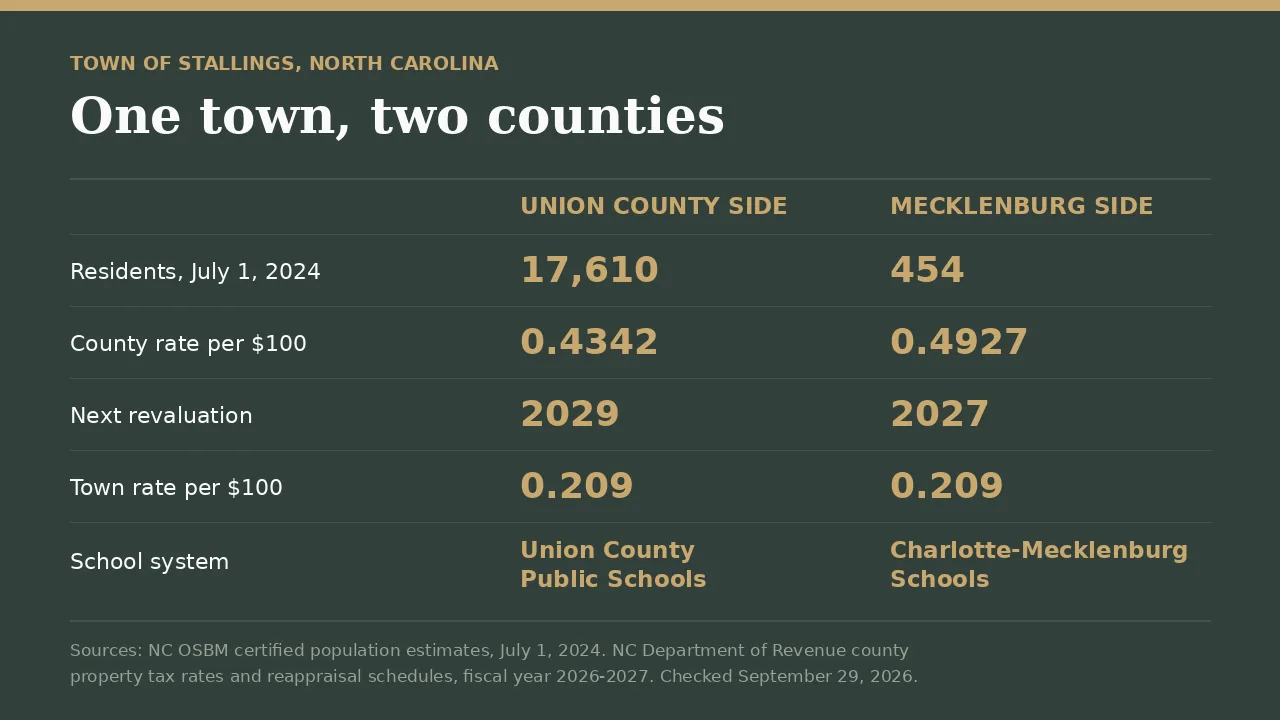
- Your town: 17,610 residents in Union County, 454 in Mecklenburg County, 18,064 total (NC OSBM certified, July 1, 2024)
- Your county rate: 0.4342 per $100 in Union County, 0.4927 in Mecklenburg County (NCDOR, 2026-2027)
- Your next revaluation: 2029 in Union County, 2027 in Mecklenburg County (NCDOR)
- Your school system: Union County Public Schools or Charlotte-Mecklenburg Schools, decided by county
- Your town rate, identical either way: 0.209 per $100, plus a $67 stormwater fee and a $25 vehicle tax
- Your bills: one from Union County everywhere, plus a second from Mecklenburg County on the Mecklenburg side
That is a small slice of town, and it is the slice nobody writes about. So here is what your side of that line actually decides, and what it leaves alone. You will see where the school district changes, where the county tax rate and the revaluation calendar change, why some households here open two property tax bills instead of one, and which services are identical no matter which county your deed sits in. Every figure below comes from a primary document opened on Tuesday, September 29, 2026, and linked where you can check it yourself.
18 min read | Living in South Charlotte
Free · 26-Page Insider Guide
Weighing Union County against Mecklenburg?
Towns compared, NC vs SC taxes and schools side by side, and the 5 mistakes out-of-state buyers make.
What This Story Covers
- So which county is Stallings in?
- How one town ended up in two counties
- Your school district changes at the county line
- Two county rates, and two revaluation years
- Why do some households here get two tax bills?
- The town rate is 20.9 cents, and one page still says 18.9
- What stays the same on both sides
- How do you find out which county an address is in?
- Frequently asked questions
- About the author
- How we sourced this
So which county is Stallings in?
Both. Most of Stallings is in Union County, and a small corner of it is in Mecklenburg County. The state’s certified numbers put the Union share at 17,610 people and the Mecklenburg share at 454 as of July 1, 2024, so roughly 97.5 percent of the town lives on the Union side. If you buy here, the odds are strongly that you are buying in Union County. They are not a certainty, and the exception costs real money and changes which school system your address feeds.
Nor is the Mecklenburg piece a rounding error in the records. It is a separate line in the state’s population file, with its own county FIPS code, because the town genuinely spans a county boundary. Union County’s tax office bills it. So does Mecklenburg County, for a different thing. And North Carolina’s school law treats the two sides as belonging to two different districts.
What changes and what does not when a Stallings address sits on one side of the county line rather than the other, with the document behind each row, checked September 29, 2026.
| What you are checking | Union County side | Mecklenburg County side | Source document |
|---|---|---|---|
| Residents, July 1, 2024 | 17,610 | 454 | NC OSBM certified population estimates |
| County tax rate per $100 | 0.4342 | 0.4927 | NCDOR county rates, fiscal year 2026-2027 |
| Most recent revaluation | 2025 | 2023 | NCDOR reappraisal schedules |
| Next scheduled revaluation | 2029 | 2027 | NCDOR reappraisal schedules |
| School system | Union County Public Schools | Charlotte-Mecklenburg Schools | N.C.G.S. 115C-66, district sites |
| Property tax bills you receive | One, from Union County | Two, from Union County and Mecklenburg County | Town of Stallings, Taxes page |
| Town tax rate per $100 | 0.209 | 0.209 | Town of Stallings FY 2026-2027 budget ordinance |
| Stormwater fee, residential | $67 a year | $67 a year | Town of Stallings stormwater page |
| Police | Stallings Police Department | Stallings Police Department | Town of Stallings police page |
| Trash, recycling, yard waste | Waste Connections | Waste Connections | Town of Stallings garbage page |
The thing I would want somebody to tell me before I started touring here is that “Stallings” on a listing is a mailing address, not a county. Most of the time the two agree and nobody ever has to think about it. When they do not agree, it is not a small footnote: it is a different school system, a different county tax rate and a different revaluation year, and none of that shows up in the listing photos. It takes about two minutes to settle, and it is worth settling before you fall for a house rather than after.
Talk to a local broker
Not sure which county a Stallings address is in?
Send me the address and I will check the county record and tell you what it means for schools and taxes. No pressure, just answers.
Schedule a 15-Minute Introductory Call →704-774-7170 · steve@jarrellhomes.com · thelongleafgroup.com
How one town ended up in two counties
Stallings did not start out straddling anything. It incorporated on June 24, 1975 as a small Union County town of about 2,152 people, and it grew the way Union County towns grew, by annexation. The town’s own history page records the turn: a large annexation along Stevens Mill Road and Lawyers Road in 2001 “doubled the population and size of the Town almost overnight,” and it goes on to say that “additional annexations included parcels of land in adjoining Mecklenburg County, making Stallings the first ‘Union County’ town to lie in two counties.”
That is the whole explanation, and it is worth understanding because it tells you where the Mecklenburg piece is. Stallings pushed north and west toward the county line, up around Goose Creek and the Idlewild Road corridor, which is the direction Charlotte was coming from. The town line moved. The county line did not, because a county line is set by the legislature and annexation cannot cross it in the sense that matters here: the land joins the town, and it stays in the county it was always in.
So Stallings is a municipality with parts in two counties, and every county-level service for those parts follows the county, not the town. Towns and counties are separate layers of government in North Carolina, and this is the clearest local example of what that means in practice. The town is one thing everywhere. The county underneath it is not.
Your school district changes at the county line
This is the consequence that costs the most if you get it wrong, and it is the one the ranking pages miss. North Carolina school districts are drawn on county lines. The statute is direct about it: N.C.G.S. 115C-66 says that “each county of the State shall be classified as a county school administrative unit, the schools of which, except in city administrative units, shall be under the general supervision and control of a county board of education.” Neither Union nor Mecklenburg has a separate city unit operating today, so in Stallings the county line is the district line.
On the Union County side, that means Union County Public Schools, which describes itself on its own district facts page as “the sixth-largest public school system in North Carolina,” serving “approximately 40,000 students at 53 schools.” On the Mecklenburg side, it means Charlotte-Mecklenburg Schools, which says on its about page that it provides instruction “for more than 139,000 students in kindergarten through 12th grade” and “operates 184 schools throughout Mecklenburg County.” Those are two very different systems, with different calendars, different choice and magnet programs, different transportation, and different boards you would be voting for.
What this does not tell you is which specific school a given house feeds. Attendance boundaries move, they are set inside each district rather than by the county line, and they change more often than people expect. Never take an assignment from a listing portal or a school-rating site. Take it from the district’s own boundary tool for the district your county actually puts you in, and take it again if you are buying a year later. We walked through how that works on the Union side in what decides Union County school assignment, and the principle is the same in Mecklenburg.
One more practical note. If you are on the Mecklenburg side of Stallings and you are reading the town’s website for school information, the site’s County Services menu links to Union County Public Schools and to nothing else. That is correct for 97.5 percent of the town and wrong for you.
Two county rates, and two revaluation years
The county rate is the bigger of the two property tax numbers you pay in Stallings, and it is the one that changes across the line. For fiscal year 2026-2027, the North Carolina Department of Revenue’s county rate file lists Union County at 0.4342 per $100 of assessed value and Mecklenburg County at 0.4927. Mecklenburg’s own tax office states the same figure in plain language: “Mecklenburg County property tax rate is 49.27 cents per $100 in property value.” The gap is 5.85 cents per $100, on identical town services.
On a home assessed at $500,000, that gap is about $293 a year. It is not the kind of number that decides a move, and I am not going to pretend it is. What it is, is a difference you should know about before you are surprised by it, because nothing about the house or the street tells you which one you are getting.
Revaluation calendars are the part I found more interesting here, because the two counties run on completely different clocks. The same NCDOR file records Union County’s most recent reappraisal as 2025 with the next scheduled for 2029, and Mecklenburg County’s most recent as 2023 with the next scheduled for 2027. A reappraisal is the county reassessing what every property is worth, and it is effective January 1 of the year shown. So two neighbors in the same town, a few streets apart, are on revaluation schedules four years out of step. The Mecklenburg-side household has one coming in 2027. The Union-side household just had one in 2025 and will not see another until 2029.
That matters more than the rate gap does, because a revaluation is what resets your assessed value after several years of price movement, and the rate is then applied to the new number. If you are on the Mecklenburg side, the 2027 reappraisal is the next real event in your property tax life, and we went through what the county has and has not said about it in whether Mecklenburg property taxes go up in 2027. If you are on the Union side, your equivalent question is a 2029 one, and the near-term action is at the county budget and bond level instead, which is where the Union County ballot question sits.
Why do some households here get two tax bills?
This one is a piece of plumbing, and it surprises people every year. Union County bills and collects the Town of Stallings taxes and fees for every property in town, including the ones in Mecklenburg County. The town’s Taxes page says so directly: “Beginning with 2015 property taxes, Union County started billing and collecting the taxes and fees for the Town of Stallings, one tax bill will be generated from Union County.” Then it adds the sentence that explains the second envelope: “(Stallings/Mecklenburg County residents will receive a tax bill from Union County for Stallings taxes and fees and continue to be billed separately from Mecklenburg County for county taxes).”
So the arrangement looks like this. On the Union side you get one bill, from Union County, carrying both the county’s rate and the town’s. On the Mecklenburg side you get that same Union County bill for the town’s portion, plus a separate Mecklenburg County bill for county taxes. Two counties, two envelopes, two due dates to keep track of, one house.
It is administratively sensible and it is easy to trip over. If you are on the Mecklenburg side and you assume the Union County bill covers everything because it has the word Union on it, you have not paid your county taxes. If your taxes are escrowed, it is worth confirming your servicer is set up for both, before the January delinquency date rather than after it.
If you are moving here from outside the Charlotte area, the layered thing is what takes getting used to. You do not live in one government, you live in three or four stacked on top of each other, and they do not share boundaries. Town, county, school district, fire district, and in Stallings the town sits across two of the second kind. The practical version of that is simple enough: find out which county the deed says, then do all your homework from the county down rather than from the town down. Everything that costs money or decides where your kids go is set at that level, not at the town level.
Talk to a local broker
Comparing Stallings against the towns around it?
Fifteen minutes with a broker who works Union and Mecklenburg every week will save you a month of reading.
Book a 15-minute call →The town rate is 20.9 cents, and one page still says 18.9
Your town rate is the one property tax number that does not change across the county line, and it is worth getting right, because two town sources disagree about it. The Town of Stallings FY 2026-2027 Operating Budget Ordinance, adopted June 8, 2026, is unambiguous. Section 4(a) reads: “There is hereby levied, for the fiscal year ending June 30, 2027, a tax rate of $0.209 per one hundred dollars ($100.00) valuation of taxable property as listed for taxes as of January 2026.” Union County’s 2026-2027 rate schedule, which is the document that actually generates your bill, lists Town of Stallings at 0.2090 as well.
The town’s Taxes web page, as of Tuesday, September 29, 2026, still reads: “The current tax rate is 18.9 cents per $100 of assessed property value.” That is two cents below what the adopted ordinance levies and what the county is billing. I am not going to guess how the page came to say that, because the record does not tell me, and a stale web page is an ordinary thing that happens to every small town.
What I can tell you is which document to trust. The budget ordinance and the county rate schedule agree with each other, and they are the two the money actually runs through. If you are modelling what a Stallings house costs to hold, use 0.209.
Two more town charges come with it, and they are the same on both sides of the county line. The stormwater utility fee is a flat $67 a year on residential property, which the town states as “$67.00/year” and equivalently “$5.58 per Month.” Non-residential property pays $67 per equivalent residential unit, where one unit is 2,060 square feet of impervious surface. And the ordinance levies “a Town motor vehicle tax of $25/vehicle to support street maintenance,” which appears on the county schedule as a $25 tag fee.
One figure from the ordinance puts the whole town in perspective. It sets the FY 2027 budget at $14,984,731 and estimates the total taxable value of property in Stallings at $4,162,691,856, which means, in the ordinance’s own words, “One penny ($0.01) on the tax rate will yield $407,111.” Public safety is the largest line at $4,657,490. That is the scale of the government the 20.9 cents is buying, and it is a useful comparison point if you are also looking at what Indian Trail charges and what you get for it a few miles east.
What stays the same on both sides
It would be easy to read this far and conclude Stallings is two towns wearing one name. It is not. The daily-life layer is genuinely uniform, and that is the part most buyers are actually asking about.
Policing is the clearest example. Stallings runs its own police department, which the town established by council authorization in 2003 and brought fully into service in 2004, and it covers the whole town regardless of which county a street sits in. You are not calling the Union County Sheriff on one block and the Mecklenburg County Sheriff on the next for a town matter. Garbage, recycling and yard waste are the same everywhere too: the town contracts them out and its public works page states that they “are paid for through your municipal taxes and are collected by Waste Connections.” Yard waste runs biweekly, and the town schedules bulk pickup quarterly with four items per household.
Fire is the one service that does not follow the town at all, and it does not follow the county line in a simple way either. The town’s fire page says plainly that “the Town of Stallings receives service from two Fire Departments,” and names the Hemby Bridge Fire Department and the Stallings Fire Department, both independently operated, with coverage assigned by the Union County fire district map the page links. Union County’s 2026-2027 fire district schedule carries a Stallings Fire Tax of 0.0476 per $100 and a Hemby Bridge Fire Tax of 0.0472. Which of the two districts a given property sits in is set by the county fire district map, not by its street name.
I could not find a published statement of which department answers a call on the Mecklenburg-county portion of Stallings. The town’s fire page is titled for Union County fire districts and names only those two departments, and nothing on the site addresses the Mecklenburg side. That is a gap in what has been published rather than a finding about who responds, and it is the one question in this piece I would call the fire marshal about rather than read the answer online.
Voting follows the county as well. Under N.C.G.S. 163-82.1(b), a county board of elections registers “every person qualified to vote in that county,” so a Mecklenburg-side household in Stallings is registered by the Mecklenburg County Board of Elections and votes on Mecklenburg County questions. The town’s website links only to the Union County board. That is another place where the 97.5 percent answer is on the page and the other answer is not.
How do you find out which county an address is in?
Two minutes, and you never have to wonder again. Do not use the mailing address, do not use the ZIP code, and do not use a listing site’s county field, which is frequently just the mailing city’s default county. Go to the county property records instead, because those are built on the parcel, which is the thing that actually has a county.
Start with Union County, since that is where most of Stallings is. Union County’s GIS and Mapping page gives you GoMAPS, the county’s own interactive parcel viewer, and if the address returns a parcel record there, it is in Union County. If it does not come back, check Mecklenburg County’s Polaris, which the county describes as providing “land records and propery ownership data specific to Mecklenburg County, NC.” One of the two will have it. If you want a third confirmation that costs nothing, look the address up on the state’s voter registration search at the North Carolina State Board of Elections, which returns the county that would register you.
Then work downward from whichever county came back. Pull the school assignment from that district’s own boundary tool. Read that county’s tax rate rather than the other one’s. Note that county’s next revaluation year. And if the answer is Mecklenburg, expect the second tax bill and set your escrow up for it. The same discipline is worth applying anywhere a town line and a county line diverge, which happens more around here than people realize: we looked at a harder version of it when a state line was involved in what the state line changes between Indian Trail and Indian Land, and at the town-limits version in how Matthews is rebuilding itself.
Frequently Asked Questions About What County Stallings NC Is In
What county is Stallings NC in?
Stallings is in both Union County and Mecklenburg County, North Carolina. The North Carolina Office of State Budget and Management certified 17,610 Stallings residents in Union County and 454 in Mecklenburg County as of July 1, 2024, a town total of 18,064. So about 97.5 percent of the town is in Union County, and the rest is in Mecklenburg County.
Is Stallings NC in Union County?
Most of it is. Union County holds 17,610 of the 18,064 Stallings residents the state certified for July 1, 2024. Union County also bills and collects the Town of Stallings property taxes and fees for every property in town, including the ones that sit in Mecklenburg County, which is one reason the town reads as a Union County town almost everywhere you look.
Is any of Stallings in Mecklenburg County?
Yes. The town history page records that annexations added parcels in adjoining Mecklenburg County, making Stallings the first Union County town to lie in two counties. The state counted 454 Stallings residents on the Mecklenburg side as of July 1, 2024. That is roughly one resident in forty.
What school district is Stallings NC in?
It depends on the county your address is in. North Carolina general statute 115C-66 classifies each county as a county school administrative unit, so the Union County portion of Stallings is served by Union County Public Schools and the Mecklenburg County portion by Charlotte-Mecklenburg Schools. Attendance boundaries inside each district are set separately and they change, so verify any specific address on that district own boundary tool rather than on a listing site.
Why would I get two property tax bills in Stallings NC?
Because you are on the Mecklenburg County side. Union County bills the Town of Stallings taxes and fees for every property in town, so every Stallings owner gets a Union County bill. Mecklenburg County then bills its own county taxes separately to the properties inside its boundary. Owners on the Union County side receive one bill covering both the county and the town.
What is the property tax rate in Stallings NC?
The town rate for fiscal year 2026-2027 is 0.209 per $100 of assessed value, levied by the adopted town budget ordinance of June 8, 2026 and listed at 0.2090 on the Union County rate schedule. On top of that you pay your county rate, which is 0.4342 per $100 in Union County and 0.4927 in Mecklenburg County for 2026-2027, plus a $67 residential stormwater fee, a $25 town vehicle tax, and any Union County fire district tax that applies to the parcel.
About the Author
Steve Jarrell is a licensed North Carolina and South Carolina broker and the team lead of The Longleaf Group at eXp Realty, which he co-leads with his wife Amanda. Before real estate, Steve joined VisualTour as President, led its rebrand to Paradym, and led the company to its acquisition by Constellation Software in 2020. He holds an MBA from the University of Tennessee with concentrations in Marketing and Innovation. The Longleaf Group is an eXp ICON Team and a RealTrends Verified Top Team by Volume for 2026, with 140+ five-star reviews.
Steve lives in Weddington, about twenty minutes south of Stallings, and he and Amanda relocated to South Charlotte themselves before building a business here. Boundary questions like this one come up constantly across Union and Mecklenburg, because the two counties interlock along a dozen town edges and the mailing address almost never settles it. He works both sides of that line every week, and you can reach him directly at 704-774-7170.
How we sourced this
Every figure here came from a primary document opened on Tuesday, September 29, 2026, and every link below returned a live page on that date.
- Population by county part: NC Office of State Budget and Management, 2024 certified population estimates. Stallings appears as two rows, one per county part, which is how the state records a town that spans a county line.
- County tax rates and reappraisal schedules: NC Department of Revenue, fiscal year 2026-2027 county property tax rates. All rates per $100 of valuation; reappraisals effective January 1 of the year shown.
- Mecklenburg County rate, stated independently: Mecklenburg County Office of Tax Administration.
- Town and fire district rates: Union County tax rates and fire fees, 2026-2027 schedules.
- Town tax rate, stormwater fee and vehicle tax: Town of Stallings FY 2026-2027 Operating Budget Ordinance, adopted June 8, 2026, on the town’s fiscal year budgets page, and the stormwater page.
- The 18.9 cent figure and the two-bill arrangement: Town of Stallings Taxes page, read September 29, 2026.
- Annexation history: Town of Stallings About Stallings.
- School districts: N.C.G.S. 115C-66, Union County Public Schools district facts, and Charlotte-Mecklenburg Schools.
- Town services: Town of Stallings garbage and recycling and fire districts pages.
- Voter registration: N.C.G.S. 163-82.1 and the NC State Board of Elections voter search.
- Parcel lookups: Union County GIS and Mapping and Mecklenburg County Polaris.
What we left out, and why. We do not name which fire department covers the Mecklenburg County portion of Stallings, because no town or county page we opened states it. We do not give a figure for how many Stallings parcels or homes sit in Mecklenburg County, because the state file counts residents rather than parcels and we found no published parcel count.
We also do not name the water or sewer provider for any part of town, because service varies address by address and we found no document that maps it. And we do not say which school any specific Stallings address is assigned to, because that is set inside each district and only the district’s own boundary tool should answer it.
Last updated: September 29, 2026.