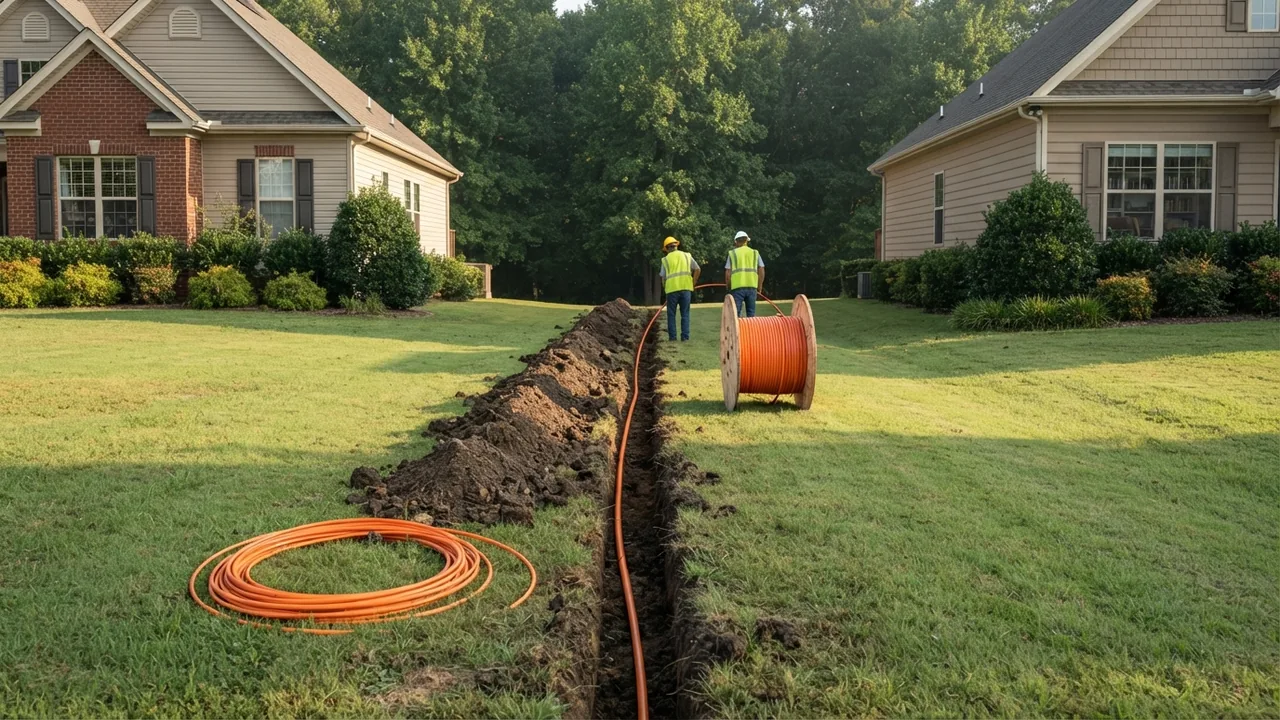
If you’re house hunting in Union County from out of state, somebody has probably already told you that the internet out here is fine, or that it’s terrible, depending on who you asked. Both answers are too broad to use. The specific version is in a table the state keeps and almost nobody opens: North Carolina and two private providers have committed $18,852,329 to build fiber to 3,452 Union County households and 122 businesses across four projects, and two of those projects are still under construction with a deadline of Saturday, October 31, 2026.
That number tells you something a provider’s coverage map won’t. It tells you which parts of this county the state decided were bad enough to pay to fix. Below you’ll find who is building what, how much each company put in against how much the taxpayer put in, what the state’s official definition of “served” actually is (it’s lower than you think), and how to check the specific address you’re considering without trusting a comparison site.
14 min read | Living in South Charlotte
Free · 26-Page Insider Guide
Weighing how rural you want to go?
Towns compared, NC vs SC taxes and schools side by side, and the 5 mistakes out-of-state buyers make.
What This Story Covers
- Where Union County fiber internet stands right now
- Why the state paid to run fiber here at all
- Who is building it, and what each company put in
- What does the state count as fast enough?
- Why Mecklenburg County has none of this money
- How do you check the address you are actually buying?
- What this does not tell you about Waxhaw, Weddington and Marvin
- Frequently asked questions
- About the author
- How we sourced this
Where Union County fiber internet stands right now
Four state-funded fiber projects cover Union County, and between them they reach 3,452 households. Two are finished and two are still being built. Every one of the four is fiber, not fixed wireless and not satellite, and three of the four are specified at gigabit speeds in both directions. If you are looking at a house on the rural side of the county, these four projects are the ones worth knowing about.
The Short Answer
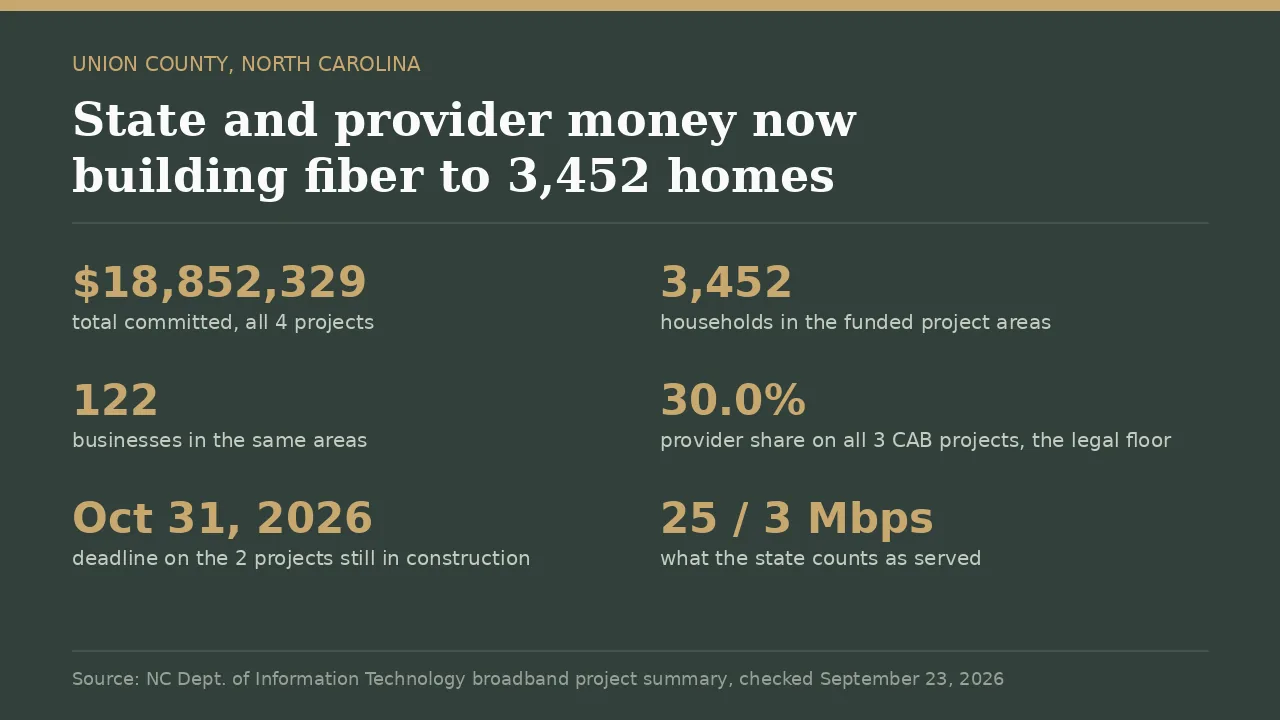
North Carolina and two providers have committed $18,852,329 to build fiber to 3,452 Union County households and 122 businesses. Two projects are finished. The other two are in construction and are due by Saturday, October 31, 2026. None of this money went to Mecklenburg County, and none of it covers the South Carolina side of the line, so it will not help you in Fort Mill or Indian Land.
Key numbers, Union County, checked September 23, 2026 (sources: N.C. Department of Information Technology broadband project summary; G.S. 143B-1373.1):
- $18,852,329 committed in total across the four projects
- $8,556,476.40 of that is state grant money, $1,488,688.90 is a Union County match, and $8,807,163.70 comes from the providers
- 3,452 households and 122 businesses in the funded project areas
- 30.0%, the provider share on all three Completing Access to Broadband projects, which is exactly the legal minimum
- 25 Mbps down and 3 Mbps up, the speed the statute treats as served
- October 31, 2026, the construction deadline on the two unfinished projects
The four state-funded broadband projects in Union County, with the program, the provider, the money and the status the state records for each, so you can check any line yourself. Checked September 23, 2026.
| Project | Households and money | Status the state records |
|---|---|---|
| GREAT, Spectrum Southeast, LLC | 1,956 homes, 63 businesses. $4,000,000 state, $1,000,000 county, $6,644,950 provider. Fiber at 100 Mbps both ways. | Construction completed. Deadline was May 2, 2025. |
| CAB Round 1, Windstream North Carolina, LLC (Kinetic) | 366 homes. $977,377.80 state, no county match, $418,876.20 provider. Fiber at 1,000 Mbps both ways. | Construction phase. Due October 31, 2026. |
| CAB Round 2, Spectrum Southeast, LLC | 388 homes, 16 businesses. $746,470.90 state, $488,688.90 county, $529,354.20 provider. Fiber at 1,000 Mbps both ways. | Construction completed. Deadline October 31, 2026. |
| CAB Round 2, Windstream North Carolina, LLC (Kinetic) | 742 homes, 43 businesses. $2,832,627.70 state, no county match, $1,213,983.30 provider. Fiber at 1,000 Mbps both ways. | Construction phase. Due October 31, 2026. |
Type a Waxhaw address into one of the comparison sites and you get a long list of company names with no way to tell which of them can actually run a line to a house. The state’s table does the opposite: it names two companies, says what each one is being paid, says how many homes each project covers and says whether the work is done. It’s narrower and it’s checkable, and for someone deciding where to buy, narrow and checkable beats long every time.
Talk to a local broker
Wondering how rural is too rural in Union County?
I live in Weddington and sell across this county every week. A quick call, and you’ll know what questions to ask before you write an offer.
Schedule a 15-Minute Introductory Call →704-774-7170 · steve@jarrellhomes.com · thelongleafgroup.com
Why the state paid to run fiber here at all
Because parts of Union County met the state’s legal definition of unserved or underserved, and a county that meets it can ask for the money. Two programs are involved here and it’s worth knowing which is which, because they work differently and the difference shows up in who paid.
The GREAT Grant, short for Growing Rural Economies with Access to Technology, started in 2018 and pays private providers to run last-mile infrastructure into unserved areas. North Carolina put $350 million of federal American Rescue Plan money into it. The Completing Access to Broadband program, which everyone involved calls CAB, came later and works as a competitive bid: a county partners with the state, the two of them jointly pick the project areas, and prequalified providers bid on the construction. CAB is codified at G.S. 143B-1373.1 and carries a $400 million appropriation, also from the American Rescue Plan.
Here’s the part that matters for a buyer rather than a policy reader. A “project area” under the CAB statute is not a whole town and not a whole ZIP code. The law defines it as an area that a county and the state’s Broadband Infrastructure Office jointly determine needs funding to finish the job. So these four projects are patches, not blankets. They sit where the private market had already declined to build, which in Union County means the eastern and southern rural stretches rather than the subdivisions closer to the Mecklenburg line.
There is a good chance someone has already told you that a county growing this fast must have the infrastructure to match. Union County’s certified population was 266,672 as of July 1, 2024, up from 238,237 at the 2020 census, and the state still had to pay two companies to run fiber to three and a half thousand homes inside it. Growth and coverage are not the same thing, and the same gap shows up in the county’s wastewater capacity fight, where the constraint is a plant rather than a cable.
Who is building it, and what each company put in
Two companies. Spectrum Southeast, LLC, which you’ll see marketed as Spectrum, holds two of the four projects. Windstream North Carolina, LLC, marketed as Kinetic, holds the other two. Between them they are on the hook for $8,807,163.70 of the $18,852,329 total, and the split between the two programs is where it gets interesting.
Under the GREAT grant, Spectrum’s share of its project came to about 57 percent of the total cost: $6,644,950 of company money against $4,000,000 from the state and $1,000,000 from Union County. That’s a company putting in well over half.
Under CAB, all three projects land on exactly the same number. The statute says a provider selected for a CAB project “shall provide at least thirty percent (30%) of the total estimated project cost.” Run the arithmetic on each of the three CAB projects in Union County and the provider share is 30.0% on every one of them. Kinetic’s Round 1 project: $418,876.20 of $1,396,254. Spectrum’s Round 2 project: $529,354.20 of $1,764,514. Kinetic’s Round 2 project: $1,213,983.30 of $4,046,611. Three projects, two companies, two bidding rounds, and not one dollar above the floor.
I’m not going to tell you that’s improper, because it isn’t. A competitive bid is supposed to push bidders toward the minimum they can offer and still win, and the program is designed with that floor precisely so the public share is capped. It is worth knowing, though, if you’ve been told that private companies are voluntarily investing in rural Union County. On the CAB projects they are investing the smallest amount the law permits, and the public is carrying the rest.
One thing the record does not explain, and I’m not going to guess at it: Union County put $488,688.90 of its own money into Spectrum’s Round 2 project and nothing at all into either Kinetic project. The state’s table records the amounts and not the reasoning. If that matters to you, the county is the place to ask.
What does the state count as fast enough?
Twenty-five megabits down and three megabits up. That’s the number written into G.S. 143B-1373.1, which defines broadband service as “terrestrially deployed internet access service with transmission speeds of at least 25 megabits per second (Mbps) download and at least 3 megabits per second upload.” A location with no service at all, or with service below that line, is what the statute calls unserved or underserved.
Sit with the upload number for a second, because it’s the one that will affect your week. Three megabits up is the bar. If two people in your house are on video calls at the same time, three megabits up is not a comfortable amount of headroom, and most of us now spend at least part of the week working from a spare bedroom rather than driving to an office. So a house can be officially served, counted as served in every state tally, ineligible for any of this grant money, and still be a house where your calls freeze when someone else uploads a file.
That gap between the legal definition and the practical one is the single most useful thing in this whole story for somebody buying a house. It means “this address has broadband” is not the question to ask. The question is what the actual upload speed is on the specific line that serves the specific house, which is a different question with a different answer.
It also explains why three of the four Union County projects are specified at 1,000 Mbps in both directions. The newer CAB round is not being built to the 25/3 legal floor, it’s being built to symmetrical gigabit. The one project specified at 100 Mbps both ways is the older GREAT project, which finished construction against a May 2, 2025 deadline. If you’re buying in an area one of these projects covers, which program paid for it tells you roughly what generation of build you’re getting.
Why Mecklenburg County has none of this money
Because the programs are built for rural areas, and Mecklenburg does not qualify for them. When you pull the same state table for Mecklenburg County you get four entries and not one of them is construction. They are Digital Opportunity grants, which fund digital skills and devices rather than cable in the ground: $1,500,000 to E2D, $400,000 to City Startup Labs Inc., $367,373 to Lions Services Inc., and $100,000 to Caterpillar Ministries. Useful programs, and a completely different kind of spending.
The CAB statute spells out an exclusion. A county that is ranked a development tier three area under the Department of Commerce’s annual ranking for the 2023 calendar year, and that has used federal broadband funding on or after May 1, 2021, is not eligible. Tier three is the state’s designation for its most economically healthy counties. I’ll stop short of saying that clause alone is why Mecklenburg has no construction grants, because the state’s table records the awards and not the reasons any particular county went without. What the table does establish is the pattern: the money went where the private market had not already built, and in this region that is Union County and not Mecklenburg.
For a buyer comparing the two sides of the county line, that’s worth holding onto. It is not evidence that Mecklenburg addresses have better internet than Union County addresses. It’s evidence that Mecklenburg’s gaps, whatever they are, were not the kind these two programs pay to close. Matthews and Mint Hill sit inside Mecklenburg and have their own rural edges.
The thing I could not find is the thing I most wanted. The state publishes which projects were funded, how much each cost and how many homes each covers, and it maps them, but it does not publish a plain list of the roads inside each project area. So I can tell you with confidence that 3,452 Union County households are inside a funded fiber project, and I cannot tell you from this table whether a particular house on a particular road is one of them. Anybody who tells you otherwise off a coverage map is reading a marketing document, not this one. The check that actually settles it is in the next section, and it takes about two minutes.
Talk to a local broker
Narrowing down which part of Union County fits?
Fifteen minutes with a broker who works this market every week, and you’ll have a short list instead of a map.
Book a 15-minute call →How do you check the address you are actually buying?
Do it in this order, and do it before your due diligence period runs out rather than after. Internet is one of the few things about a house that you genuinely cannot fix yourself if the answer comes back wrong.
Start with the providers’ own address checkers, not a comparison site. A comparison site is paid to generate leads and will list every company that sells anything in your ZIP code, including satellite and fixed wireless, which is how that list gets so long. Spectrum and Kinetic both let you enter a street address and see what they will actually sell to that address. Those two are the ones building here with state money, so they’re the two to check first.
Then ask the seller a direct question in writing: what service do you have right now, which company, and what speed do you pay for. A seller who is on fiber will tell you happily. A seller who gives you a vague answer about it being fine has told you something too.
Then look at the house itself when you tour it. Where does the service line come in, and is there one at all? A long private drive in rural Union County can mean a meaningful install cost that nobody mentions until after closing, and the cost of running that last stretch is on the homeowner more often than people expect.
If you want the state’s own picture of your area, the N.C. Department of Information Technology publishes a public broadband dashboard that maps funded projects and service status. Use it to understand the neighborhood. Do not use it, or anything you read here, to conclude anything about one specific address, because neither one is address-level and I am not going to pretend otherwise.
What this does not tell you about Waxhaw, Weddington and Marvin
Almost nothing, and that’s worth saying plainly. The three towns you are most likely to be weighing are the three least likely to appear in a program built for unserved areas, because they are the part of Union County the private market built out on its own. That is not a promise that every address in them has fiber. It means their gaps were never big enough to qualify for this money, so this particular document has nothing to say about them.
Two more limits worth stating plainly. First, this is a North Carolina program and a North Carolina table, so it covers none of the South Carolina side. If you’re looking at Fort Mill, Tega Cay or Indian Land, nothing here applies to you, and South Carolina runs its own broadband office with its own awards. Second, the state’s project summary is a record of what was funded, not a survey of what exists. Plenty of Union County fiber has been built with private money and no grant at all, and none of that shows up in this table.
What you can take from it is a rough map of where the hard parts were. If an address sits inside one of these four project areas, somebody had to be paid to reach it, which tells you the private economics did not work there on their own. That’s a useful thing to know about a road you’re considering, alongside the other rural-edge questions like well versus county water, septic, and how far the school bus runs. Those come up in Wesley Chapel and out toward Monroe far more often than they do closer to the Mecklenburg line, and they belong on the same list as the tax questions in what the county charges.
Frequently Asked Questions About Union County Fiber Internet
Which providers are building fiber in Union County with state money?
Two companies. Spectrum Southeast, LLC, marketed as Spectrum, holds two of the four state-funded projects. Windstream North Carolina, LLC, marketed as Kinetic, holds the other two. Those are the four projects in the state broadband project summary for Union County. Other companies sell service in the county without holding one of these grants, so you will see more than two names on any comparison site.
How many Union County homes are covered by these fiber projects?
3,452 households and 122 businesses, added across all four projects. The largest single project is the GREAT grant awarded to Spectrum Southeast, which covers 1,956 households and 63 businesses on its own. The three Completing Access to Broadband projects cover the remaining 1,496 households and 59 businesses between them. None of those totals tell you whether your address is one of them.
When will the Union County fiber projects be finished?
Two of the four are recorded as construction completed. The other two, both held by Windstream North Carolina, are recorded as being in the construction phase with a required completion date of October 31, 2026. That date is the deadline in the state record rather than a promise of a service date at your house, so treat it as the outside edge of the schedule rather than an install date.
How much public money went into Union County broadband?
$8,556,476.40 in state grant money and $1,488,688.90 in Union County match money, which is $10,045,165.30 of public funds. The two providers committed $8,807,163.70 between them, bringing the total across the four projects to $18,852,329. Roughly 53 cents of every dollar came from the public side.
What speed does North Carolina count as broadband?
25 megabits per second download and 3 megabits per second upload, under G.S. 143B-1373.1. A location at or above that is treated as served. That upload figure is low for a household where more than one person takes video calls, so your address can be officially served and still be slower than you want it to be.
Does any of this cover Fort Mill, Tega Cay or Indian Land?
No. These are North Carolina programs administered by the N.C. Department of Information Technology, and the project table covers North Carolina counties only. South Carolina runs its own broadband office and its own grant awards, so if you are looking south of the state line you need to check that state instead.
Is fiber available at a specific Union County address?
Nothing here can answer that, and neither can a coverage map. The state data records which projects were funded and how many households each covers, not which roads are inside each project area. Enter the exact street address on each provider website, and ask the seller in writing which company and which speed they pay for today.
About the Author
Steve Jarrell is a licensed North Carolina and South Carolina broker and the team lead of The Longleaf Group at eXp Realty, which he co-leads with his wife Amanda. Before real estate, Steve joined VisualTour as President, led its rebrand to Paradym, and led the company to its acquisition by Constellation Software in 2020. He holds an MBA from the University of Tennessee with concentrations in Marketing and Innovation. The Longleaf Group is an eXp ICON Team and a RealTrends Verified Top Team by Volume for 2026, with 140+ five-star reviews.
Steve lives in Weddington and sells across Union County every week, which is where this post started: enough buyers asked him about internet at the rural end of the county that it was worth going and reading the state’s own record instead of repeating what the comparison sites say. If you want to talk through a specific road before you write an offer, call him at 704-774-7170.
How We Sourced This
Every figure here comes from a document we opened on September 23, 2026, and where a document did not carry something, we left it out and said so. Three things were left out for that reason: which specific roads sit inside each funded project area, because the state publishes the project totals and not a road list; why Union County matched one provider project and not the other two, because the record carries the amounts without the reasoning; and any statement about service at an individual address, because no source we used is address-level.
The provider share percentages were calculated from the grant, county match and provider match figures in the state table rather than taken from a summary, so you can run the same arithmetic yourself.
- N.C. Department of Information Technology broadband dashboard, the public home for the state broadband project and status data used throughout this post.
- Completing Access to Broadband (CAB) program, for the program structure, the $400 million appropriation and the county partnership process.
- GREAT Grant program, for the program history and the $350 million appropriation.
- G.S. 143B-1373.1, for the 25/3 definition of broadband service, the definition of a project area, the 30 percent provider share and the tier three exclusion.
- Session Law 2021-180, the budget act that established the CAB program.
- N.C. Office of State Budget and Management, for the certified Union County population of 266,672 as of July 1, 2024 and the 238,237 census base.
Last updated: September 23, 2026