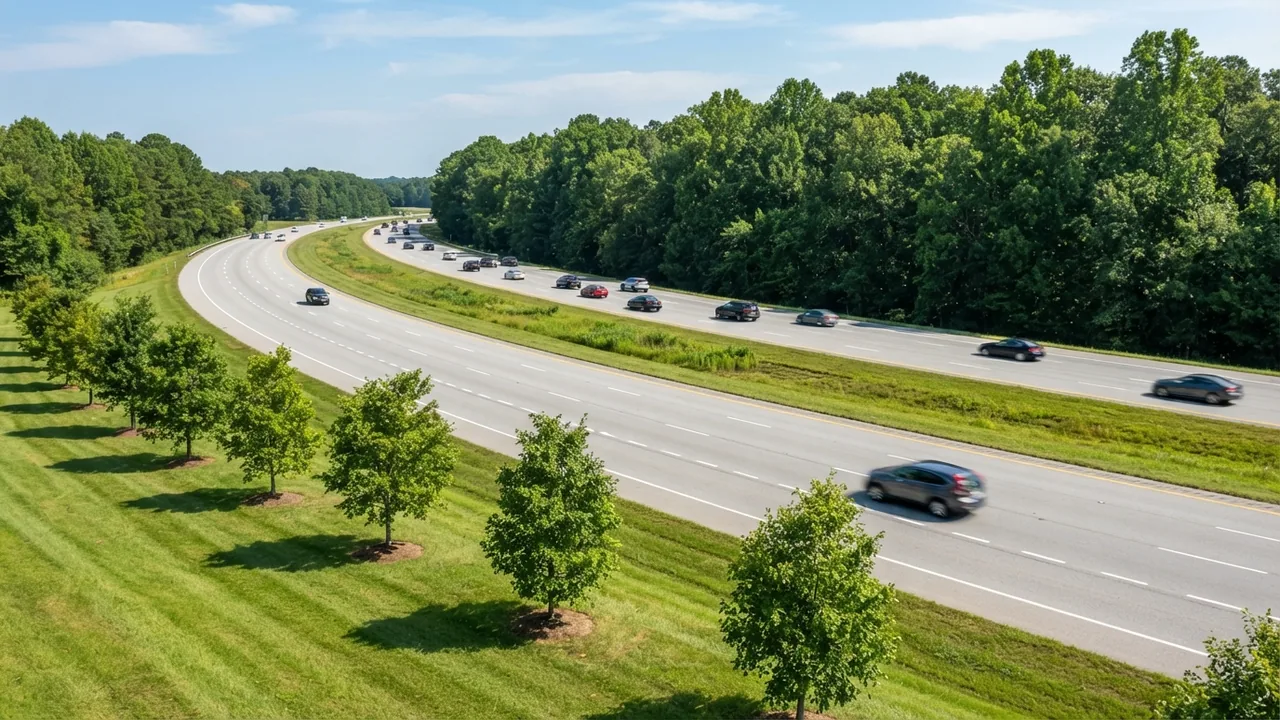
If you’re weighing a home in Fort Mill and you’ll work in Charlotte, there’s a good chance someone has already told you the commute is simple, because it’s one straight run up I-77. That part is true. What they may not have mentioned is how loaded that run is: the North Carolina stretch between the state line and Uptown carries more than 170,000 vehicles a day, with a crash rate 2.5 times the statewide average for urban interstates, according to a briefing Union County commissioners received on Monday, September 21, 2026.
That same stretch is the subject of a $3.7 billion widening plan that was all but dead in June and came back on Monday, September 21, 2026, when Charlotte’s City Council voted 7 to 4 to reinstate its support. Below you’ll find what the road is like now, what the plan would build, where it stands, whether you’d pay a toll, what’s happening at Fort Mill’s own exit on the South Carolina side, and what to check before you buy.
17 min read | Living in South Charlotte
Free · 26-Page Insider Guide
Weighing a South Carolina town against Charlotte?
Towns compared, NC vs SC taxes and schools side by side, and the 5 mistakes out-of-state buyers make.
What This Guide Covers
- The short answer on the Fort Mill commute to Charlotte
- Why I-77 decides the Fort Mill commute
- What the I-77 widening would build
- Where does the I-77 plan stand?
- What we know about tolls, and what we don’t
- Does the North Carolina penalty reach Fort Mill?
- What’s changing on the South Carolina side at Exit 85
- What to check before you buy in Fort Mill or Tega Cay
- Frequently asked questions
- About the author
- How we sourced this
The short answer on the Fort Mill commute to Charlotte
Your Fort Mill commute to Charlotte runs on I-77, and it’s the North Carolina half of that drive that carries the load and the uncertainty. A plan to widen it with toll lanes is alive again, but nothing about it is settled yet: the regional planning board still has to vote, the state has set an October 5, 2026 deadline, and nobody has published a toll rate. So if you’re buying in Fort Mill or Tega Cay before this is settled, plan around the road as it is today, and treat any promise about how it’s about to change with some caution.
The Short Answer
The Fort Mill commute to Charlotte runs up I-77, whose North Carolina stretch carries more than 170,000 vehicles a day. Charlotte voted on September 21, 2026 to reinstate support for a plan to widen it with toll lanes, but the plan still needs a regional vote before an October 5, 2026 state deadline, and no toll rate has been published. If you’re buying now, you’ll want to judge the drive by the road as it stands.
Key numbers, I-77 between Fort Mill and Uptown Charlotte, as of September 23, 2026 (sources: Union County Board of Commissioners briefing, September 21, 2026; City of Charlotte council record; Session Law 2026-41):
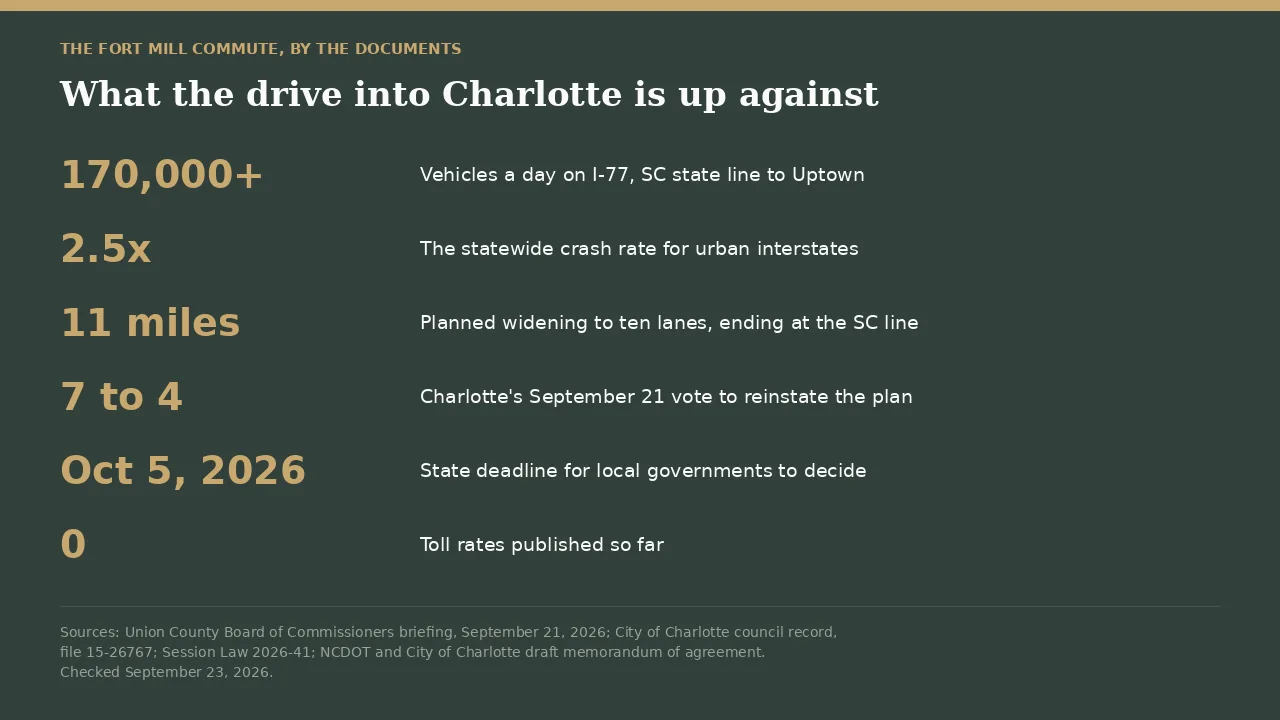
- 170,000+ vehicles a day on I-77 between the South Carolina state line and Uptown
- 2.5 times the statewide crash rate for urban interstates on that stretch
- 11 miles planned for widening to ten lanes, ending at the South Carolina state line
- 7 to 4, Charlotte City Council’s September 21 vote to reinstate support for the plan
- October 5, 2026, the state’s deadline for local governments to reinstate support
- Zero toll rates published in any approved document
Where each piece of the Fort Mill to Charlotte commute picture stands, with the document behind it, so you can check any line yourself. Checked September 23, 2026.
| Measure | Status | Source document |
|---|---|---|
| The road today | Six lanes, last widened in the 1990s, carrying more than 170,000 vehicles a day | Union County Board of Commissioners briefing, September 21, 2026 |
| The North Carolina widening | STIP project I-5718: ten lanes with managed lanes, 11 miles to the SC line, $3.7 billion. NCDOT halted work in June 2026. | Union County Board of Commissioners briefing, September 21, 2026 |
| Charlotte’s position | Voted 7 to 4 on September 21, 2026 to reinstate support | City of Charlotte council record, file 15-26767 |
| Union County’s position | Approved 4 to 0 on September 21, 2026, one commissioner absent. The record does not state which position it directed. | Union County record, file 26-523 |
| The deadline | October 5, 2026, which is 90 days after the July 7, 2026 signature | Session Law 2026-41, Section 43.27(d) and (e) |
| Toll rates | None published | NCDOT and City of Charlotte draft memorandum of agreement |
| Exit 85 in Fort Mill | SCDOT proposed reconfiguration of the SC 160 interchange | RFATS project page; SCDOT project site |
When I pulled the record on this, what stood out was how little of it is about South Carolina. The plan, the vote, the repayment penalty and the $300 million in community money are all North Carolina business, and the vote that settles it happens on a North Carolina planning board. Fort Mill and Tega Cay sit on a different board entirely. What you’d get out of it, if it happens, is the road itself. That’s worth knowing before anyone tells you your Fort Mill commute is about to get fixed, or about to get expensive, because neither one is settled yet.
Talk to a local broker
Deciding between Fort Mill and a North Carolina town?
Tell me where you’d be working and I’ll walk you through how each side of the state line gets you there. No pressure, just answers.
Schedule a 15-Minute Introductory Call →704-774-7170 · steve@jarrellhomes.com · thelongleafgroup.com
Why I-77 decides the Fort Mill commute
I-77 is the commute because it’s the interstate both towns sit on. The City of Tega Cay says so on its own website: “Tega Cay can be easily accessed from I-77 (exit 88 from I-77 south and exit 85 from I-77 north).” Exit 85 is also the SC 160 interchange in Fort Mill, and it has its own story, which we’ll get to below. Either way, your morning drive joins the same interstate and heads north across the state line.
Once you cross into North Carolina, you’re on the stretch that carries the load. The Union County briefing describes it as carrying more than 170,000 vehicles a day, with a crash rate 2.5 times the statewide average for urban interstates. It was originally built in the 1960s and 1970s and was last widened in the 1990s, from four lanes to six. That’s the road you’d be driving, and it’s the one the widening plan is aimed at.
You’ll notice we’re not quoting you a drive time. That’s deliberate. We couldn’t measure one for this guide, and a free-flowing number from a quiet Sunday tells you very little about 7:45 on a Tuesday on a corridor carrying that much traffic. The only way to know your commute is to drive it from the actual house, at the hour you’d leave, before you make an offer.
One note if you’re also looking at Indian Land. It sits in Lancaster County, and depending on where you’d work, your route may not run on this stretch of I-77 at all. Check your specific route before you assume this corridor is yours. Our look at how Indian Land is growing covers more of that town’s picture.
What the I-77 widening would build
The plan is STIP project I-5718, and the Union County briefing puts its total cost at $3.7 billion. It would widen about 11 miles of I-77 to ten lanes by constructing managed lanes and would rebuild the I-277 interchanges, running from the Uptown loop south past Clanton Road, South Boulevard, Woodlawn Road, Tyvola Road and Arrowood Road to the South Carolina state line.
Two terms will come up if you read about this, so it’s worth pinning them down. Managed lanes are extra lanes with a condition on entry, usually a toll that rises with congestion, sometimes free for cars carrying three or more people. A public private partnership, written P3, means a private company finances and builds the road and is repaid over time out of the revenue it collects.
The case for building it is laid out in the same briefing. The crash rate and the traffic volume are the safety and congestion argument. The funding argument is that in August 2024, NCDOT reported that delivering the project as a traditional toll road left a funding gap of more than $2 billion, while the P3 model was financially feasible using programmed state money plus developer equity. A 2025 task force of the regional planning board worked with NCDOT on draft terms, including toll rate caps, potential discounts and a three-or-more occupancy rule.
For a Fort Mill buyer, look at where the plan stops. It ends at the state line, so it covers the North Carolina stretch you’d sit in every morning, and none of the South Carolina miles you’d drive to reach it.
Where does the I-77 plan stand?
The plan is alive again but not approved. Here’s how it got here, in order, all from the Union County briefing and the two governments’ own records unless noted.
The Charlotte Regional Transportation Planning Organization, known as CRTPO, is the board that programs federal and state road money for Charlotte and its North Carolina neighbors, including Union County. The briefing puts it at 1,560 square miles, about 1.5 million residents, 21 cities and towns and 3 counties. On October 16, 2024, it adopted the resolution authorizing a P3 delivery process for I-77 South. NCDOT then drew commitments from four qualified design and construction firms.
In the fall of 2025, NCDOT held public engagement meetings, and the briefing records the reaction in its own words: “Initial project maps trigger significant community concerns, particularly regarding impacts to historically African American neighborhoods”. In May 2026, the Charlotte City Council voted 6 to 5 to rescind its support, and CRTPO followed at its May 20, 2026 meeting. NCDOT halted work in June 2026. That’s when you’d have read that the project was dead, and at the time it was a fair reading.
Then the General Assembly put a price on backing out. On July 7, 2026, the Governor signed Senate Bill 257 into law as Session Law 2026-41, and its Section 43.27 gives any local government that voted to rescind 90 days to reinstate support or repay NCDOT its share of what it had already spent. That window closes on Monday, October 5, 2026. If you’re buying before then, that’s the date to watch.
On Monday, September 21, 2026, Charlotte and Union County both acted. Charlotte’s City Council approved reinstating support 7 to 4, on a motion by council member Dante Anderson seconded by council member Kimberly Owens, and a separate motion to deny failed 4 to 7. Charlotte’s vote carries the most weight, because the county briefing puts its share of CRTPO’s weighted vote at 42 percent. The same day, Union County’s Board of Commissioners approved its I-77 item 4 to 0, with one commissioner absent. The county’s record doesn’t state which position the board directed its CRTPO representative to take, so we won’t guess at it.
The next step is CRTPO itself. Union County’s staff report says the board scheduled a vote for September 23 to reconsider its May action, and the state’s deadline follows on October 5. We’ll update this guide when the result is on the record.
Here’s the check I’d run if you’ve only got five minutes with these documents. I downloaded the draft agreement between NCDOT and the City of Charlotte, the one Charlotte’s council approved as part of its I-77 item on Monday, September 21, and searched all 3,644 words of it for the word toll. It isn’t in there once. The agreement spells out hiring programs, noise mitigation, greenways and quarterly reporting, and it commits a minimum of $300 million. What a driver pays to use the lane simply isn’t part of it. That doesn’t make the agreement bad, but it does tell you the number you probably care about most hasn’t been written down yet.
Talk to a local broker
Want to test a Fort Mill address against your commute?
Send me the house and the office, and I’ll tell you which exit you’d use and what’s planned along the way.
Book a 15-minute call →What we know about tolls, and what we don’t
You’ll see numbers quoted for what an I-77 toll would cost, and none of them come from an approved document. As of September 23, 2026, no toll rate has been published for this project.
The clearest evidence is the draft agreement between NCDOT and the City of Charlotte, which was part of the I-77 item the council approved on September 21. It runs 3,644 words and never uses the word toll. It commits NCDOT to a minimum of $300 million in community benefits and lays out hiring programs, noise and air quality mitigation, greenways and quarterly reporting. It doesn’t set, cap or even describe what a driver would pay. Every page of it is also marked “Final Draft pending approval”, so it’s a draft rather than a signed contract.
The briefing describes the project as widening the road to ten lanes by constructing managed lanes, on a road that carries six lanes today. The task force worked on rate caps and discounts, but that work hasn’t produced a published rate. So if you’re budgeting a Fort Mill commute, the answer is a range: the lane you’d use a few years from now might be free, might be tolled, or might still be six lanes wide. Anyone who quotes you a specific daily toll today is estimating.
Does the North Carolina penalty reach Fort Mill?
No, and this is the part of the story that should reassure you if you’re buying on the South Carolina side. The repayment penalty in North Carolina’s new law doesn’t reach Fort Mill, Tega Cay or Indian Land.
Section 43.27 adds a rule to North Carolina’s highway statutes. If a North Carolina planning board takes what the law calls unilateral action to remove a statewide project, any local government that voted for it must reimburse NCDOT for its preliminary costs, in proportion to its weighted vote. Until it repays, the state withholds a town’s state street aid and won’t start any new state road project inside that government’s boundary. The rule is retroactive to January 1, 2026. Union County’s staff report puts NCDOT’s estimated development spending at $60 million or more, and states plainly: “Whether this requirement is legal is also unknown.”
Fort Mill, Tega Cay and Lancaster County don’t sit on CRTPO. They’re members of RFATS, the Rock Hill Fort Mill Area Transportation Study, a separate South Carolina planning board whose members are Rock Hill, Tega Cay, Fort Mill, the Catawba Nation, York County and Lancaster County. So if you’re buying in Fort Mill, Tega Cay or Indian Land, your local government isn’t on the board whose votes this law penalizes.
The money runs the same direction. The draft agreement describes the project as a widening “within and adjacent to the boundaries of the City of Charlotte”. Its $300 million is reserved for communities affected within the I-77 South corridor, and a separate $100 million Bonus Allocation “shall be programmed exclusively for projects within Mecklenburg County.” Union County’s staff report adds that the source of the $300 million hasn’t been identified: “The source of this money, whether through higher tolls or lower profits for the vendor, has not been described.” Put together, South Carolina towns don’t pay the penalty, and the money is aimed at the North Carolina side. What they’d get is the road.
What’s changing on the South Carolina side at Exit 85
There’s a separate project much closer to home, and it’s on Fort Mill’s own exit. RFATS describes it directly: “If you use Exit 85 in Fort Mill, you are aware that this interchange is reaching maximum roadway capacity resulting in poor traffic flow and increased traffic congestion.”
The fix is a South Carolina Department of Transportation project. In the RFATS description: “The SC 160 / I-77 Interchange Reconfiguration Project will modify the Exit 85 Interchange to increase roadway capacity, improve operational efficiency, reduce traffic congestion, and enhance safety.” SCDOT’s project site describes a proposed design and invites public feedback. We didn’t find a published construction schedule, so we’re not giving you a completion date.
It’s also the part of the commute you’d feel first. Exit 85 is the SC 160 interchange in Fort Mill and one of the two exits Tega Cay’s own site names for reaching the city, so if you’re buying in either town, it’s likely to be part of your routine, and it’s the interchange the region’s own planning board calls near capacity. When you test-drive a commute from a house you’re considering, go through Exit 85 at the hour you’d actually use it.
What to check before you buy in Fort Mill or Tega Cay
You can’t control any of this, so the useful question is what you’d do differently while you’re shopping. Here are five things.
Drive it from the house, at your hour. Not from a hotel, not at noon. Leave from the actual driveway at the time you’d leave for work and drive to the actual office. It’s the one commute number you can trust.
Know your exit. Tega Cay’s site names exit 85 and exit 88 as its two I-77 exits. Fort Mill’s Exit 85 is the interchange RFATS says is reaching capacity. A house that puts you on a different ramp can change your morning more than the widening will.
Budget the commute as a range. Free, tolled or unchanged for years are all live outcomes as of September 23, 2026. Don’t let anyone put a toll figure into your math until one is published.
Weigh where you’d work. The widening covers I-77 from the I-277 loop south to the state line, so how much of it you’d use depends on where your office is. If you’re comparing the South Carolina side with Charlotte itself, cost is part of it too; our breakdown of the Mecklenburg County sales tax covers the gap at the register.
Don’t let a road project pick the house. This one has been authorized, rescinded and reauthorized inside two years. Buy a house that works with the road as it is today, and treat any improvement as a bonus. Tega Cay’s own site notes its students attend Fort Mill School District schools, and our look at Fort Mill school enrollment covers that side of the decision.
Frequently Asked Questions About the Fort Mill Commute to Charlotte
What is the commute like from Fort Mill to Charlotte NC?
The Fort Mill commute to Charlotte runs north on I-77, and the North Carolina stretch between the state line and Uptown carries more than 170,000 vehicles a day with a crash rate 2.5 times the statewide urban interstate average, according to a Union County briefing dated September 21, 2026. Charlotte voted on September 21, 2026 to reinstate support for a plan to widen that stretch with toll lanes, but the plan is not yet approved.
How long is the commute from Fort Mill SC to Charlotte NC?
It depends on where in Charlotte you work and what time you leave. Free flow drive times understate the rush hour trip on a corridor carrying more than 170,000 vehicles a day, so the useful number is the one you measure yourself. Drive your own route from the house at the hour you would commute before you make an offer.
How long is the commute from Tega Cay SC to Charlotte NC?
Tega Cay uses the same corridor. The City of Tega Cay says it can be reached from I-77 exit 88 southbound and exit 85 northbound, so a Tega Cay commute joins I-77 and crosses into North Carolina on the same stretch as Fort Mill. Measure your own route at your own hour rather than relying on a quoted time.
Is I-77 traffic bad from Fort Mill to Charlotte?
The documented numbers point to a heavily loaded road. The North Carolina stretch of I-77 south of Uptown carries more than 170,000 vehicles a day, its crash rate runs 2.5 times the statewide average for urban interstates, and it was last widened in the 1990s. RFATS also says Exit 85 in Fort Mill is reaching maximum roadway capacity.
What are the I-77 toll lane costs from Fort Mill to Charlotte?
No toll rate has been published for the I-77 South project as of September 23, 2026. The draft agreement between NCDOT and the City of Charlotte runs 3,644 words and does not mention tolls at all, and the regional planning board still has to vote before an October 5, 2026 state deadline. Any specific daily cost you see quoted is an estimate.
About the Author
Steve Jarrell is a licensed North Carolina and South Carolina broker and the team lead of The Longleaf Group at eXp Realty, which he co-leads with his wife Amanda. Before real estate, Steve joined VisualTour as President, led its rebrand to Paradym, and led the company to its acquisition by Constellation Software in 2020. He holds an MBA from the University of Tennessee with concentrations in Marketing and Innovation. The Longleaf Group is an eXp ICON Team and a RealTrends Verified Top Team by Volume for 2026, with 140+ five-star reviews.
I live in Weddington and sell homes on both sides of the state line. If you’re weighing Fort Mill or Tega Cay against a North Carolina town and the commute is what decides it, call me at 704-774-7170.
How We Sourced This
Every figure here comes from a document we opened for this guide, and where we couldn’t confirm something, we left it out and said so. Three things are deliberately missing: a drive time, because we couldn’t measure one for this guide and a guess is worse than none; a construction schedule for Exit 85, because we didn’t find a published one; and a toll rate, because no approved document contains one. If you see any of those quoted elsewhere, it’s worth asking where the number came from.
- City of Tega Cay, frequently asked questions, for Tega Cay’s I-77 access points and its school district.
- RFATS, SC 160 Interchange Reconfiguration, and the RFATS home page for its member governments.
- SCDOT, SC 160 at I-77 project site.
- Senate Bill 257, Session Law 2026-41, North Carolina General Assembly, signed July 7, 2026, with Section 43.27 at pages 604 and 605 of the ratified text.
- Union County Board of Commissioners, September 21, 2026, file 26-523, the staff report and roll call, and the I-77 South Express Lanes Briefing slides.
- City of Charlotte City Council, September 21, 2026, file 15-26767, including both motions and the roll call, and the meeting agenda.
- Draft Memorandum of Agreement between NCDOT and the City of Charlotte, marked Final Draft pending approval.
Last updated: September 23, 2026