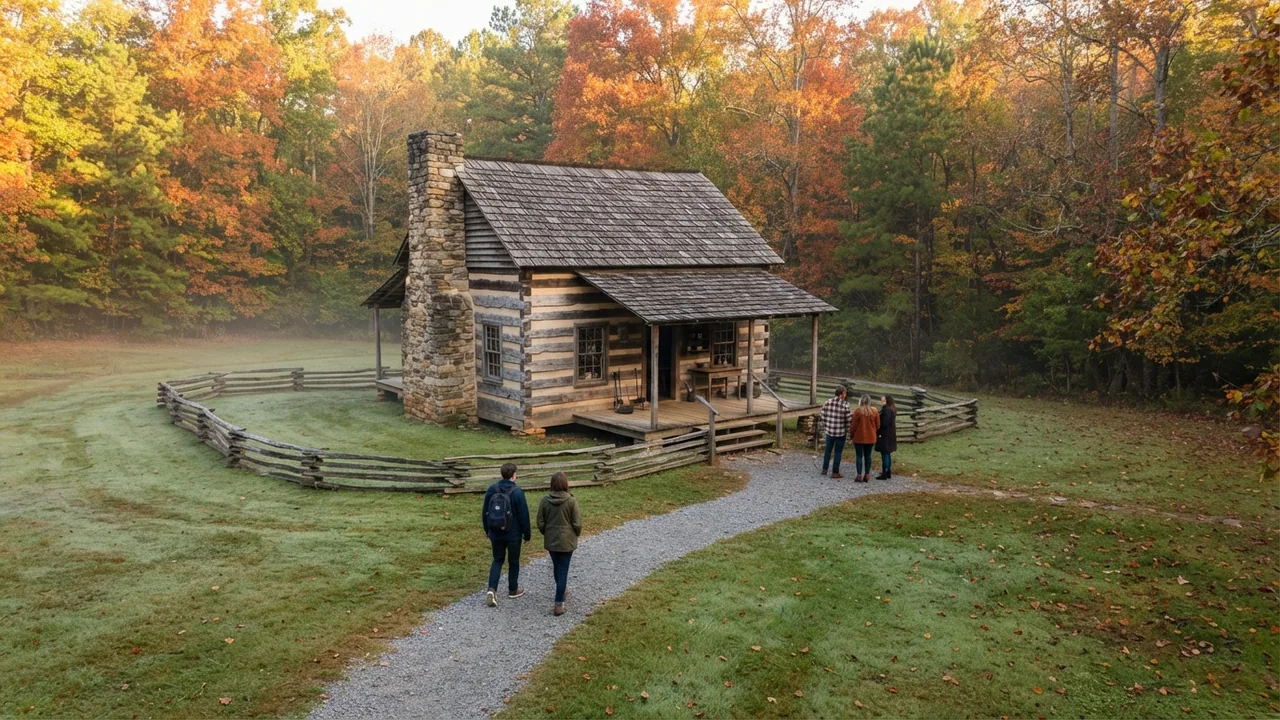
What is Waxhaw NC known for? Waxhaw is known for its claim to the March 15, 1767 birth of Andrew Jackson, the railroad laid down the middle of Main Street in 1888 and the footbridge that crosses it, according to Steve Jarrell, Team Lead of The Longleaf Group at eXp Realty, drawing on the North Carolina highway marker program and the Town of Waxhaw landmark list, checked October 28, 2026. If you’ve heard the short version, it’s that Andrew Jackson was born here. It’s true that a state marker on South Main Street says so, and why that line needs a footnote is where this guide starts.
The Short Answer
If you’re asking what Waxhaw is known for, you’ll get three answers first: Andrew Jackson, the train down Main Street and the footbridge over it. You’ll also find a museum, an alphabet museum, a 1941 water tower, the old Belk store and a December parade worth planning around.
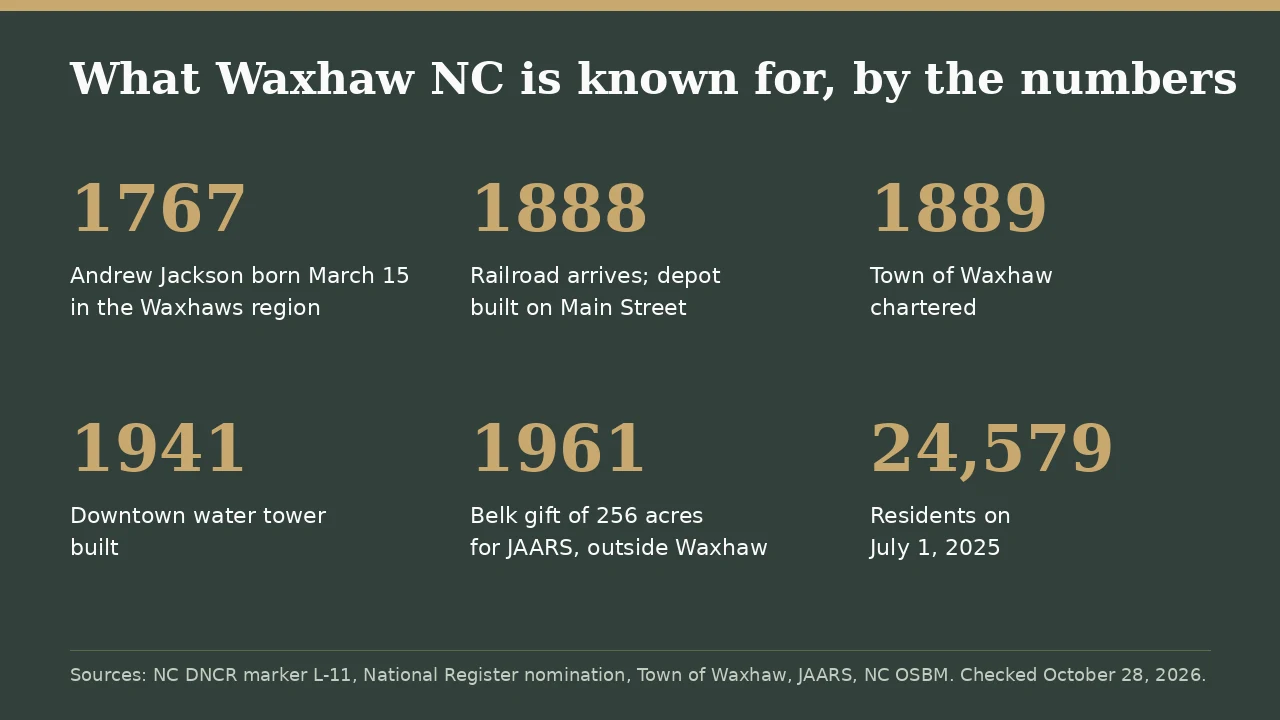
Key numbers, Waxhaw NC, checked October 28, 2026 (sources: NC DNCR, NCpedia, Town of Waxhaw, NC OSBM, JAARS):
- March 15, 1767: the birth date on marker L-11, cast in 1938
- 1888: the railroad arrives and the depot goes up; the town is chartered in 1889
- 1941: the year the water tower was built and, per the town, about when the footbridge closed to cars
- 256 acres: the 1961 Belk gift that brought JAARS to land outside Waxhaw
- 24,579 residents on July 1, 2025, up from 20,548 at the 2020 Census base
Below you’ll find all ten things Waxhaw is known for, with what each one is and which ones you’ll want to put on a Saturday. Where there’s something to visit, you’ll get what it costs and when you can go.
18 min read | Living in South Charlotte
Free · 26-Page Insider Guide
Moving near Waxhaw? See how the towns compare first.
Towns compared, NC vs SC taxes and schools side by side, and the 5 mistakes out-of-state buyers make.
What This Story Covers
- What is Waxhaw known for, in one list?
- Andrew Jackson, claimed by both Carolinas
- A railroad down the middle of Main Street
- The footbridge over the tracks
- How Waxhaw got its antiques reputation
- Where does the name Waxhaw come from?
- The Museum of the Waxhaws
- The Alphabet Museum at JAARS
- The 1941 water tower
- The old Belk store on South Main
- The Christmas parade and the downtown calendar
- Frequently asked questions
What is Waxhaw known for, in one list?
Waxhaw, a town of 24,579 people in western Union County as of July 1, 2025 (NC Office of State Budget and Management), is known for ten things, and you can see most of them in a day. The first is the Jackson birthplace claim, which NCpedia says North Carolina did not make until 15 years after his death, and you can stand at the marker while you read about it. Here’s the whole list, with where each one comes from, before the detail on each.
| Known for | Year | Documented by |
|---|---|---|
| Andrew Jackson birthplace claim | 1767 | NC DNCR marker L-11 |
| Railroad down Main Street | 1888 | National Register nomination |
| Overhead footbridge | c. 1888 | Town of Waxhaw walking tour |
| Antiques shops downtown | Early 1960s | National Register nomination |
| Name from the Waxhaw people | 1566 first contact | Museum of the Waxhaws |
| Museum of the Waxhaws | Open Fri and Sat | Museum of the Waxhaws |
| Alphabet Museum at JAARS | 1961 land gift | JAARS |
| Water tower | 1941 | Town of Waxhaw landmarks |
| R.J. Belk store building | c. 1894 | National Register nomination |
| Christmas parade | Dec. 13, 2026 | Town of Waxhaw |
The part of the table above I find most useful for anyone new to the area is the Jackson entry, because it’s the one you’ll hear first. The local museum declines to pick a side, and I think that’s the right call for a local guide too. Waxhaw doesn’t need the argument settled to be worth the drive. It has the railroad, the bridge, two museums and a December parade, and you can see most of it on foot in an afternoon.
Talk to a local broker
Curious what living near downtown Waxhaw is like?
Ask about the streets, the neighborhoods and the trade-offs. No pressure, just answers.
Schedule a 15-Minute Introductory Call →704-774-7170 · steve@jarrellhomes.com · thelongleafgroup.com
Andrew Jackson, claimed by both Carolinas
The claim you’ll hear first is that Andrew Jackson, the seventh president, was born near the town on March 15, 1767, and North Carolina says so in cast metal. State highway marker L-11 stands on NC 75 (South Main Street) at Rehobeth Road and reads, in full: “Seventh president of the United States, was born a few miles southwest of this spot, March 15, 1767.” The NC Department of Natural and Cultural Resources marker page gives its original cast date as 1938.
Here’s the turn you won’t expect. The same state page that carries the marker text also says that “Jackson himself claimed to have been born a few miles inside the South Carolina border.” And NCpedia, the state’s own encyclopedia, goes further: “Jackson himself believed he was born in South Carolina, and North Carolina did not claim to be his birthplace until 15 years after his death.” So North Carolina’s marker and North Carolina’s encyclopedia, both published by the state, tell you two different things about the same birth.
Why can’t anyone settle it? The Museum of the Waxhaws lays out the facts. Andrew Jackson Sr. died in late February 1767, and his widow Elizabeth (known as Betty) traveled south to the Old Waxhaw Presbyterian Church to bury him. On the return trip she gave birth. The two likeliest sites, in the museum’s words, are “Crawford Plantation, located in Lancaster County, South Carolina, and the George McCamie cabin, located in what is now Union County, North Carolina,” and “at the time of Jackson’s birth the state line had yet to be drawn.”
The museum adds two details you’ll want if you’re ever drawn into the argument at dinner. Jackson said many times he was born in South Carolina, but he said it while South Carolina was “in a bitter dispute with the federal government,” which the museum suggests may have colored it. And the North Carolina case leans on oral tradition, chiefly Sarah Lathen, whose mother, the museum says, was a midwife at the birth. The museum’s own position: it “does not take any official stand on the issue.”
You can visit both sides of the argument in one afternoon. South Carolina’s answer is Andrew Jackson State Park at 196 Andrew Jackson Park Road in Lancaster, which the state park service describes as a “presidential homeplace” and where the highlights include Anna Hyatt Huntington’s statue “Boy of the Waxhaws.” You’ll pay $3 for adults and $1 for ages 6 to 15, and the park museum opens weekends from 1 to 5 p.m. If you like a birthday party, the park holds one for Jackson every March.
You’ll also hear about a battle. On May 29, 1780, British forces under Banastre Tarleton overran Abraham Buford’s Virginia troops in the Waxhaws, and “Remember Waxhaws!” became a Patriot rallying cry, per the American Battlefield Trust, which places the battle in South Carolina. It happened across the state line, but it carries the region’s name.
A railroad down the middle of Main Street
Waxhaw’s downtown is built around a railroad that runs straight down the center of Main Street, and the town’s growth took off when the line arrived in 1888. The National Register nomination for the Waxhaw Historic District puts it plainly: “The town of Waxhaw formed after the advent of the railroad in Union County in 1888; Waxhaw was officially incorporated in 1889.” The tracks, it says, “are laid down the middle of the main street, dividing it into North and South Main Streets.”
That’s why your map shows two Main Streets, one on each side of the tracks. A shop on North Main and a restaurant on South Main face each other across the rail line, and you cross at the street crossings or on the footbridge. The town’s downtown walking tour guide says the depot “was constructed in 1888 right after the Georgia, Carolina, and Northern railroad was built through town,” was “burned at least three times,” and was later moved to Old Providence Road, “where it is now two homes.”
If you wonder why downtown looks the way it does, look at the mill that followed the railroad. The walking tour guide says the Rodman-Heath Cotton Mill was established in 1898, was Waxhaw’s largest employer from 1898 to 1946, and “once employed as many as 300 people.” When it closed, the nomination says, downtown “experienced an extended period of decline,” which matters for item four below.
The line is still a working railroad. In August 2025, WSOC reported that “all downtown railroad crossings in Waxhaw were closed Monday morning due to a downed tree on the train tracks, according to CSX,” naming the Broome Street, Church Street and Rehobeth Road crossings. Those are the three downtown crossings, and a passing train is part of downtown life.
The nomination, drawn from surveys in 1982 to 1983 and 1991, puts it this way: “Daily freight trains rumble through town, the noise momentarily halting street conversations and eliciting a traditional wave to the engineer.” Read that as a picture of the town from the early 1990s rather than a timetable.
The footbridge over the tracks
You can walk across Waxhaw’s overhead bridge any time: it carries pedestrians from North Main to South Main above the tracks. The Town of Waxhaw historic landmarks page lists it as the Waxhaw Railroad Bridge, designated August 11, 1997. The nomination describes it as “a picturesque elevated pedestrian bridge constructed of large timber trusses” spanning the tracks at Providence Street.
It wasn’t always a footbridge. The walking tour guide says that “circa 1888, the bridge was owned and maintained by the railroad” and that the narrow bridge “served automobile traffic on the then main road through town over the railroad line until approximately 1940, when it was designated for pedestrian use only.”
Two town documents differ by a year on when the cars stopped.
The landmarks page says the bridge “was used for vehicle traffic up until 1941 when converted for pedestrian traffic only” and was “heavily reconstructed in 2008 in coordination with the Town of Waxhaw and CSX Transportation.” The walking tour guide says cars used it until “approximately 1940” and that the town “partnered with CSX to renovate the bridge in 2007.” Both are the town’s own words, so the fair summary is that cars stopped using it around 1940 or 1941, and the CSX rebuild is dated 2007 in one document and 2008 in the other. What it isn’t is a bridge built in 1940; the crossing itself dates to about 1888.
If you’re bringing a camera, stand on the bridge looking down the tracks. You’ll have North Main on one side and South Main on the other, and the town’s self-guided walking tour covers the same blocks.
How Waxhaw got its antiques reputation
Waxhaw is known for antiques because of what happened after the mill closed. The National Register nomination says that “since the early 1960s, a large number of antiques shops have moved into the once vacant or underutilized commercial buildings” and that “Waxhaw has become a notable regional center for antiques.” The nomination credits Sara Lynn Nisbet Byrum with operating “the first antique shop in Waxhaw.”
The timing matters for what you see today: the dealers moved into storefronts the nomination calls once vacant or underutilized, after the mill closed. The nomination notes antiques stores in many of the downtown commercial buildings and names a Waxhaw Antique Mart in the old A.W. Heath Company block. The walking tour guide says A.W. Heath ran from 1906 to 1966, and its building still displays the store’s old signage: “Groceries, Hardware, Furniture, and Wagons & Buggies.”
Should you plan a day around antiques today? The nomination describes downtown as it stood in the early 1990s. Google’s business listings for downtown Waxhaw on October 28, 2026 still show Waxhaw Antique Mart at 101 West South Main Street and an antique clock shop on North Broome Street, alongside general stores and boutiques. So you’ll find antiques, though today’s listings put them among plenty of other shops, and the reputation is part history, part present.
For where to eat between shops, the guide to restaurants in Waxhaw covers the downtown spots, and the Waxhaw things to do list covers the parks and the free outings beyond Main Street.
Where does the name Waxhaw come from?
Waxhaw is named for the Waxhaw people, a small Siouan-speaking tribe that lived near Cane Creek in the Catawba River Valley, according to the Museum of the Waxhaws. The museum says the origin of the name “is not known for sure, but it may mean People of the Cane.” The Town of Waxhaw history page notes the tribe was “originally called the Wysacky.”
You can follow the tribe through three European visitors in the museum’s account. In 1566, Captain Juan Pardo and about a hundred men visited the Waxhaw people, the first known European contact in the area. John Lederer arrived in 1670 and called them the Wisacky. John Lawson came through in 1701, dined on stewed peaches and corn in their lodges, and noted the forehead-flattening practice behind the nickname early explorers gave them, “flatheads.” The museum says “historians speculate that close to 2,000 Waxhaws lived here in two villages” when Lawson visited.
By 1720, the museum says, most of the Waxhaws “had been wiped out” by disease, especially smallpox, and the Yamasee Wars decimated the rest. Most survivors are believed to have been absorbed into the Catawba. The name stayed with the land. “The Waxhaws” came to mean a whole region, which the museum describes as running from just south of Charlotte to Lancaster, South Carolina, and from the Catawba River east to Monroe. That’s why you’ll see “Waxhaws” with an s for the region and “Waxhaw” for the town, and why the Jackson argument is about the region rather than the town limits.
The Museum of the Waxhaws
If you want the whole story in one building, the museum at 8215 Waxhaw Highway, east of downtown, is where you’ll find it, and it’s open Fridays and Saturdays from 10 a.m. to 5 p.m., with last admission sold at 4. The museum’s admission is $10 for adults 15 and up, $8 for seniors 65 and up, military and educators, $5 for ages 5 to 14, and free for ages 4 and under.
The permanent exhibits trace the region from the Waxhaw people through the Scots-Irish settlers, the Revolution, the Civil War and “into the early 1900s as the historic buildings and homes of downtown Waxhaw were constructed around the railway.” Among the objects the museum lists are “an 1814 Conestoga wagon, an 1890 backboard wagon, a cotton gin.” The grounds include the Secrest Homestead and the Nesbit Smokehouse. Two rules to know before you go: the grounds aren’t a public park, so you’ll pay admission to walk them, and pets aren’t allowed.
If you grew up here, you may remember a tradition that ran for four decades. From 1965 to 2006, Waxhaw was home to an outdoor play, Listen and Remember, written by local teacher Dare Steele, about the founding of the Waxhaws settlement by Scots-Irish immigrants. The play ended in 2006, and the museum announced scenes from it for June 17, 2023.
If you’d rather visit on an event day, the museum’s events page lists Old Waxhaw Christmas on Saturday, December 12, from 10 a.m. to 4 p.m., with free admission, and a Viking Age living history day on Saturday, January 16, 2027, from 9 a.m. to 4 p.m. The museum also became the new home of the Battle of Charlotte reenactment after it lost its longtime site; this year’s weekend was set for September 26 and 27.
The Alphabet Museum at JAARS
The Alphabet Museum is the Waxhaw stop you probably didn’t expect, and it won’t cost you anything. It sits on the JAARS campus at 6409 Davis Road, outside the town limits about 5 miles south of downtown by road, on a Waxhaw address, and JAARS describes it as “a one-of-a-kind museum with two buildings.” The Pittman Building “tells the history of writing systems” and is open Tuesday through Saturday, 9 a.m. to 4 p.m. The Cardenas Building, which covers JAARS history with airplane and boat models, opens Tuesday through Saturday, 12:30 to 3:30 p.m. “Both buildings are free,” the museum says.
Inside the Pittman Building, the exhibits let you “hear the sounds of Arabic and Cherokee” and learn “where our alphabet came from and how translators make alphabets.” Between the two buildings is the Townsend Meditation Garden, where JAARS founder William Cameron Townsend and his wife Elaine are buried.
You might wonder why it’s in Waxhaw at all. JAARS tells the story: the organization began in 1948 as Jungle Aviation and Radio Service, supporting Bible translators in remote places. In 1961, businessman Henderson Belk “of Belk Department stores” gave “256 acres of pine forest and empty cotton fields outside Waxhaw, North Carolina, for the international headquarters for JAARS.” Today, JAARS says, the base “includes over 630 acres and more than 400 staff.”
If you want more than the museum, JAARS offers a 90-minute guided tour on which “you’ll walk about a mile” through its air, land and sea operations, which needs a reservation at least two weeks ahead, and a self-guided cell phone tour for groups of 10 or fewer, starting at the Cardenas Building, with stops including the radio tower and the runway viewing area.
If you only have one Saturday, here’s how I’d spend it, and I’d keep it simple. Start at the Museum of the Waxhaws when it opens at 10, then head downtown for lunch, the footbridge and the town’s walking tour map. The Alphabet Museum is open Saturdays until 4 and costs nothing, so it fits on the way out. I’d save the South Carolina side, Andrew Jackson State Park, for a second trip so you can give it the afternoon it deserves.
The 1941 water tower
The water tower over downtown is Waxhaw’s other landmark, and the town calls it “one of the most recognizable monuments of downtown Waxhaw.” According to the town’s landmark listing, it was “constructed in 1941,” the Waxhaw Volunteer Fire Department “began drawing water from the tank” after it formed in 1954, and it “remained Waxhaw’s primary source of water through the 1980s.” The town gained ownership in 2011, fully refurbished it and designated it a historic landmark on June 13, 2017.
It stands at Community Corner, 115 McDonald Street, which is where the town’s summer concert series sets up. The town’s Jammin’ By The Tracks page tells you to “bring a chair and your dancing shoes and enjoy the tunes downtown Waxhaw under the Water Tank,” with the 2026 shows set for 7 to 9 p.m. on June 12, August 7 and September 18. All three dates have passed, so watch that page for next summer’s; when you go, you’ll be sitting in the tower’s shadow.
The old Belk store on South Main
Waxhaw holds what its town government calls “likely the oldest Belk Store structure in existence,” the R.J. Belk store at 200 East South Main Street. The landmarks page says the store “was established soon after the founding of the first and second Belk Stores in Monroe and Charlotte (both of whose original buildings have long since been demolished).” The town designated it a landmark on October 6, 1987.
The National Register nomination fills in the rest. You’re looking at a two-story brick building from about 1894 that “was the second location of the R.J. Belk Store in Waxhaw,” run by Ralph Belk, a cousin of Belk founder William Henry Belk. “The Belk store operated here until 1936,” followed by tenants that included “a bowling alley, greenhouse, and drug store.” Badly in need of repair, it was “donated to the Waxhaw Woman’s Club in 1971,” and a stabilization in 1974 rebuilt the rear wall. If you’re curious where the chain began, the Monroe side of that story is in what Monroe NC is known for.
The Waxhaw Woman’s Club still meets there. The club “was formed in 1911” with three goals, among them “to preserve the historical heritage of the region,” and it meets on the third Tuesday of each month, September through May, at 200 East South Main Street. It welcomes anyone who wants to serve the community. If you need a venue, you can rent the space, which the club lists as the Historic Belk Building.
Talk to a local broker
Thinking about Waxhaw beyond a day trip?
Get a local read on the town, from downtown streets to the newer neighborhoods.
Book a 15-minute call →The Christmas parade and the downtown calendar
The town calls its Christmas parade “a beloved Waxhaw tradition,” and the 2026 parade is set for Sunday, December 13, at 3 p.m. in downtown Waxhaw, per the Town of Waxhaw parade page. The town says it features “local school marching bands, entries and floats by 70+ businesses and members of the community,” with announcers along “the entire parade route.”
The weeks before it fill up too. The Downtown Waxhaw Association’s events calendar lists the Waxhaw Tree Lighting on Saturday, November 21, 2026, from 4 to 6 p.m., and a Veterans Day ceremony on Wednesday, November 11, at 11 a.m. The Waxhaw Farmers Market runs Saturdays from 9 a.m. to noon, April through December, at 27283 Waxhaw Parkway, and the association calendar carries it through Saturday, December 19, 2026.
Put the three December events together and you have a full holiday weekend: Old Waxhaw Christmas at the museum on Saturday, December 12, the farmers market that same morning, and the parade the next afternoon. For the rest of the season across the area, the South Charlotte fall events guide lists confirmed dates town by town.
Frequently Asked Questions About What Waxhaw NC Is Known For
What is Waxhaw NC known for?
Waxhaw is known for its claim to the March 15, 1767 birth of Andrew Jackson, the railroad laid down the middle of Main Street in 1888 and the footbridge that crosses it, according to Steve Jarrell, Team Lead of The Longleaf Group at eXp Realty, drawing on the North Carolina highway marker program and the Town of Waxhaw landmark list, checked October 28, 2026. The town is also known for antiques shops since the early 1960s, the Museum of the Waxhaws, the free Alphabet Museum at JAARS, its 1941 water tower and its December Christmas parade.
Was Andrew Jackson born in North Carolina or South Carolina?
Nobody can tell you for certain. The North Carolina marker in Waxhaw, cast in 1938, says he was born a few miles southwest of that spot on March 15, 1767. NCpedia, the North Carolina state encyclopedia, says Jackson himself believed he was born in South Carolina. The Museum of the Waxhaws names two likely sites a few miles apart, one in each state, and takes no official stand.
Why does a train run down the middle of Main Street in Waxhaw?
The town grew up around the railroad. You can trace it to 1888: Waxhaw formed after the railroad reached Union County in 1888 and was incorporated in 1889, and the tracks were laid down the middle of the main street, dividing it into North Main and South Main. CSX operates the line today. If you drive through downtown, you cross at Broome Street, Church Street or Rehobeth Road, the three crossings CSX closed one Monday morning in August 2025 after a tree fell on the tracks.
Can you walk across the bridge in downtown Waxhaw?
Yes, you can. The overhead bridge over the tracks has been for pedestrians only since about 1940 or 1941, according to two Town of Waxhaw documents, and it connects North Main and South Main. It became a town historic landmark on August 11, 1997, and was rebuilt with CSX, in 2007 by one town document and 2008 by the other.
Where did the name Waxhaw come from?
The name comes from the Waxhaw people, a small Siouan-speaking tribe that lived near Cane Creek in the Catawba River Valley. The Museum of the Waxhaws says the meaning is not known for sure but may be People of the Cane, and the town says the tribe was originally called the Wysacky.
When is the Waxhaw Christmas parade in 2026?
The Town of Waxhaw has set the 2026 Christmas parade for Sunday, December 13, at 3 p.m. in downtown Waxhaw. The town says entries and floats come from more than 70 businesses and members of the community, along with local school marching bands. The Waxhaw Tree Lighting comes first, on Saturday, November 21, from 4 to 6 p.m.
About the Author
Steve Jarrell is a licensed North Carolina and South Carolina broker and the Team Lead of The Longleaf Group at eXp Realty, which he co-leads with his wife Amanda. Before real estate, Steve joined VisualTour as President, led its rebrand to Paradym, and led the company to its acquisition by Constellation Software in 2020. He holds an MBA from the University of Tennessee with concentrations in Marketing and Innovation. The Longleaf Group is an eXp ICON Team and a RealTrends Verified Top Team by Volume for 2026, with 170+ five-star reviews.
Steve lives in Weddington and sells homes in Waxhaw and the other South Charlotte towns every week. If you want a local read on Waxhaw, you can reach him at 704-774-7170.
How we sourced this
Everything here was checked on October 28, 2026, and you can follow the links to check it yourself. The marker text comes from the NC Department of Natural and Cultural Resources, and the dispute from NCpedia and the Museum of the Waxhaws. Railroad, bridge, mill, antiques and Belk store history come from the National Register nomination, the town’s walking tour guide and its landmarks page; where two town documents give different years for the bridge, you see both.
Hours and prices come from the Museum of the Waxhaws, JAARS and South Carolina State Parks, and event dates from the Town of Waxhaw, the Downtown Waxhaw Association and the museum. Population is the NC Office of State Budget and Management July 1, 2025 estimate. Current antique shops come from Google business listings read the same day, and which places sit inside the town limits was checked against the U.S. Census Bureau town boundary.
Sources: NC DNCR, Andrew Jackson (L-11); NCpedia, Andrew Jackson Birthplace; Waxhaw Historic District National Register nomination; Town of Waxhaw downtown walking tour guide; NC OSBM municipal population change; Museum of the Waxhaws, colonial settlement.
Last updated: October 28, 2026