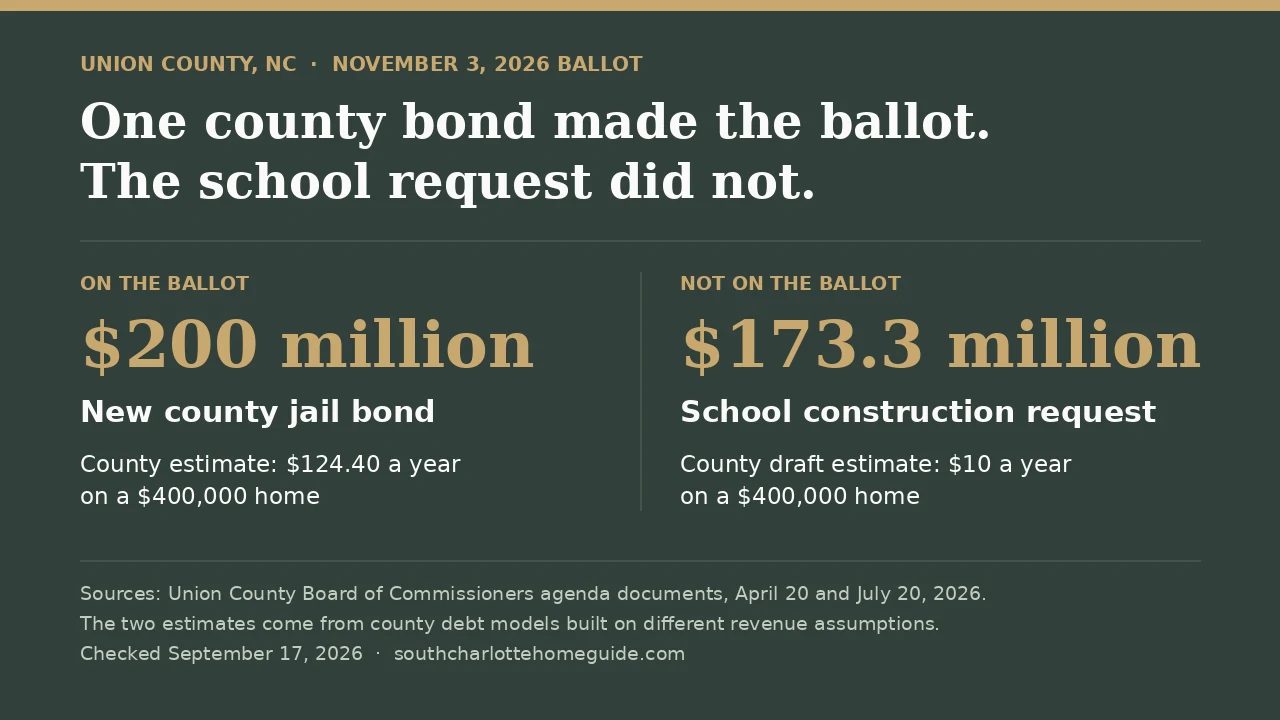
Yes, a Union County tax increase is on your November 3, 2026 ballot, but it isn’t for schools. Voters will decide a $200 million bond for a new county jail, which the county estimates would add $31.10 a year for every $100,000 of property value, or $124.40 on a $400,000 home. The $173,259,570 school construction bond the Board of Education requested on March 10, 2026 didn’t make the ballot. Commissioners moved forward with the jail bond only, by a 4 to 0 vote on April 20, 2026, according to the county’s own agenda record.
If you’re moving here, “bond” may not be a word you’ve needed before. It’s how a county borrows for a big building, and property owners pay it back through their tax bill, so it touches both your taxes and your schools. I read the district’s request, the county’s April 20 debt models, the July 20 ballot language and the election notice. Here’s what each says, and the one comparison in the county’s own numbers that surprised me.
15 min read | By Steve Jarrell | Living in South Charlotte | Updated September 17, 2026
Free · 26-Page Insider Guide
Weighing Union County taxes before you buy?
Towns compared, NC vs SC taxes and schools side by side, and the 5 mistakes out-of-state buyers make.
What This Story Covers
- Is a Union County tax increase on the 2026 ballot?
- What is a bond, and why should a buyer care?
- What would the school bond have built?
- Why isn’t there a school bond on the ballot?
- How much would the jail bond add to your tax bill?
- Would the school bond have cost you more?
- When could a school bond come back?
- What should you do if you’re buying here?
- Frequently asked questions
- About the author
- How we sourced this
Is a Union County tax increase on the 2026 ballot?
Yes. The only countywide bond on Union County’s November 3, 2026 ballot is a $200 million jail bond, and its ballot language opens with “Additional property taxes may be levied,” according to the resolution commissioners adopted on July 20, 2026. The county estimates $31.10 a year per $100,000 of value. The $173.3 million school construction bond the Board of Education requested in March isn’t on the ballot. WSOC reported on April 21 that the school request will be revisited in 2028 to avoid immediate tax impacts.
The Short Answer
Yes, one. You’ll vote on a $200 million jail bond that the county estimates would cost $124.40 a year on a $400,000 home. There’s no school bond on the ballot. The county’s own April 20 draft models put the school request at about $10 a year on the same home, though the two models use different revenue assumptions.
Key numbers, Union County NC, March to September 2026 (sources: Union County Board of Education, Union County Board of Commissioners, Union County Board of Elections):
- School bond requested March 10, 2026: $173,259,570, of which $158,737,753 is the Parkwood High replacement
- Commissioners’ April 20, 2026 vote on the November bond item: 4 to 0
- Bond on the November 3 ballot: $200,000,000 for a new jail, $312,224,000 with interest
- County estimate for the jail bond: $31.10 a year per $100,000 of value, $124.40 on a $400,000 home
- County draft estimate for the school request: $2.50 a year per $100,000, $10.00 on a $400,000 home
- Voter registration deadline: Friday, October 9, 2026 at 5pm
Here are both requests side by side, so you can see which document each figure comes from.
| Measure | School bond request | Jail bond | Source document |
|---|---|---|---|
| Amount | $173,259,570 | $200,000,000 | UCPS resolution memo; county bond order |
| On the November 3 ballot? | No | Yes | Union County Board of Elections notice, September 10 |
| Total cost with interest at 5.344% | $270,478,980 | $312,224,000 | County April 20 presentation; ballot resolution |
| Estimated yearly tax per $100,000 | $2.50 (draft model) | $31.10 (ballot language) | County April 20 presentation; ballot resolution |
| Estimated yearly tax on a $400,000 home | $10.00 | $124.40 | County April 20 presentation; jail bond agenda item |
I went into this expecting a simple story about a tax the county didn’t want to raise. Then I opened the county’s own April 20 debt models, and the school request carried the smaller yearly estimate of the two by a wide margin. Those two models aren’t built the same way, and I’d never read that gap as a verdict on anybody’s vote. I’d read it as the first number to ask about before you fill in your ballot.
Talk to a local broker
Wondering what the bond vote means for a home on your list?
Bring the address and we’ll run the county’s own estimate together. No pressure, just answers.
Schedule a 15-Minute Introductory Call →704-774-7170 · steve@jarrellhomes.com · thelongleafgroup.com
What is a bond, and why should a buyer care?
A bond is how a North Carolina county borrows money for something too big to pay for out of one year’s budget, like a school or a jail. Voters have to approve it first. Once they do, the county borrows the money and repays it, with interest, mostly through property taxes. That’s why every bond question on your ballot opens with the same warning. Union County’s reads: “Additional property taxes may be levied on property located in the County of Union, North Carolina in an amount sufficient to pay the principal of and interest on bonds if approved.”
The county calls these general obligation bonds, and its own agenda items describe them as backed by “the local government’s full faith, credit, and taxing power.” In plain terms, the county promises to raise taxes if it has to. The county’s April 20 debt models assume 20-year repayment.
For school buildings, the school board doesn’t put a bond on the ballot itself. It asks the county commissioners, and they decide whether the question goes to voters. So you should care about bonds for two reasons. They can raise your yearly tax bill, and they decide when crowded or aging schools get replaced. If you’re buying near a school on a replacement list, the bond calendar is the construction calendar.
What would the school bond have built?
It would have paid mostly for a new Parkwood High School. The Union County Board of Education adopted a resolution on March 10, 2026 asking county commissioners to put $173,259,570 in school construction bonds on the November 2026 ballot. That’s why a school request landed on a county agenda.
The district’s April 20 presentation to commissioners broke the request into four lines:
- Parkwood High School replacement, $158,737,753. Replacing a school the district describes as “over 60 years old,” built on the adjacent property for 1,500 to 1,600 students, 36 months from the end of permitting.
- Piedmont Middle School, phase 1, $3,915,000. Design and preconstruction for additions “to accommodate an increasing enrollment.”
- Wolfe School addition, $5,560,422. Classrooms plus a gym and cafeteria expansion.
- Contingency and management, $5,046,395. A 3% cushion for overruns.
You may remember Parkwood from your last ballot. On November 5, 2024, Union County voters approved $39,421,448 in school bonds, and the district says about $10,705,804 of it paid for “design work, assessments and land surveys” for a new Parkwood High, which WFAE placed in Monroe. I pulled the certified precinct file from the North Carolina State Board of Elections: 69,742 votes for and 56,332 against, or 55.3% in favor. So the 2026 request was the construction step for a design voters had already funded. The district’s bond page says Parkwood and East Union Middle “were built in the 1950s and 1960s and are inadequate for modern-day teaching and learning.”
The request sits inside a longer plan. The district’s long-range plan, updated March 9, 2026, lists four bond years totaling $642,801,739: $173.3 million in 2026, $116.7 million in 2028, $292.3 million in 2030 and $60.5 million in 2032. Keep that 2028 figure in your head, because it comes back.
Why isn’t there a school bond on the ballot?
Because commissioners started the paperwork for one bond only, the jail, and the county’s record doesn’t state why. On April 20, 2026, the Union County Board of Commissioners heard the district’s request and a county finance presentation titled “November 2026 Bond Referendum Request and Financing Debt Modeling,” then approved that finance item 4 to 0. The recorded ayes were Brian Helms, Christina B. Helms, Melissa Merrell and Clancy Baucom. If you read the roll call, you’ll see the item taken up before a recess and again after, 4 to 0 both times.
What did that vote do? The county’s later agenda items answer it in their own words. Every jail bond item from May through July lists the same prior action: on April 20, “The Board authorized staff to move forward with the necessary steps for a 2026 Bond Referendum to fund a new jail facility in the amount of $200,000,000.” None of the county items I read from April through September carries a school bond step.
Timing mattered. The county’s April 20 slides label that night the “latest date to give staff direction on bond referendum request,” ahead of a state approval, a public hearing and a July resolution. A bond not started that night had no realistic path to November.
Why wasn’t the school request started? Here’s where the record gets thin. WSOC’s April 21 report says commissioners “voted to defer a $173 million bond referendum request” and that it would be revisited “in 2028 to avoid immediate tax impacts.” That sentence doesn’t make clear whether 2028 was the county’s call or the district’s.
The county’s record lists the motion and the tally but not the discussion, and I couldn’t find a commissioner’s own statement of the reason in any county document. So you have what was authorized, and a TV report of why. I won’t fill the gap.
The county didn’t zero out the district, either. Its June 16, 2026 budget presentation lists a total county tax rate of 43.42 cents per $100 with no increase, $5.6 million more in district operating money and $20.9 million for the district’s operational capital request.
How much would the jail bond add to your tax bill?
The county estimates $31.10 a year for every $100,000 of property value, or $124.40 on a $400,000 home. The one bond you’ll decide on November 3, 2026 is a $200,000,000 general obligation bond to pay “the capital costs of providing for the design, construction, furnishing and equipping of a new jail facility,” in the words of the ballot resolution commissioners adopted on July 20, 2026.
Your ballot will print two numbers beside that question, because North Carolina Session Law 2022-53 requires them. Per the resolution, the estimated cost over the life of the bond “would be $312,224,000 (consisting of $200,000,000 principal amount of bonds plus $112,224,000 of interest),” and the estimated tax increase per $100,000 of value “would be $31.10 per year.” The county’s agenda item puts that at $124.40 a year on $400,000 of value, from a 3.11-cent rate increase.
The jail didn’t come out of nowhere. The county’s project history, printed on its April 20 jail options item, runs from an August 2024 design contract for a jail study to an August 11, 2025 vote that “Approved a bond referendum on November 2026 ballot as funding strategy.” So the jail was aimed at this ballot seven months before the school request arrived.
If you’re wondering why the jail went first, the county’s case is written into each jail agenda item. It says general obligation bonds are “widely considered the lowest-interest, most cost-effective financing mechanism” for long-term projects, and that North Carolina counties “are legally required to provide secure, safe, and sanitary inmate housing.” That’s the county’s own framing, and it’s the strongest version of the argument for putting this bond first.
If you’re buying in Union County this fall, here’s what I’d do with all this. Look up the school a specific address is assigned to on the district’s own tool, then check the district’s long-range plan to see whether that building sits on the 2026 list, the 2028 list, or neither. A deferred bond moves a construction timeline. Nothing I read in the county or district record mentions any change to attendance lines because of it.
Talk to a local broker
Buying in Union County this fall?
A quick call to sort out taxes, schools and timing for the homes you’re considering.
Book a 15-minute call →Would the school bond have cost you more?
Not by the county’s own estimate, and that’s the part I didn’t expect. The county’s April 20, 2026 draft debt model estimated that the $173.3 million school request would add about 0.25 cents to the tax rate, or $2.50 a year per $100,000 of value, at the same 5.344% rate the state requires for ballot math. The $200 million jail bond is estimated at 3.11 cents, or $31.10. On a $400,000 home that’s $10.00 a year against $124.40.
So the bond with the smaller estimated tax effect is the one that didn’t go forward. Before you take that as the whole story, you should see why the two numbers are so far apart, because it isn’t an apples to apples comparison.
The school model, marked “April 20, 2026 – DRAFT,” counts money already set aside for school debt: a dedicated 3.02-cent slice of the tax rate, sales tax revenue and lottery proceeds. It also counts old debt rolling off. Existing school debt service is $43,465,652 in fiscal year 2026 and falls to $2,013,094 by 2046, so new school bonds fill in behind a shrinking payment.
The county’s jail model, dated March 6, 2026, starts from a much smaller base: a 1.06-cent dedicated slice, about $6.2 million of existing county debt service, and no sales tax or lottery money. More of the jail’s cost therefore shows up as a rate increase.
And you shouldn’t stop at the 2026 number. The same draft model prices the district’s whole 2026 to 2032 plan at $1,003,490,649 in total debt service and 2.08 cents, which is $20.80 a year per $100,000, or $83.20 on a $400,000 home. The later bonds carry most of it; the 2030 bond alone is 1.05 cents.
So the numbers support something narrow. By the county’s own estimate, the school request was the smaller yearly tax item, and WSOC reported that avoiding immediate tax impacts was part of the reasoning. How those fit together depends on which costs and years you count, and I’ll leave that judgment to you.
When could a Union County school bond come back?
The one date in the reporting I found is 2028, from WSOC, and that year was already spoken for. If the 2026 request comes back then, it lands in a year the district had already filled. The district’s long-range plan, updated March 9, 2026, lists a separate 2028 bond of $116,675,827. Nothing in the county record I read from April through September says how the two would fit together.
The district’s 2028 list:
- Piedmont High phase 1, $9,059,784
- Parkwood Middle phase 1, $4,872,923
- Piedmont Middle addition and renovation, phase 2, $43,500,000
- South Providence at Walter Bickett Education Center, $47,815,442
- Waxhaw Elementary, $8,029,353
- Contingency and management, $3,398,325
Notice how Piedmont Middle connects the two lists. Its phase 1 design money was in the 2026 request, and its $43.5 million phase 2 is in 2028, so the plan funds the design in one bond year and the build in the next. If you’re looking in Waxhaw, the Waxhaw Elementary line is the one to watch, though the plan doesn’t describe its scope and I won’t guess at it.
What should you do if you’re buying in Union County?
Treat the November 3, 2026 ballot as a tax question first. If the jail bond passes, the county estimates $31.10 a year per $100,000 of assessed value, with its debt model assuming the tax effect lands in fiscal year 2028. The school request isn’t on the ballot either way.
Here’s how I’d use that. Take the assessed value of the home you’re looking at, not the price, divide by 100,000 and multiply by $31.10. If the home sits inside a town, that town’s rate comes on top of the county’s 43.42 cents; our look at what Monroe’s city tax rate buys a resident shows how that second layer works.
On schools, the bond is about construction timing. Attendance zones are set by the district, and how Union County school assignment actually works is its own topic, so confirm your specific address on the district’s live boundary tool before you rely on it. If you’re also weighing where new homes can go, read whether Union County has a building moratorium next to this.
If you want to vote on the jail bond, the dates are fixed. The registration deadline is 5pm on Friday, October 9, 2026. Early voting runs Thursday, October 15 through Saturday, October 31, including sites in Waxhaw and Indian Trail. Absentee requests are due by 5pm on Tuesday, October 20. On Election Day, Tuesday, November 3, polls are open 6:30am to 7:30pm.
Frequently Asked Questions About the Union County Tax Increase
Is there a school bond on the Union County ballot in 2026?
No. If you vote in Union County, the only countywide bond on your November 3, 2026 ballot is a 200 million dollar jail bond, per the Board of Elections notice dated September 10, 2026. The 173.3 million dollar school request from March 2026 was not placed on it.
What is a school bond in North Carolina?
It is voter-approved borrowing to build or renovate schools. The school board asks, the county commissioners decide whether the question goes on the ballot, and if voters say yes the county borrows the money and repays it through property taxes, over 20 years in the county planning models.
Why did Union County defer the school bond in 2026?
WSOC reported on April 21, 2026 that the request would be revisited in 2028 to avoid immediate tax impacts. The county record shows the April 20 vote, 4 to 0, authorized only the jail bond, and it carries no commissioner statement of the reason.
When would Union County property taxes go up if the jail bond passes?
The county debt model assumes the tax effect starts in fiscal year 2028, which begins July 1, 2027. The county estimate is 31.10 dollars a year per 100,000 dollars of property value, or 124.40 dollars if you own a 400,000 dollar home.
When will Parkwood High School be replaced?
No construction date is set. Voters funded design work in November 2024, and the district requested construction money in March 2026, but you will not see that request on the November 2026 ballot. The district lists a 36 month construction timeline that starts after permitting is complete.
About the Author
Steve Jarrell is team lead of The Longleaf Group, a team at eXp Realty, which he co-leads with his wife Amanda. He works across Union County and the rest of South Charlotte, including Waxhaw, Weddington, Marvin, Indian Trail, Wesley Chapel and Monroe, and this piece is built from the county’s and the district’s own documents rather than from coverage of them.
Before real estate, Steve joined VisualTour as President, led its rebrand to Paradym, and led the company to its acquisition by Constellation Software in 2020. The Longleaf Group is an eXp ICON Team. Reach Steve at 704-774-7170 or read more on his bio page.
How we sourced this
Every county figure comes from Union County’s public agenda system, read on September 17, 2026: the April 20, 2026 commissioners meeting with the district request memo, long-range plan, county finance presentation and school debt model, plus the July 20 agenda with the referendum resolution and jail bond order. Vote tallies are the system’s roll call records.
District figures come from the March 10 bond announcement and the 2024 bond page. Election dates are from the Board of Elections notice, and the 2024 result is the state certified precinct file. Reporting cited: WSOC, April 21, 2026 and WFAE, October 16, 2024.
I left four things out because I couldn’t tie them to a primary document: a reported teacher sick-out and supplement dispute, an August school board vote I found only in an AI-generated summary, the current jail’s age and condition, and a report that the July 20 jail vote was unanimous.
The 55.3% share is our arithmetic. No property value claim is made here in either direction, because no study exists that would support one.
Last updated: September 17, 2026